Kirjojen hintavertailu – 12 859 828 kirjaa ja 27 kauppaa

Kirjailija

Raf Van Rooy

Kirjat ja teokset yhdessä paikassa: 4 kirjaa, julkaisuja vuosilta 2020–2024, suosituimpiin kuuluu New Ancient Greek in a Neo-Latin World. Vertaile teosten hintoja ja tarkista saatavuus suomalaisista kirjakaupoista.

4 kirjaa

Kirjojen julkaisuvuodet: 2020–2024.

Reading, Writing, Translating

Reading, Writing, Translating

JOHANNA AKUJÄRVI; Kristina Savin; GIANMARIO CATTANEO; FEDERICA CICCOLELLA; ERIK ZILLÉN; STEFAN WEISE; RAF VAN ROOY; XANDER FEYS; TOMAS VETEIKIS; PETRA MATOVIC; ANA MIHALJEVIC; JANIKA PÄLL; PER RÅLAMB; PETER SJÖKVIST

Lunds universitet, Media-Tryck
2024
nidottu
This volume collects eleven studies that investigate different aspects of the teaching and learning of Greek in early modern northern Europe (c. 1500–1750), from France in the west to Lithuania in the east. They give important insights that advance our understanding of the homogeneity despite diversity in the complex developments of classical reception, the study of Greek, its significance, and the practice of Greek in the various religious, cultural, and socio-political environments of the complicated spatio-temporal and geopolitical realities of Europe.
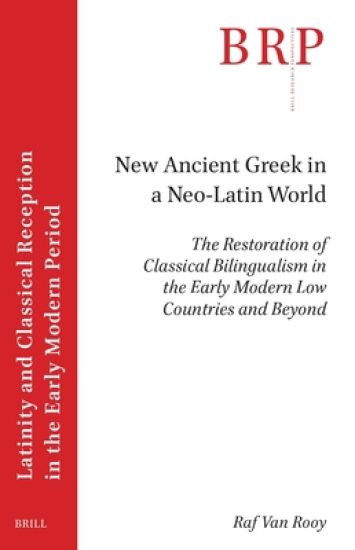
New Ancient Greek in a Neo-Latin World
Did you know that many reputed Neo-Latin authors like Erasmus of Rotterdam also wrote in forms of Ancient Greek? Erasmus used this New Ancient Greek language to celebrate a royal return from Spain to Brussels, to honor deceded friends like Johann Froben, to pray while on a pilgrimage, and to promote a new Aristotle edition. But classical bilingualism was not the prerogative of a happy few Renaissance luminaries: less well-known humanists, too, activated their classical bilingual competence to impress patrons; nuance their ideas and feelings; manage information by encoding gossip and private matters in Greek; and adorn books and art with poems in the two languagges, and so on. As reader, you discover promising research perspectives to bridge the gap between the long-standing discipline of Neo-Latin studies and the young field of New Ancient Greek studies.
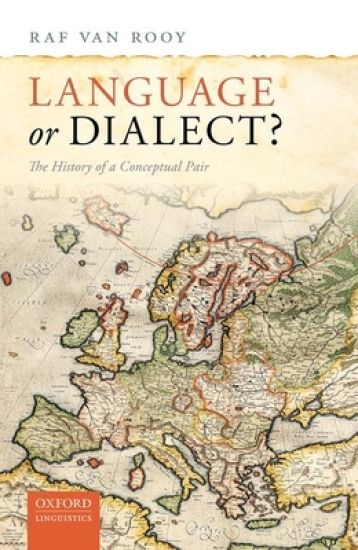
Language or Dialect?

Language or Dialect?

Raf Van Rooy

Oxford University Press
2020
sidottu
This is an open access title available under the terms of a CC BY-NC-ND 4.0 International licence. It is free to read on the Oxford Academic platform and offered as a free PDF download from OUP and selected open access locations. This book provides a historiographic study of the distinction between language and dialect, a puzzle which has long fascinated linguists and laypeople alike. It offers a comprehensive account of the intriguing and complex history of the language-dialect pair, and shows that its real origins can be found in sixteenth-century humanist scholarship. The book begins with a survey of the prehistory of the language/dialect distinction in antiquity and the Middle Ages. Raf Van Rooy then provides a detailed investigation of the emergence, establishment, and development of the conceptual pair during the early modern period, from the Renaissance to the Enlightenment, when linguistic diversity was first studied in depth. Finally, the much-debated and ambiguous fate of the language/dialect opposition in modern linguistics is explored: although a number of earlier ideas were adopted by later scholars, many linguists today question the notion of a seemingly arbitrary and subjective distinction between language and dialect.
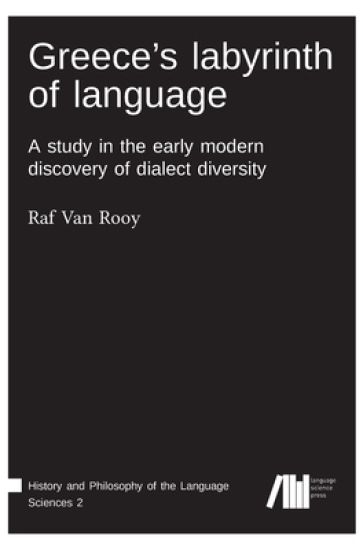
Greece's labyrinth of language

Greece's labyrinth of language

Raf Van Rooy

Language Science Press
2020
sidottu
Fascinated with the heritage of ancient Greece, early modern intellectuals cultivated a deep interest in its language, the primary gateway to this long-lost culture, rehabilitated during the Renaissance. Inspired by the humanist battle cry "To the sources " scholars took a detailed look at the Greek source texts in the original language and its different dialects. In so doing, they saw themselves confronted with major linguistic questions: Is there any order in this immense diversity? Can the Ancient Greek dialects be classified into larger groups? Is there a hierarchy among the dialects? Which dialect is the oldest? Where should problematic varieties such as Homeric and Biblical Greek be placed? How are the differences between the Greek dialects to be described, charted, and explained? What is the connection between the diversity of the Greek tongue and the Greek homeland? And, last but not least, are Greek dialects similar to the dialects of the vernacular tongues? Why (not)? This book discusses and analyzes the often surprising and sometimes contradictory early modern answers to these questions. "This work offers readers a thoroughly novel and particularly enlightening perspective on Ancient Greek dialects through its examination of how the study of these dialects developed in ancient up through pre-modern times. Deftly interweaving discussions of dialectological detail with a consideration of the emergence of various classificatory schemes over many centuries, author Van Rooy has produced a fine work that has much of interest to a wide audience of Hellenists, Classicists, linguists, and historians of the language sciences."- Brian Joseph, Distinguished University Professor of Linguistics, Ohio State University