Kirjojen hintavertailu – 12 903 725 kirjaa ja 27 kauppaa

Kirjailija

Rafael Reuveny

Kirjat ja teokset yhdessä paikassa: 6 kirjaa, julkaisuja vuosilta 2004–2009, suosituimpiin kuuluu Limits to Globalization. Vertaile teosten hintoja ja tarkista saatavuus suomalaisista kirjakaupoista.

6 kirjaa

Kirjojen julkaisuvuodet: 2004–2009.

Democracy and Economic Openness in an Interconnected System

Democracy and Economic Openness in an Interconnected System

Quan Li; Rafael Reuveny

Cambridge University Press
2009
sidottu
In this book, Quan Li and Rafael Reuveny combine the social scientific approach with a broad, interdisciplinary scope to address some of the most intriguing and important political, economic, and environmental issues of our times. Their book employs formal and statistical methods to study the interactions of economic globalization, democratic governance, income inequality, economic development, military violence, and environmental degradation. In doing so, Li and Reuveny cross multiple disciplinary boundaries, engage various academic debates, bring the insights from compartmentalized bodies of literature into direct dialogue, and uncover policy tradeoffs in a growingly interconnected political-economic-environmental system. They show that growing interconnectedness in the global system increases the demands on national leaders and their advisors; academicians and policy makers will need to cross disciplinary boundaries if they seek to better understand and address the policy tradeoffs of even more complex processes than the ones investigated here.
Democracy and Economic Openness in an Interconnected System

Democracy and Economic Openness in an Interconnected System

Quan Li; Rafael Reuveny

Cambridge University Press
2009
pokkari
In this book, Quan Li and Rafael Reuveny combine the social scientific approach with a broad, interdisciplinary scope to address some of the most intriguing and important political, economic, and environmental issues of our times. Their book employs formal and statistical methods to study the interactions of economic globalization, democratic governance, income inequality, economic development, military violence, and environmental degradation. In doing so, Li and Reuveny cross multiple disciplinary boundaries, engage various academic debates, bring the insights from compartmentalized bodies of literature into direct dialogue, and uncover policy tradeoffs in a growingly interconnected political-economic-environmental system. They show that growing interconnectedness in the global system increases the demands on national leaders and their advisors; academicians and policy makers will need to cross disciplinary boundaries if they seek to better understand and address the policy tradeoffs of even more complex processes than the ones investigated here.
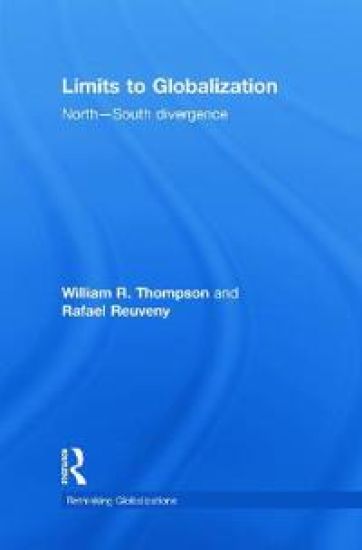
Limits to Globalization

Limits to Globalization

William R. Thompson; Rafael Reuveny

Routledge
2009
sidottu
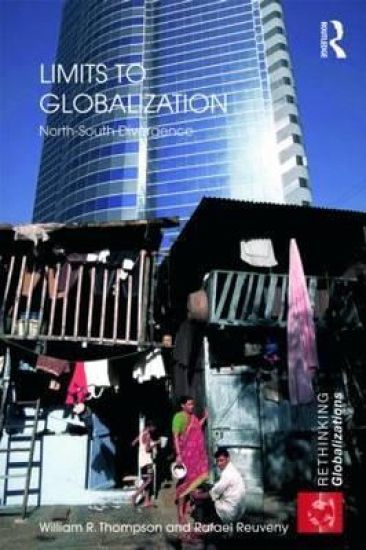
In the post-Cold War era, economic globalization has loomed, at least for some, as the world system's next crisis carrier, creating winners and losers and trampling on the distinctiveness of local cultures. Yet the liberal assumption is that if the market does its job, the poor will catch up to the rich via trade-driven growth and the economies of developed and less developed countries will gradually converge. Investigating the processes of economic globalization, this book explores whether it is truly a "global" process. It examines how globalization is experienced around the world, comparing its intensity and impact in both the global North and South. Using a world systems approach and developing a theoretical analysis that builds on the leadership long-cycle approach to global political economy, this book seeks to dispel some of the myths widely propagated regarding economic development. Through a focus on the issues of technological diffusion, debt, conflict, and democratisation, the authors demonstrate how and why the asymmetries that have characterized the global North and South in the past and present are growing more acute. This important book will be of interest to students and scholars of international political economy, globalisation, international trade and development.
Limits to Globalization

Limits to Globalization

William R. Thompson; Rafael Reuveny

Routledge
2009
nidottu
In the post-Cold War era, economic globalization has loomed, at least for some, as the world system's next crisis carrier, creating winners and losers and trampling on the distinctiveness of local cultures. Yet the liberal assumption is that if the market does its job, the poor will catch up to the rich via trade-driven growth and the economies of developed and less developed countries will gradually converge. Investigating the processes of economic globalization, this book explores whether it is truly a "global" process. It examines how globalization is experienced around the world, comparing its intensity and impact in both the global North and South. Using a world systems approach and developing a theoretical analysis that builds on the leadership long-cycle approach to global political economy, this book seeks to dispel some of the myths widely propagated regarding economic development. Through a focus on the issues of technological diffusion, debt, conflict, and democratisation, the authors demonstrate how and why the asymmetries that have characterized the global North and South in the past and present are growing more acute. This important book will be of interest to students and scholars of international political economy, globalisation, international trade and development.
Growth, Trade, and Systemic Leadership

Growth, Trade, and Systemic Leadership

Rafael Reuveny; William R. Thompson

The University of Michigan Press
2004
nidottu
Using a "lead economy" approach, Reuveny and Thompson link question about the global trade system to debates about hegemonic stability and the balance of power in world politics. By focusing on economic growth, protectionism, and trade, they surpass hegemonic stability interpretations of international politics to explain not only how hegemons maintain political order, but also the source of hegemonic/systemic leadership, the rise and decline of leadership over time, and the role of system leaders in generating worldwide economic growth and international political economic order. Rafael Reuveny is Associate Professor in the School of Public and Environmental Affairs at Indiana University. William R. Thompson is Professor of Political Science at Indiana University.
Growth, Trade, and Systemic Leadership

Growth, Trade, and Systemic Leadership

Rafael Reuveny; William R. Thompson

The University of Michigan Press
2004
sidottu
Using a "lead economy" approach, Reuveny and Thompson link question about the global trade system to debates about hegemonic stability and the balance of power in world politics. By focusing on economic growth, protectionism, and trade, they surpass hegemonic stability interpretations of international politics to explain not only how hegemons maintain political order, but also the source of hegemonic/systemic leadership, the rise and decline of leadership over time, and the role of system leaders in generating worldwide economic growth and international political economic order. Rafael Reuveny is Associate Professor in the School of Public and Environmental Affairs at Indiana University. William R. Thompson is Professor of Political Science at Indiana University.