Kirjojen hintavertailu – 12 859 824 kirjaa ja 27 kauppaa

Kirjailija

Rafiq Dossani

Kirjat ja teokset yhdessä paikassa: 11 kirjaa, julkaisuja vuosilta 2002–2024, suosituimpiin kuuluu Conference Proceedings on Indian and U.S. Security Cooperation. Vertaile teosten hintoja ja tarkista saatavuus suomalaisista kirjakaupoista.

11 kirjaa

Kirjojen julkaisuvuodet: 2002–2024.

Conference Proceedings on Asia-Pacific and Indian Military and Defense Consequences of the Russia-Ukraine War
RAND and the Observer Research Foundation convened an in-person Track II Dialogue on January 12, 2024. These conference proceedings provide a summary of the event, conclusions from it, and the full text of all six papers that were written for it. This publication can help inform foreign and defense policy officials in both countries who are responsible for U. S.-Indian relations, bilateral defense cooperation, and defense policy.
Middle-Power Equities in a Cross-Strait Conflict

Middle-Power Equities in a Cross-Strait Conflict

Rafiq Dossani; Cortez A Cooper; Joan Chang

RAND Corporation
2024
pokkari
In this report, the authors explore the equities of four middle powers-Australia, Canada, Japan, and the United Kingdom-and roles that they might play in deterring or limiting conflict between China and Taiwan over the Taiwan Strait. A country's equities are its long-term interests in a scenario, such as a cross-Strait conflict. Middle powers are nations that are not small but lack the size and influence to significantly disrupt global affairs.
China's AI Exports

China's AI Exports

Jennifer Bouey; Lynn Hu; Keller Scholl; William Marcellino; Rafiq Dossani; Ammar A Malik; Kyra Solomon; Sheng Zhang; Andy Shufer

RAND Corporation
2024
pokkari
Researchers from the RAND Corporation and AidData jointly built a new database on China's artificial intelligence (AI) export projects funded with official development financing. In this report, the authors analyze this quantitative dataset--adding qualitative country case studies based on interviews and social media analysis--to examine the distribution, technology, financing, and data safety aspects of China's AI exports.
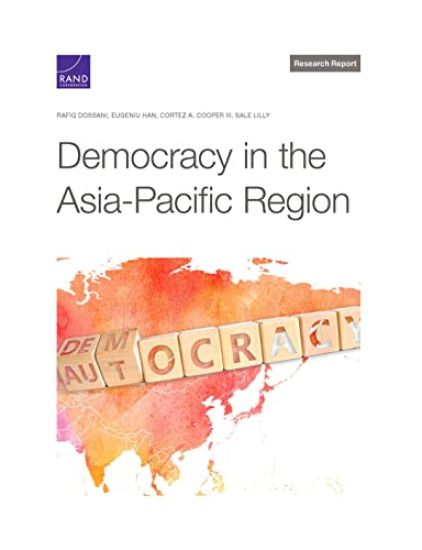
Democracy in the Asia-Pacific Region

Democracy in the Asia-Pacific Region

Rafiq Dossani; Eugeniu Han; Cortez A Cooper

RAND
2022
nidottu
Why do some Asian states consolidate democratic gains while others slide toward authoritarianism? In this report, RAND researchers use a literature review, statistical analysis, and case studies of Taiwan, Thailand, Sri Lanka, and Malaysia to study democratization and the factors that influence it among small Asian states, identify policies that can support democratization, and examine how external actors can help countries democratize.
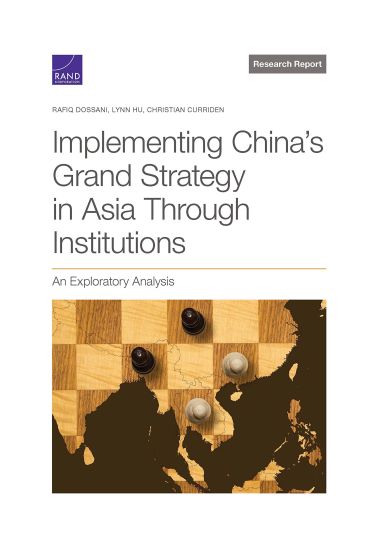
Implementing China's Grand Strategy in Asia Through Institutions

Implementing China's Grand Strategy in Asia Through Institutions

Rafiq Dossani; Lynn Hu; Christian Curriden

RAND
2022
nidottu
China's economic growth has led to a rise in its regional and global ambitions. In this report, the authors review the literature on China's grand strategy, its use of institutions, and its emphasis on Asia. Drawing on the input of policy experts, the authors discuss China's use of institutions in implementing its grand strategy toward Asian nations of interest to China, including, as a case study, the countries of the Korean Peninsula.
Engagement with North Korea
Following the failure of recent efforts by the United States to engage North Korea in denuclearization negotiations, the author proposed and tested an approach to negotiations, the portfolio method, that addresses the reasons for past failures.
Building the Links Between Funding and Quality in Higher Education

Building the Links Between Funding and Quality in Higher Education

Lindsay Daugherty; Trey Miller; Rafiq Dossani; Megan Clifford

RAND
2013
pokkari
India has joined a worldwide trend in which nations are seeking to improve the quality of their higher education systems by giving greater autonomy and accountability to higher education institutions. In this report, the authors review India's and other countries' higher education systems and suggest seven policy actions that the Indian national government and other stakeholders can take to improve higher education by linking funding to quality.
University Expansion in a Changing Global Economy

University Expansion in a Changing Global Economy

Martin Carnoy; Prashant Loyalka; Maria Dobryakova; Rafiq Dossani; Isak Froumin; Katherine Kuhns; Jandhyala Tilak; Rong Wang

Stanford University Press
2013
sidottu
This is a study of higher education in the world's four largest developing economies—Brazil, Russia, India, and China. Already important players globally, by mid-century, they are likely to be economic powerhouses. But whether they reach that level of development will depend in part on how successfully they create quality higher education that puts their labor forces at the cutting edge of the information society. Using an empirical, comparative approach, this book develops a broad picture of the higher education system in each country in the context of both global and local forces. The authors offer insights into how differing socioeconomic and historic patterns of change and political contexts influence developments in higher education. In asking why each state takes the approach that it does, this work situates a discussion of university expansion and quality in the context of governments' educational policies and reflects on the larger struggles over social goals and the distribution of national resources.
Telecommunications Reform in India

Telecommunications Reform in India

Rafiq Dossani

Praeger Publishers Inc
2002
sidottu
Telecommunications reform in India is complete, according to policymakers there. They have done everything correctly in their efforts to transform a state-run monopoly into an independently regulated sector in which private companies compete with government-owned and operated providers. And yet, India lags behind nations whose telecom sectors provided comparable levels of service a decade ago. What went wrong? Dossani and his contributors argue that the classic textbook solutions are insufficient to produce a healthy telecom industry in India, which needs to improve regulatory design, introduce competition in a single phase instead of gradually, implement innovative funding models, and choose appropriate technologies in order to improve access to universal service. Containing valuable lessons for the telecommunications industries in Mexico, Indonesia, the Philippines, and other countries taking formerly state-run industries private, this book constitutes a valuable resource for policymakers, regulators, practitioners, scholars, and overseas investors. Policymakers and regulators will learn that cookie-cutter solutions derived from rich-country experience do not always work in countries that are poor, yet democratic and pro-market. Practitioners will be interested in the sections on universal service, technology convergence, and the implications for reducing costs and improving the quality of both basic telephone services and IT-enabled services. In particular, Indian technology workers in Silicon Valley should find this book indispensable. Investors will gain valuable knowledge about this potentially huge market. Scholars' preconceived ideas may be nudged aside as their knowledge base is enhanced and their research agenda expanded. Whereas some of the book's conclusions support current thinking, such as the need to begin a sequence of reform with a regulatory system in place and the need for dominant-carrier regulation, other conclusions challenge the conventional wisdom. Contributors make a cogent case for reformulating the balance of power between regulators and policymakers, introducing competition at the local level rather than through large franchises, and replacing public subsidies with cross-subsidies of universal service. Provides a multidisciplinary approach to understanding the problems of telecommunications reform in all their complexity.