Kirjojen hintavertailu – 12 859 829 kirjaa ja 27 kauppaa

Kirjailija

Raji C. Steineck

Kirjat ja teokset yhdessä paikassa: 4 kirjaa, julkaisuja vuosilta 2014–2026, suosituimpiin kuuluu Kritik Der Symbolischen Formen II: Zur Konfiguration Altjapanischer Mythologien. Vertaile teosten hintoja ja tarkista saatavuus suomalaisista kirjakaupoista.

4 kirjaa

Kirjojen julkaisuvuodet: 2014–2026.

Zen Time

Zen Time

Raji C. Steineck

STATE UNIVERSITY OF NEW YORK PRESS
2026
pokkari
Offers a groundbreaking approach to a key text in Zen Buddhism. In Zen Time, Raji C. Steineck provides a robust contextualization of Dogen's Uji, the most renowned text on time in Zen Buddhism. Situating the text within the historical context of the medieval Zen master's writing, Steineck illustrates how Dogen shaped the rhythm of life in the Zen monastery to actualize his idea that time in itself is salvific. Dogen was meticulous in his observation of the particulars of each temporal moment, regarding them as an opportunity to bring together interrelated tenets of Buddhist doctrine and practice. In contrast to readings that equate the Zen approach to time with "living the moment" and that pit qualitative understandings of time against quantitative understandings, Steineck shows how Dogen was able to connect time's qualitative and quantitative aspects in a way that, despite its mystical elements, remains instructive in relation to contemporary secular and philosophical discussions. The book includes a translation of Uji in an appendix. An open access version of this book was published with the support of the Swiss National Science Foundation.
Zen Time

Zen Time

Raji C. Steineck

STATE UNIVERSITY OF NEW YORK PRESS
2025
sidottu
Offers a groundbreaking approach to a key text in Zen Buddhism. In Zen Time, Raji C. Steineck provides a robust contextualization of Dogen's Uji, the most renowned text on time in Zen Buddhism. Situating the text within the historical context of the medieval Zen master's writing, Steineck illustrates how Dogen shaped the rhythm of life in the Zen monastery to actualize his idea that time in itself is salvific. Dogen was meticulous in his observation of the particulars of each temporal moment, regarding them as an opportunity to bring together interrelated tenets of Buddhist doctrine and practice. In contrast to readings that equate the Zen approach to time with "living the moment" and that pit qualitative understandings of time against quantitative understandings, Steineck shows how Dogen was able to connect time's qualitative and quantitative aspects in a way that, despite its mystical elements, remains instructive in relation to contemporary secular and philosophical discussions. The book includes a translation of Uji in an appendix. An open access version of this book was published with the support of the Swiss National Science Foundation.

Kritik Der Symbolischen Formen II: Zur Konfiguration Altjapanischer Mythologien
English summary: Myth is one of the most powerful forms the human mind has developed to make sense of the world. This volume starts from Cassirer's idea of myth as symbolic form that follows a genuine kind of logic. It takes ancient Japanese mythologies as an example to explore this idea and take it beyond the notion, still held by Cassirer, of the primitivity of myth. Ancient Japanese mythologies select, grasp and order their objects in accordance with a discernible rational agenda, and they interact with each other and with other symbolic forms present at the time. Their analysis thus reveals important clues about the way mythology operates as a genuine form of "worldmaking" in concert and conflict with other modes of making sense. German description: Mythen sind bis heute ein wirkmachtiger Bestandteil menschlicher Kultur. Gegen ihre Einschatzung als archaisches Residuum durch die Moderne knupft das vorliegende Buch an Ernst Cassirers Konzeption des Mythos als symbolischer Form an. Es analysiert exemplarisch die Mythologien des japanischen Altertums, wie sie in den Reichs-Chroniken Kojiki und Nihonshoki, in Gedichten, Gebeten (norito) und Dokumenten der Schreine und Adelshauser erhalten sind, und zeigt, wie sie im Hinblick auf ihre jeweilige Agenda ihre Gegenstande auswahlen, gliedern und zu eigenen Welten zusammenfugen. Dabei zeigt sich, dass die Vorstellung von der Primitivitat des Mythos, an der auch Cassirer noch festhielt, aufgegeben werden muss. Denn Mythologien erweisen sich als entwicklungsfahig und interagieren mit der je gegebenen Konstellation symbolischer Formen; so vermogen sie das jeweilige Weltwissen zu integrieren und sich gegen sachliche Kritik zu immunisieren. Damit gelingt ein ganz neuer und fruchtbarer Zugang zur Mythologie.
Tokens of the Path

Tokens of the Path

Martina Wernsdorfer; Tomoe Irene Maria Steineck; Raji C. Steineck

Arnoldsche
2014
sidottu
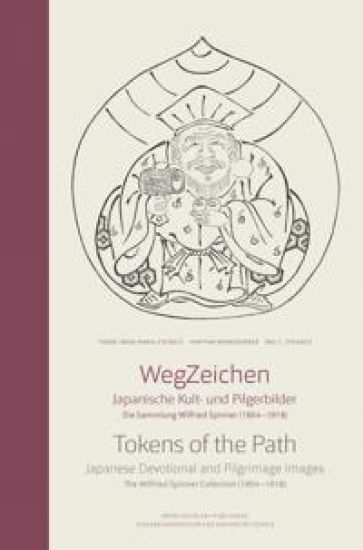
Between 1885 and 1891 the Swiss pastor Wilfried Spinner sojourned in Japan on behalf of the East Asian mission. He founded the first Christian parishes in Tokyo and Yokohama and began to intensively teach there. However, his interest was also directed at local beliefs, which informed the everyday lives of the population. He brought back to Europe around eighty religious scrolls, comprising some painted hanging scrolls and numerous black-and-white prints (ofuda). Ofuda are paper amulets featuring representations of important deities, Buddhas and bodhisattvas, which were printed in and distributed from temples. Some of them additionally feature calligraphy, which was written by the monks in the presence of the pilgrims. They are evidence to their pilgrimage and accompany them onwards as protection and good luck charms. The recently discovered collection of Wilfried Spinner in the Ethnographic Museum at the University of Zurich covers a broad spectrum both figuratively and in content. Text in English, German, and Japanese.