Kirjojen hintavertailu – 12 859 828 kirjaa ja 27 kauppaa

Kirjailija

Rakhmiel Peltz

Kirjat ja teokset yhdessä paikassa: 3 kirjaa, julkaisuja vuosilta 1997–2024, suosituimpiin kuuluu Language Loyalty, Continuity and Change. Vertaile teosten hintoja ja tarkista saatavuus suomalaisista kirjakaupoista.

3 kirjaa

Kirjojen julkaisuvuodet: 1997–2024.

Memories of My Life in a Polish Village, 1930-1949

Memories of My Life in a Polish Village, 1930-1949

Toby Knobel Fluek; Rakhmiel Peltz

The Experiment LLC
2024
sidottu

Halvin toimitettuna 33,90 €

In her own words and with her own beautiful paintings and drawings, artist Toby Knobel Fluek (1926–2011) lovingly unfurls a unique view of Jewish life. She introduces us to her village, to her family, to the people among whom they lived; she shows us how customs and holidays were observed; and, with both feeling and restraint, she illustrates how this long-enduring way of life was shattered by World War II. She depicts her family’s experiences through Russian occupation and the devastation wreaked by the Nazis—and, finally, her new beginning in America. New to this edition is a foreword by Rakhmiel Peltz, PhD, PhD, Founding Director of the Judaic Studies Program at Drexel University, which he led for twenty years.
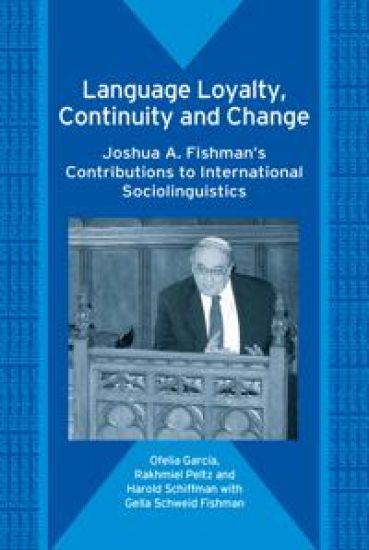
Language Loyalty, Continuity and Change

Language Loyalty, Continuity and Change

Ofelia García; Rakhmiel Peltz; Harold F. Schiffman

Multilingual Matters
2006
nidottu
This short volume provides a comprehensive and synoptic view of Joshua A. Fishman's contributions to international sociolinguistics from 1949 to the present. Readers will find in this volume the essential understandings of Fishmanian sociolinguistics in two short essays that integrate his life's work. The first essay by García and Schiffman identifies the major theoretical contributions and the development of Fishmanian sociolinguistics, often echoing Fishman's own words. The essay by Peltz then analyzes Fishman´s contributions to Yiddish scholarship, as well as the role of that scholarship in his general work. These essential understandings are then extended through Fishman's own concluding sentiments, as well as by the comprehensive and up-to-date bibliography of over 1,000 titles of Joshua A. Fishman's work, compiled by his wife, Gella Schweid Fishman. Together, the contributions in this volume pay tribute to the life work of one of the world's most prolific and original scholars in the field of sociolinguistics -- the founder of what we refer to in this volume as Fishmanian sociolinguistics.
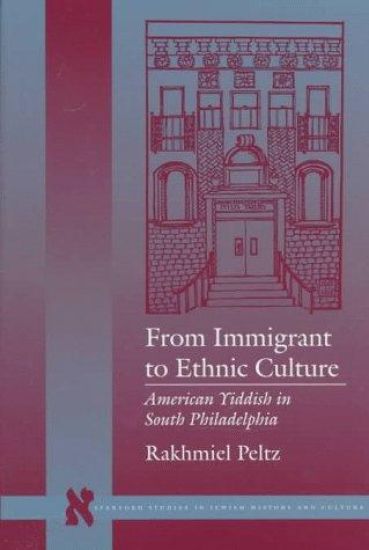
From Immigrant to Ethnic Culture

From Immigrant to Ethnic Culture

Rakhmiel Peltz

Stanford University Press
1997
sidottu
This book provides a fresh look at ethnic culture in the contemporary United States through an ethnographic account of everyday life in the Jewish community of South Philadelphia. By embracing the language and traditions of their childhood, elderly Jewish residents, the children of immigrants, create a path for the transmission of immigrant culture. The work highlights the role of language in collective memory. The residents’ use of Yiddish and their warm attitude toward the language illuminate their changing and overlapping identifications with the neighborhood, their non-Jewish neighbors, Jewish traditions and religion, and their children and parents. The book serves as a corrective to the view of the second generation that concentrates solely on the framework of mobility and rejection of one’s parents’ culture, neglecting the importance of life cycle changes. It depicts children of immigrants as crucial interpreters of the culture of the immigrants’ homeland as they forge a meaningful existence for themselves and their own children. In the course of the work, the author documents and analyzes for the first time the Yiddish speech of American Jews. He examines the cultural implications of the use of English in Yiddish speech, as well as the change in Yiddish sounds and verbal forms. Throughout, the author carefully examines his own role in revitalizing Yiddish in South Philadelphia as he established close relationships with elderly Jews, meeting them in their homes, shops, and senior center, and leading a Yiddish conversation group at the community center. He thus provides a thoughtful contribution to the methodological discussion among anthropologists, sociologists, and linguists of the paradoxes inherent in participant-observer studies.