Kirjojen hintavertailu – 12 903 725 kirjaa ja 27 kauppaa

Kirjailija

Ralf Dahrendorf

Kirjat ja teokset yhdessä paikassa: 31 kirjaa, julkaisuja vuosilta 1956–2024, suosituimpiin kuuluu Ralf Dahrendorf on Class and Society. Vertaile teosten hintoja ja tarkista saatavuus suomalaisista kirjakaupoista.

31 kirjaa

Kirjojen julkaisuvuodet: 1956–2024.

Ralf Dahrendorf on Class and Society

Ralf Dahrendorf on Class and Society

Ralf Dahrendorf

TaylorFrancis Ltd
2022
muu
Originally published between 1959 and 1975 these 4 volumes are by one of the 20th Century's foremost sociologists. The ideas of power, resistance, conflict, historical change, openness, freedom and uncertainty pervade this set and make the works as relevant now as when they were originally published.
The New Liberty

The New Liberty

Ralf Dahrendorf

TAYLOR FRANCIS LTD
2023
nidottu
Originally published in 1975, Ralf Dahrendorf’s Reith Lectures were an important contribution to public debate, exploring as they do the theme of the new liberty and being concerned to refashion liberalism to cope with the problems and tension of contemporary societies. The analysis covers endemic economic problems, such as growth, inflation and development, the complex nature of organizations, and the problems of political representation.
Class and Conflict in an Industrial Society

Class and Conflict in an Industrial Society

Ralf Dahrendorf

TAYLOR FRANCIS LTD
2023
nidottu
Originally published in England in 1959, this book evolves a new theory of conflict in industrial society. By way of illustrating and testing this theory, the book provides detailed analyses of various social phenomena. The author carries out a full critique of Marx in the light of history and modern sociology and discusses the theories of class-conflict of James Burnham, Fritz Croner and Karl Renner.
Homo Sociologicus

Homo Sociologicus

Ralf Dahrendorf

TAYLOR FRANCIS LTD
2023
nidottu
First published in English as part of the Essays in the Theory of Society, this volume reissues the stand-alone Homo Sociologicus for which the author wrote a new introduction when it was originally published in 1973. The controversial book deals with the history, significance and limits of the category of social role and discusses the dilemma posed by homo sociologicus. The author shows that for society and sociology, socialization invariably means depersonalization, the yielding up of man’s absolute individuality and liberty to the constraint and generality of social roles. This volume includes the essay, Sociology and Human Nature, written as a postscript to Homo Sociologicus.
Essays in the Theory of Society

Essays in the Theory of Society

Ralf Dahrendorf

TAYLOR FRANCIS LTD
2023
nidottu
Originally published in 1968, these ten essays by one of Europe’s leading sociological theorists deal with important issues on the borderline between sociology and social philosophy and demonstrate the author’s deep insight into history and political analysis. The author maintains that the structures of power in which the political process takes place not only originate change and give it direction, but also produce the fertile conflicts that give expression to the fundamental uncertainty of human existence. Through an examination of various concepts inherent in this dynamic process – power, resistance, conflict, change, freedom, uncertainty – a coherent theory of society emerges.
The New Liberty

The New Liberty

Ralf Dahrendorf

TAYLOR FRANCIS LTD
2022
sidottu
Originally published in 1975, Ralf Dahrendorf’s Reith Lectures were an important contribution to public debate, exploring as they do the theme of the new liberty and being concerned to refashion liberalism to cope with the problems and tension of contemporary societies. The analysis covers endemic economic problems, such as growth, inflation and development, the complex nature of organizations, and the problems of political representation.
Class and Conflict in an Industrial Society

Class and Conflict in an Industrial Society

Ralf Dahrendorf

TAYLOR FRANCIS LTD
2022
sidottu
Originally published in England in 1959, this book evolves a new theory of conflict in industrial society. By way of illustrating and testing this theory, the book provides detailed analyses of various social phenomena. The author carries out a full critique of Marx in the light of history and modern sociology and discusses the theories of class-conflict of James Burnham, Fritz Croner and Karl Renner.
Homo Sociologicus

Homo Sociologicus

Ralf Dahrendorf

TAYLOR FRANCIS LTD
2022
sidottu
First published in English as part of the Essays in the Theory of Society, this volume reissues the stand-alone Homo Sociologicus for which the author wrote a new introduction when it was originally published in 1973. The controversial book deals with the history, significance and limits of the category of social role and discusses the dilemma posed by homo sociologicus. The author shows that for society and sociology, socialization invariably means depersonalization, the yielding up of man’s absolute individuality and liberty to the constraint and generality of social roles. This volume includes the essay, Sociology and Human Nature, written as a postscript to Homo Sociologicus.
Essays in the Theory of Society

Essays in the Theory of Society

Ralf Dahrendorf

TAYLOR FRANCIS LTD
2022
sidottu
Originally published in 1968, these ten essays by one of Europe’s leading sociological theorists deal with important issues on the borderline between sociology and social philosophy and demonstrate the author’s deep insight into history and political analysis. The author maintains that the structures of power in which the political process takes place not only originate change and give it direction, but also produce the fertile conflicts that give expression to the fundamental uncertainty of human existence. Through an examination of various concepts inherent in this dynamic process – power, resistance, conflict, change, freedom, uncertainty – a coherent theory of society emerges.
Reflections on the Revolution in Europe
The fall of the Berlin Wall in 1989 effectively ended the division of Europe into East and West, and the features of our world that have resulted bear little resemblance to those of the forty years that preceded the Wall's fall. The rise of a new Europe prompts many questions, most of which remain to be answered. What does it all mean? Where is it going to lead? Are we witnessing the conclusion of an era without seeing anything to replace an old and admittedly dismal way of life? What will a market economy do to the social texture of various countries of Central Europe? Will it not make some rich while many will become poorer than ever? How can the rule of law be brought about? In this incisive and lucid book, Ralf Dahrendorf, one of Europe's most distinguished scholars, ponders these and other equally vexing questions. He regards what has happened in East Central Europe as a victory for neither of the social systems that once opposed each other across the Iron Curtain. Rather, he views these events as a vote for an open society over a closed society. The continuing conundrum, he argues, which will plague peoples everywhere, will be how to balance the need for economic growth with the desire for social justice while building authentic and enduring democratic institutions. Reflections on the Revolution in Europe, which includes a new introduction from the author, is a humane, skeptical, and anti-utopian work, a manifesto for a radical liberalism in which the social entitlements of citizenship are as important a condition of progress as the opportunities for choice. A fascinating study of change and geopolitics in the modern world, Reflections points the way towards a new politics for the twenty-first century. Ralf Dahrendorf, born in Hamburg, Germany in 1929, is a member of Britain's House of Lords. He was professor of sociology at Hamburg, Tobingen and Konstanz from 1957 to 1968, and in 1974 moved to Britain. He has been the director of the London School of Economics, warden of St. Antony's College, and pro vice-chancellor of the University of Oxford. He is the author of numerous books, including The Modern Social Conflict and After 1989: Morals, Revolution and Civil Society.

Homo Sociologicus

Homo Sociologicus

Ralf Dahrendorf

VS Verlag fur Sozialwissenschaften
2010
nidottu
Der "Homo Sociologicus" ist ein Klassiker der Soziologie. Mit einem Nachwort von Heinz Abels. "Das Vergnügen, das die Lektüre des schlanken Bandes noch immer bereitet, sei den Studenten gegönnt [...]." Frankfurter Allgemeine Zeitung, 19.1.2007 "Ralf Dahrendorfs vor bald einem halben Jahrhundert erschienenen ‚Homo Sociologicus' ein klassikverdächtiges Buch zu nennen, wäre eine Untertreibung. […] Der schmalen Schrift ist es nicht unwesentlich zu verdanken, dass der Begriff der sozialen Rolle auch in der deutschsprachigen Soziologie heimisch hat werden können […]." Neue Zürcher Zeitung, 1./2.7.2006
Reflections on the Revolution in Europe

Reflections on the Revolution in Europe

Ralf Dahrendorf

Transaction Publishers
2004
nidottu
The fall of the Berlin Wall in 1989 effectively ended the division of Europe into East and West, and the features of our world that have resulted bear little resemblance to those of the forty years that preceded the Wall's fall. The rise of a new Europe prompts many questions, most of which remain to be answered. What does it all mean? Where is it going to lead? Are we witnessing the conclusion of an era without seeing anything to replace an old and admittedly dismal way of life? What will a market economy do to the social texture of various countries of Central Europe? Will it not make some rich while many will become poorer than ever? How can the rule of law be brought about? In this incisive and lucid book, Ralf Dahrendorf, one of Europe's most distinguished scholars, ponders these and other equally vexing questions. He regards what has happened in East Central Europe as a victory for neither of the social systems that once opposed each other across the Iron Curtain. Rather, he views these events as a vote for an open society over a closed society. The continuing conundrum, he argues, which will plague peoples everywhere, will be how to balance the need for economic growth with the desire for social justice while building authentic and enduring democratic institutions. Reflections on the Revolution in Europe, which includes a new introduction from the author, is a humane, skeptical, and anti-utopian work, a manifesto for a radical liberalism in which the social entitlements of citizenship are as important a condition of progress as the opportunities for choice. A fascinating study of change and geopolitics in the modern world, Reflections points the way towards a new politics for the twenty-first century. Ralf Dahrendorf, born in Hamburg, Germany in 1929, is a member of Britain's House of Lords. He was professor of sociology at Hamburg, Tobingen and Konstanz from 1957 to 1968, and in 1974 moved to Britain. He has been the director of the London School of Economics, warden of St. Antony's College, and pro vice-chancellor of the University of Oxford. He is the author of numerous books, including The Modern Social Conflict and After 1989: Morals, Revolution and Civil Society.

Time and Poverty in Western Welfare States

Time and Poverty in Western Welfare States

Lutz Leisering; Stephan Leibfried; Ralf Dahrendorf

Cambridge University Press
2001
pokkari
Time and Poverty in Western Welfare States is the English-language adaptation of one of the most important contributions to welfare economics published in recent years. Professors Leibfried and Leisering offer a time-based (dynamic) analysis of the study of poverty, and suggest the need for a radical re-think of conventional theoretical and policy approaches. The core of this study is the empirical analysis of the life course of recipients of 'Social Assistance' in Germany, although the conclusions are put into a wider context of socio-economic and socio-political analysis and comparative observations are made with other countries, notably the USA. Time, Life and Poverty will be of interest to upper-level students, researchers and policy-makers in a wide range of social science disciplines, including: economics, social policy, sociology, psychology and European studies.
Ein Neuer Dritter Weg?

Ein Neuer Dritter Weg?

Ralf Dahrendorf

JCB Mohr (Paul Siebeck)
1999
nidottu
English summary: The new Third Way is the optimistic attitude towards the challenges posed by globalization and also the fundamental adoption of neoliberal economic policies. Ralf Dahrendorf discusses the necessary reforms and strategic changes in an altered world. German description: Der neue Dritte Weg, das ist die optimistische Haltung zu den Herausforderungen der Globalisierung und die grundsatzliche Ubernahme der neoliberalen Wirtschaftspolitik. Ralf Dahrendorf diskutiert notwendige Reformen und strategische Veranderungen in einer gewandelten Welt.
After 1989

After 1989

Ralf Dahrendorf

Palgrave Macmillan
1997
sidottu
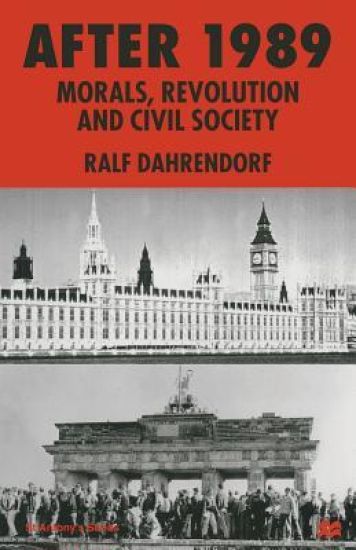
The essays assembled in this volume are a thoughtful and lively commentary on Europe after the revolution of 1989. Must revolutions fail? Certainly, the open society has its own problems, not least that of citizens in search of meaning. The Good Society has to square the circle of prosperity, civility and liberty. Social science can help us understand what needs to be done, and intellectuals have a responsibility to initiate and accompany change. All this raises questions for Europe which extend far beyond the all too narrow confines of the European Union.
After 1989

After 1989

Ralf Dahrendorf

Palgrave Macmillan
1997
nidottu
The essays assembled in this volume are a thoughtful and lively commentary on Europe after the revolution of 1989. Must revolutions fail? Certainly, the open society has its own problems, not least that of citizens in search of meaning. The Good Society has to square the circle of prosperity, civility and liberty. Social science can help us understand what needs to be done, and intellectuals have a responsibility to initiate and accompany change. All this raises questions for Europe which extend far beyond the all too narrow confines of the European Union.
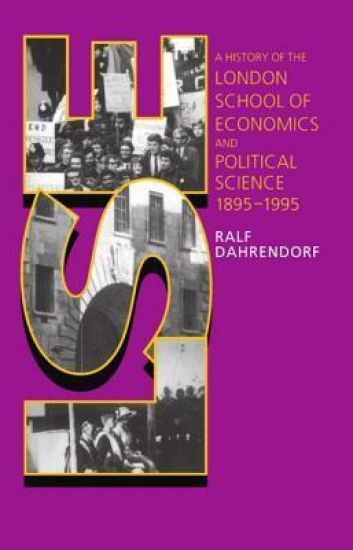
LSE

LSE

Ralf Dahrendorf

Clarendon Press
1995
sidottu
The London School of Economics and Political Science -- the LSE -- is one of the most famous academic institutions in the world. This history provides a lively account of the fist century of a university which, form its beginnings has captured not only the minds of social scientists but also the imagination of a wider public. It is the biography of an institution written by an author who was closely involved as a student and later as Director of the School and who remains deeply attached to it. The book places the School in the context of the drama of the twentieth century and it does so through a mirror, the mirror of the social sciences. Lord Dahrendorf traces the story of the LSE from its `invention' by Beatrice and Sidney Webb, George Bernard Shaw, and Graham Wallas as a breakfast in August 1894, through its foundation in 1895, the travails of its early years, the triumphs of the Beveridge years between the wars, the great expansion of the post-war period, and the changing moods of the succeeding decades, including the `troubles' of 1968. The individuals and the events of the LSE's century of existence have been memorable, yet the School has always been more than the sum of its parts. Its base was London, and its home the world.