Kirjojen hintavertailu – 12 903 724 kirjaa ja 27 kauppaa

Kirjailija

Ralph Hanna

Kirjat ja teokset yhdessä paikassa: 25 kirjaa, julkaisuja vuosilta 1995–2025, suosituimpiin kuuluu Hope Allen's Writings Ascribed to Richard Rolle. Vertaile teosten hintoja ja tarkista saatavuus suomalaisista kirjakaupoista.

25 kirjaa

Kirjojen julkaisuvuodet: 1995–2025.

Three Oxford Exemplum Books

Three Oxford Exemplum Books

Ralph Hanna

LIVERPOOL UNIVERSITY PRESS
2025
sidottu
The most ubiquitous medieval instruction was oral and came from the pulpit. Sermons not only addressed basic Christian responsibilities, but also a great deal more. Following contemporary homiletic practice, preachers were expected to illustrate their points, and a variety of tools had been developed to aid them in this rhetorical amplification. Among these, exemplum books, collections of illustrative stories, had a primary place and were particularly effective in addressing lay audiences. As part of a drive for innovative and arresting anecdotes of this type, Oxford preaching materials are particularly renowned for their use of classical materials for this purpose. This volume, following a lengthy introduction that addresses the cultural importance of exempla, presents editions and translations of three outstanding examples of the genre, all assembled by Oxford mendicants: John of Wales’s Breviloquium (1260s), Thomas Waleys’s Moralitates in Isaiam (c. 1320), and Robert Holcot’s Moralitates (1330s?). While there is a century’s worth of discussion of sermon exempla, this volume is the first collection devoted exclusively to insular materials.
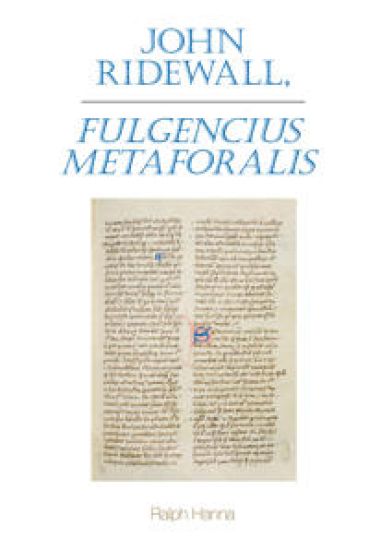
John Ridewall, Fulgentius metaforalis

John Ridewall, Fulgentius metaforalis

Ralph Hanna

LIVERPOOL UNIVERSITY PRESS
2025
nidottu
John Ridewall's Fulgencius metaforalis is a moralising commentary on Fulgentius's sixth-century Mitologiae, an introduction to the classical gods and their stories. Composed in Oxford in the 1330s and subject to almost immediate local (and broader English) use, the work was a pan-European success, and more than 100 manuscripts preserve Ridewall's text in some form. Fulgencius metaforalis has been edited before, nearly a century ago, by a great medievalist, Hans Liebeschütz; he, however, did not recognise that the manuscript he presented was a fragment, containing only about one-third of the whole. This volume provides Ridewall's entire text, as usually communicated, with a translation. In addition, it contains a substantial introduction; this outlines various difficulties in the transmission of Fulgencius and evidence for the work's extensive medieval reception. Annotation to the text identifies and indexes Ridewall's sources – most of his mythographic knowledge reflects either Remigius of Auxerre's commentary on Martianus Capella or the Third Vatican Mythographer; and offers one manuscript tabula/index, useful for seeing how readers may have accessed the work piecemeal (by manuscript consultation, not, as frequently claimed, as a set of 'memory diagrams').
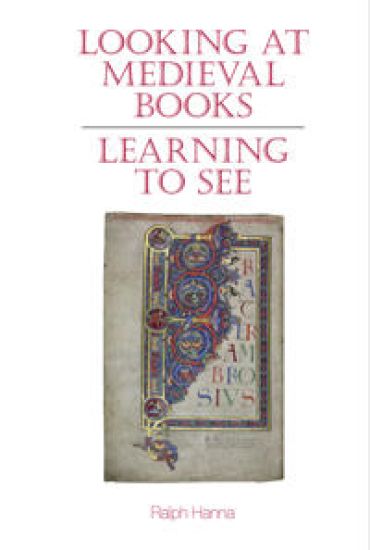
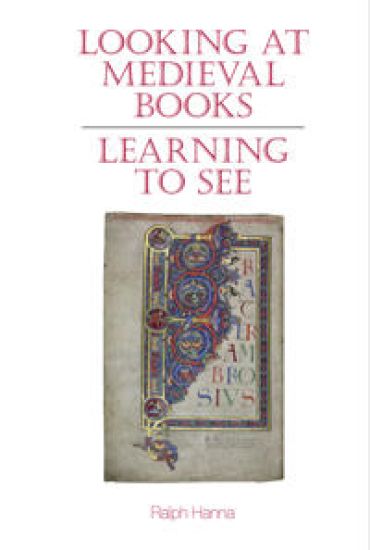
Looking at Medieval Books

Looking at Medieval Books

Ralph Hanna

LIVERPOOL UNIVERSITY PRESS
2025
nidottu
Unlike books familiar to us from print culture, every medieval book is unique, the product of individual circumstances of planning, execution, and history. This is a fundamental difficulty for study, particularly for those beginning the investigation of texts in manuscript. There are two conventional ways of approaching this difficulty: explaining the series of processes by which a manuscript book is constructed and explaining how to construct a professional description of a manuscript book. Neither addresses a problem fundamental for beginners: what happens when a librarian presents you with a manuscript? How should you proceed? Fundamentally, this is a problem of visual examination, and taking its procedure from the grand M. R. James and M. B. Parkes, this book attempts to stimulate the visual and experiential. It attempts, in a heavily exemplified account, to explain what might be there in a manuscript to perceive and what it might mean. The argument follows a process of examination that begins with the physical bulk of what's in front of you (and its cover, or binding) and ends with traces of the book's history.
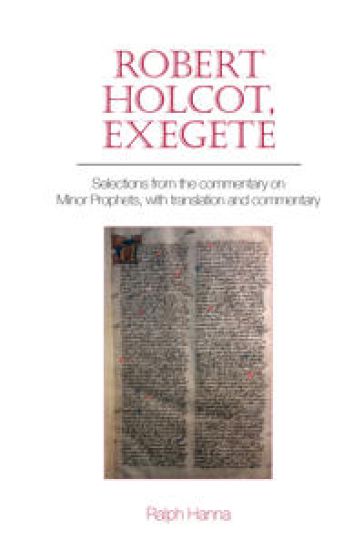
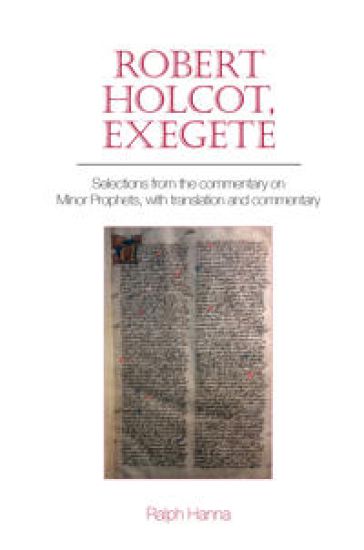
Robert Holcot, exegete

Robert Holcot, exegete

Ralph Hanna

LIVERPOOL UNIVERSITY PRESS
2024
nidottu
Robert Holcot (d. 1349) was a Dominican friar, most prominently connected with the convent in Oxford where he became a Doctor of Theology. Holcot is perhaps most famous today, following an important discussion by Heiko Obermann in the 1960s, for his 'semi-Pelagian' theological views. In contrast to traditional Augustinianism, he believed that God granted salvation to individuals on the basis of 'bonum quod in se est', that is, on the basis of an individual's intention to do good, rather than any achievement. While historians of theology know Holcot in these terms, his wide medieval reputation was rather different. Holcot was read all over Europe as an exegete, an explicator of biblical texts, especially the Old Testament sapiential books. This volume presents a selection, nearly a quarter of the whole, from Holcot's readings in the minor prophets, originally delivered in the 1330s as lectures in Oxford's Dominican studium. In a commentary appended to the text, it uses these selections to offer a view of exegesis, and of Holcot's strategies, that differs from customary scholarship on the topic. The commentary attempts to clarify the relation between Holcot's usually tacit discussion (a feature perhaps driven by the fact that the received text represents a reportatio or outline, not a stenographic transcription) and the biblical text at hand. It further addresses some argumentative features, principally Holcot's use of narrative and of imagistic distinctiones. The volume is fully annotated, with a facing-page translation, numerous references to analogous discussions elsewhere in Holcot (including his classic Super Sapientiam Salamonis), and full indexes of Holcot's biblical references, his parallel treatments, and his sources.
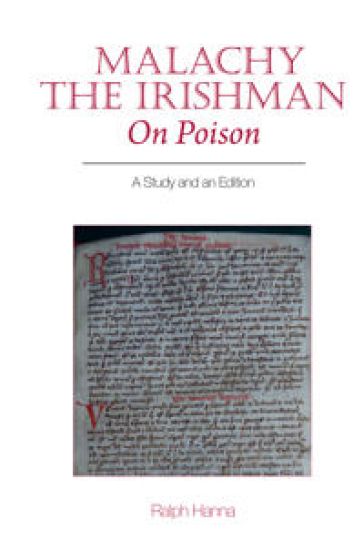
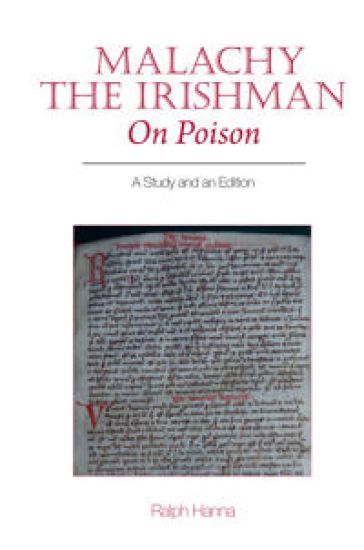
Malachy the Irishman, On Poison

Malachy the Irishman, On Poison

Ralph Hanna

LIVERPOOL UNIVERSITY PRESS
2023
nidottu
The 'De venenis' attributed to 'Malachias Hibernicus' is a portable discussion of vices and virtues. Probably composed about 1280, originally as an aid for Franciscan preachers, it adopts the innovative metaphor that sin is a poison removed by various 'treacles'. Its argumentative mode is to adduce scientific data about venomous beasts, the sins, and the antidotes to their poisons, the 'remedial' virtues. From these 'facts' of natural history, Malachy constructs homiletic similitudines (analogical figures). These, typically of a sort designed for use in sermones ad status, he applies to vicious and virtuous activities, and perhaps particularly ones peculiar to Ireland. Although Malachy the Irishman and his On Poison have received only a handful of scholarly notices in the last century, in the later Middle Ages, his was a widely known book. A lengthy introduction presents evidence for the wide circulation of Malachy's text and the little that is known of the author. It further addresses literary issues: the work's genre, hovering between a treatise on vices and virtues, a compendium of scientific information, and a handbook for preachers; Malachy's efforts at compilation of authoritative materials; and a preliminary account of some early users, including William Langland and Robert Holcot. The introduction concludes by examining the insuperable difficulties involved in editing the text. The centre of the volume presents an annotated preliminary text and translation, together with some account of early interpolations the text received. The volume concludes with three indexes, one with all biblical citations, one of all Malachy's other citations, and a third of Malachy's similitudines, his moralised scientific information.
John Ridewall, Fulgentius metaforalis

John Ridewall, Fulgentius metaforalis

Ralph Hanna

LIVERPOOL UNIVERSITY PRESS
2023
sidottu
John Ridewall's Fulgencius metaforalis is a moralising commentary on Fulgentius's sixth-century Mitologiae, an introduction to the classical gods and their stories. Composed in Oxford in the 1330s and subject to almost immediate local (and broader English) use, the work was a pan-European success, and more than 100 manuscripts preserve Ridewall's text in some form. Fulgencius metaforalis has been edited before, nearly a century ago, by a great medievalist, Hans Liebeschütz; he, however, did not recognise that the manuscript he presented was a fragment, containing only about one-third of the whole. This volume provides Ridewall's entire text, as usually communicated, with a translation. In addition, it contains a substantial introduction; this outlines various difficulties in the transmission of Fulgencius and evidence for the work's extensive medieval reception. Annotation to the text identifies and indexes Ridewall's sources – most of his mythographic knowledge reflects either Remigius of Auxerre's commentary on Martianus Capella or the Third Vatican Mythographer; and offers one manuscript tabula/index, useful for seeing how readers may have accessed the work piecemeal (by manuscript consultation, not, as frequently claimed, as a set of 'memory diagrams').
Looking at Medieval Books

Looking at Medieval Books

Ralph Hanna

LIVERPOOL UNIVERSITY PRESS
2023
sidottu
Unlike books familiar to us from print culture, every medieval book is unique, the product of individual circumstances of planning, execution, and history. This is a fundamental difficulty for study, particularly for those beginning the investigation of texts in manuscript. There are two conventional ways of approaching this difficulty: explaining the series of processes by which a manuscript book is constructed and explaining how to construct a professional description of a manuscript book. Neither addresses a problem fundamental for beginners: what happens when a librarian presents you with a manuscript? How should you proceed? Fundamentally, this is a problem of visual examination, and taking its procedure from the grand M. R. James and M. B. Parkes, this book attempts to stimulate the visual and experiential. It attempts, in a heavily exemplified account, to explain what might be there in a manuscript to perceive and what it might mean. The argument follows a process of examination that begins with the physical bulk of what's in front of you (and its cover, or binding) and ends with traces of the book's history.
Robert Holcot, exegete

Robert Holcot, exegete

Ralph Hanna

Liverpool University Press
2021
sidottu
Robert Holcot (d. 1349) was a Dominican friar, most prominently connected with the convent in Oxford where he became a Doctor of Theology. Holcot is perhaps most famous today, following an important discussion by Heiko Obermann in the 1960s, for his 'semi-Pelagian' theological views. In contrast to traditional Augustinianism, he believed that God granted salvation to individuals on the basis of 'bonum quod in se est', that is, on the basis of an individual's intention to do good, rather than any achievement. While historians of theology know Holcot in these terms, his wide medieval reputation was rather different. Holcot was read all over Europe as an exegete, an explicator of biblical texts, especially the Old Testament sapiential books. This volume presents a selection, nearly a quarter of the whole, from Holcot's readings in the minor prophets, originally delivered in the 1330s as lectures in Oxford's Dominican studium. In a commentary appended to the text, it uses these selections to offer a view of exegesis, and of Holcot's strategies, that differs from customary scholarship on the topic. The commentary attempts to clarify the relation between Holcot's usually tacit discussion (a feature perhaps driven by the fact that the received text represents a reportatio or outline, not a stenographic transcription) and the biblical text at hand. It further addresses some argumentative features, principally Holcot's use of narrative and of imagistic distinctiones. The volume is fully annotated, with a facing-page translation, numerous references to analogous discussions elsewhere in Holcot (including his classic Super Sapientiam Salamonis), and full indexes of Holcot's biblical references, his parallel treatments, and his sources.
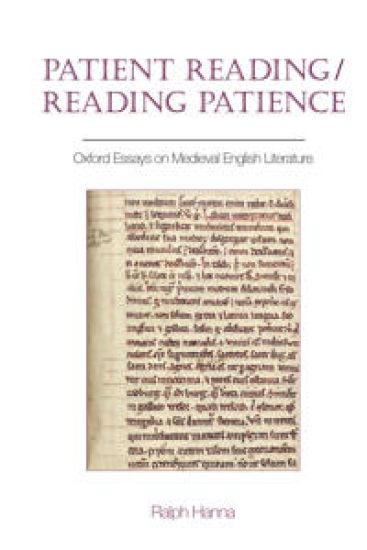
Patient Reading/Reading Patience

Patient Reading/Reading Patience

Ralph Hanna

Liverpool University Press
2020
nidottu
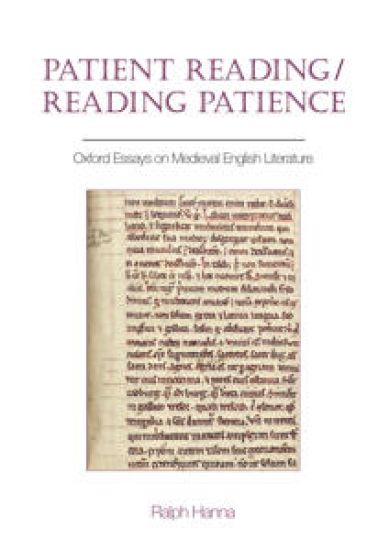
This volume brings together a variety of studies, some reprinted, some new; all are devoted to the literate culture of the English later Middle Ages. The studies hover about four foci: normative English polylingualism (across three grammatically distinct languages); the messiness and discontinuities of medieval manuscript production; drawing conclusions about historical audiences/literary communities on the basis of book-evidence; and finally, the Middle English poem Piers Plowman. In general, although all the essays here arrive at broad conclusions, their point is other. The essays exemplify methods of study, the identification of problems and the recognition of tools appropriate or helpful in addressing them. Perhaps particularly the volume gestures toward a range of skills appropriate for the task; these range from narrow observation of book-production techniques to bringing a local historical record to bear on an individual volume or group of them.
Malachy the Irishman, On Poison

Malachy the Irishman, On Poison

Ralph Hanna

Liverpool University Press
2020
sidottu
The 'De venenis' attributed to 'Malachias Hibernicus' is a portable discussion of vices and virtues. Probably composed about 1280, originally as an aid for Franciscan preachers, it adopts the innovative metaphor that sin is a poison removed by various 'treacles'. Its argumentative mode is to adduce scientific data about venomous beasts, the sins, and the antidotes to their poisons, the 'remedial' virtues. From these 'facts' of natural history, Malachy constructs homiletic similitudines (analogical figures). These, typically of a sort designed for use in sermones ad status, he applies to vicious and virtuous activities, and perhaps particularly ones peculiar to Ireland. Although Malachy the Irishman and his On Poison have received only a handful of scholarly notices in the last century, in the later Middle Ages, his was a widely known book. A lengthy introduction presents evidence for the wide circulation of Malachy's text and the little that is known of the author. It further addresses literary issues: the work's genre, hovering between a treatise on vices and virtues, a compendium of scientific information, and a handbook for preachers; Malachy's efforts at compilation of authoritative materials; and a preliminary account of some early users, including William Langland and Robert Holcot. The introduction concludes by examining the insuperable difficulties involved in editing the text. The centre of the volume presents an annotated preliminary text and translation, together with some account of early interpolations the text received. The volume concludes with three indexes, one with all biblical citations, one of all Malachy's other citations, and a third of Malachy's similitudines, his moralised scientific information.
Editing Medieval Texts

Editing Medieval Texts

Ralph Hanna

Liverpool University Press
2019
nidottu
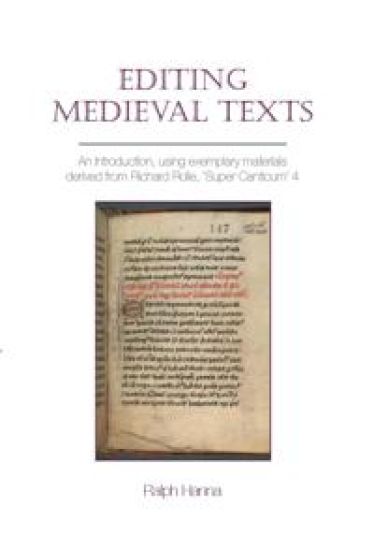
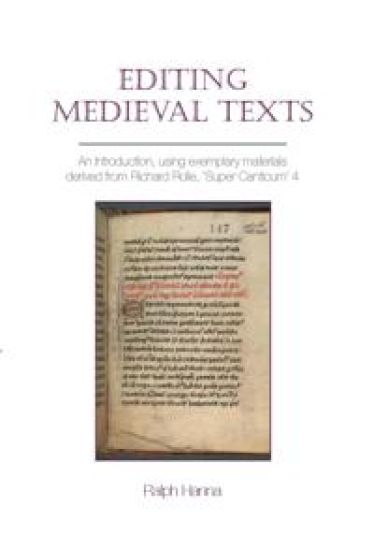
This book draws on a lengthy experience of teaching graduates how to approach medieval books. It leads the reader through the stages of the editorial process, using part of Richard Rolle's Commentary on the Song of Songs as the working exemplar. In the humane sciences, the need for texts is ubiquitous; they provide the regular objects of study. But far less prevalent than editions is any discussion of the premises underlying these objects, or the mechanisms by which they have been constructed. This volume takes up both challenges. First, in a preliminary chapter, it discusses what is at stake in any edition one might read; the persistent argument is that these represent products of modern scholarly decision-making, the imposition of various kinds of unity on the extremely diverse evidence medieval books offer for any literary work. This chapter also explains broadly various options for the presentation of texts – and the difficulties inherent in them all. The remainder of the volume is given over to a step-by-step guide to the process of editing (and eventually to a finished presentation of) a heretofore unpublished medieval text. The discussion seeks to exemplify the decisions editors routinely face, and to suggest ways of addressing them.
Hope Allen's Writings Ascribed to Richard Rolle

Hope Allen's Writings Ascribed to Richard Rolle

Ralph Hanna; A I Doyle

Brepols N.V.
2019
nidottu
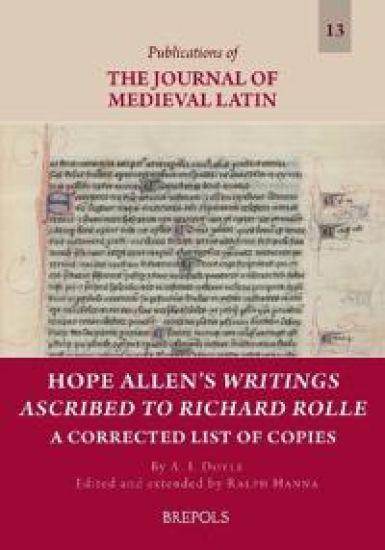
Hope Allen's Writings Ascribed to Richard Rolle, now nearly a century old, is a foundational work of English palaeography. This volume extends Allen's most basic contribution, her catalogue of manuscripts conveying Rolle's works; it provides references to more than 600 relevant medieval books.
Patient Reading/Reading Patience

Patient Reading/Reading Patience

Ralph Hanna

Liverpool University Press
2017
sidottu
This volume brings together a variety of studies, some reprinted, some new; all are devoted to the literate culture of the English later Middle Ages. The studies hover about four foci: normative English polylingualism (across three grammatically distinct languages); the messiness and discontinuities of medieval manuscript production; drawing conclusions about historical audiences/literary communities on the basis of book-evidence; and finally, the Middle English poem Piers Plowman. In general, although all the essays here arrive at broad conclusions, their point is other. The essays exemplify methods of study, the identification of problems and the recognition of tools appropriate or helpful in addressing them. Perhaps particularly the volume gestures toward a range of skills appropriate for the task; these range from narrow observation of book-production techniques to bringing a local historical record to bear on an individual volume or group of them.
The Penn Commentary on Piers Plowman, Volume 2

The Penn Commentary on Piers Plowman, Volume 2

Ralph Hanna

University of Pennsylvania Press
2017
sidottu
The first full commentary on Piers Plowman since the late nineteenth century, the Penn Commentary places the allegorical dream-vision of Piers Plowman within the literary, historical, social, and intellectual contexts of late medieval England, and within the long history of critical interpretation of the poem, assessing past scholarship while offering original materials and insights throughout. The authors' line-by-line, section by section, and passus by passus commentary on all three versions of the poem and on the stages of its multiple revisions reveals new aspects of the work's meaning while assessing and summarizing a complex and often divisive scholarly tradition. The volumes offer an up-to-date, original, and open-ended guide to a poem whose engagement with its social world is unrivaled in medieval English literature, and whose literary, religious, and intellectual accomplishments are uniquely powerful. The Penn Commentary is designed to be equally useful to readers of the A, B, or C texts of the poem. It is geared to readers eager to have detailed experience of Piers Plowman and other medieval literature, possessing some basic knowledge of Middle English language and literature, and interested in pondering further the particularly difficult relationships to both that this poem possesses. Others, with interest in poetry of all periods, will find the extended and detailed commentary useful precisely because it does not seek to avoid the poem's challenges but seeks instead to provoke thought about its intricacy and poetic achievements. Volume 2, by Ralph Hanna, deliberately addresses the question of the poem's perceived "difficulty," by indicating the legitimate areas of unresolved dilemmas, while offering often original explanations of a variety of textual loci. Perhaps more important, his commentary indicates what has not always appeared clear in past approaches-that the poem only "means" in its totality and within some critical framework, and that its annotation needs always to be guided by a sense of Langland's developing arguments.
Editing Medieval Texts

Editing Medieval Texts

Ralph Hanna

Liverpool University Press
2015
sidottu
This book draws on a lengthy experience of teaching graduates how to approach medieval books. It leads the reader through the stages of the editorial process, using part of Richard Rolle's Commentary on the Song of Songs as the working exemplar. In the humane sciences, the need for texts is ubiquitous; they provide the regular objects of study. But far less prevalent than editions is any discussion of the premises underlying these objects, or the mechanisms by which they have been constructed. This volume takes up both challenges. First, in a preliminary chapter, it discusses what is at stake in any edition one might read; the persistent argument is that these represent products of modern scholarly decision-making, the imposition of various kinds of unity on the extremely diverse evidence medieval books offer for any literary work. This chapter also explains broadly various options for the presentation of texts – and the difficulties inherent in them all. The remainder of the volume is given over to a step-by-step guide to the process of editing (and eventually to a finished presentation of) a heretofore unpublished medieval text. The discussion seeks to exemplify the decisions editors routinely face, and to suggest ways of addressing them.
Introducing English Medieval Book History

Introducing English Medieval Book History

Ralph Hanna

Liverpool University Press
2014
nidottu
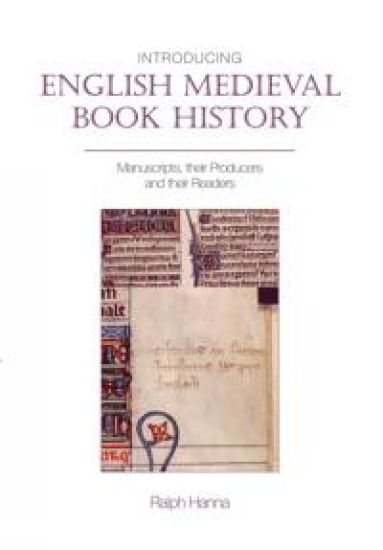
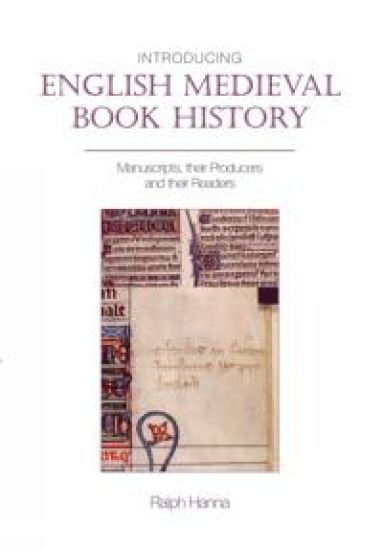
This book offers an introduction to medieval English book-history through a sequence of exemplary analyses of commonplace book-historical problems. Rather than focus on bibliographical particulars, the volume considers a variety of ways in which scholars use manuscripts to discuss book culture, and it provides a wide-ranging introductory bibliography to aid in the study. All the essays try to suggest how the study of surviving medieval books might be useful in considering medieval literary culture more generally. Subjects covered include authorship, genre, discontinuous production, scribal individuality and community, the history of libraries and the history of book provenance.
Richard Morris's Prick of Conscience

Richard Morris's Prick of Conscience

Ralph Hanna; Sarah Wood

Oxford University Press
2013
sidottu
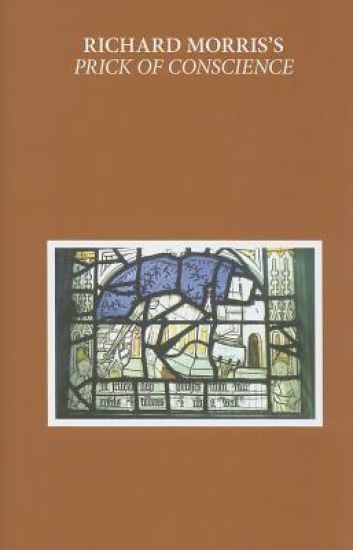
This mid fourteenth-century poem, a discussion of the 'contempt of the world' and the 'Four Last Things', was one of the most popular Middle English texts in its time, as indicated by the large number of extant copies, and illustrations of it in the windows of All Saints, North Street, in York. It was a widely influential compendium of religious instruction, originating in Yorkshire, but more widely disseminated, and thus representing this important regional culture, as well as its absorption into a nationwide religious culture. The only edition, by Richard Morris (1863), is now generally unavailable outside research libraries. The present edition revises Morris's text extensively and offers full modern annotation, including extensive discussion of the poem's sources. Morris's text, although based on an exceptionally good manuscript copy, has been fully collated with the principal early manuscripts; this information is presented in a separate textual commentary. There is an introduction presenting the poem in its context and a Glossary.
Introducing English Medieval Book History

Introducing English Medieval Book History

Ralph Hanna

University of Exeter Press
2013
sidottu
This book offers an introduction to medieval English book-history through a sequence of exemplary analyses of commonplace book-historical problems. Rather than focus on bibliographical particulars, the volume considers a variety of ways in which scholars use manuscripts to discuss book culture, and it provides a wide-ranging introductory bibliography to aid in the study. All the essays try to suggest how the study of surviving medieval books might be useful in considering medieval literary culture more generally. Subjects covered include authorship, genre, discontinuous production, scribal individuality and community, the history of libraries and the history of book provenance.
The English Manuscripts of Richard Rolle

The English Manuscripts of Richard Rolle

Ralph Hanna

University of Exeter Press
2010
sidottu
Richard Rolle - the Yorkshire hermit, visionary and transmitter of religious counsel - was widely recognised in the later English Middle Ages as a major spiritual author. However, this influential figure poses difficulties for scholars and remains a largely untapped literary resource. Encompassing over one hundred and twenty books, Rolle's work is central to the largely uninvestigated sacred culture of that period and provides scholars with a rich source of insight. Ralph Hanna has collected and catalogued this important body of work following detailed research of the manuscript evidence over two decades. Rolle's status makes it appropriate that he will be the only Middle English author other than Chaucer to have an author-based bibliography. The catalogue describes each of Rolle's books and includes full details of contents and codicology. The book also includes an introduction to Rolle’s work explaining its significance, examining the transmission of his writings, and providing a guide to the conventions of presentation used in the catalogue. A series of indexes provides useful additional resources.
London Literature, 1300–1380

London Literature, 1300–1380

Ralph Hanna

Cambridge University Press
2009
pokkari
English literary culture in the fourteenth century was vibrant and expanding. Its focus, however, was still strongly local, not national. This study examines in detail the literary production from the capital before, during, and after the time of the Black Death. In this major contribution to the field, Ralph Hanna charts the development and the generic and linguistic features particular to London writing. He uncovers the interactions between texts and authors across a range of languages and genres: not just Middle English, but Anglo-Norman and Latin; not just romance, but also law, history, and biblical commentary. Hanna emphasises the uneasy boundaries legal thought and discourse shared with historical and 'romance' thinking, and shows how the technique of romance, Latin writing associated with administrative culture, and biblical interests underwrote the great pre-Chaucerian London poem, William Langland's Piers Plowman.