
Kirjailija
Ram U. Verma
Kirjat ja teokset yhdessä paikassa: 5 kirjaa, julkaisuja vuosilta 2017–2019, suosituimpiin kuuluu Semi-Infinite Fractional Programming. Vertaile teosten hintoja ja tarkista saatavuus suomalaisista kirjakaupoista.
5 kirjaa
Kirjojen julkaisuvuodet: 2017–2019.
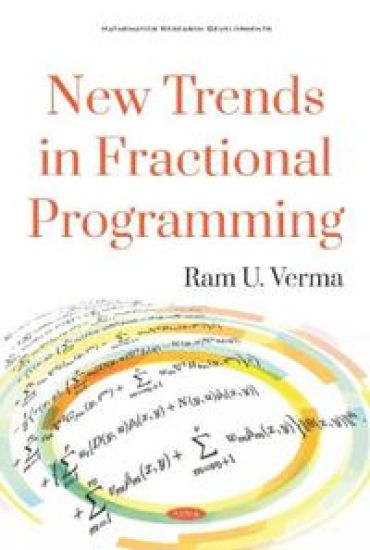
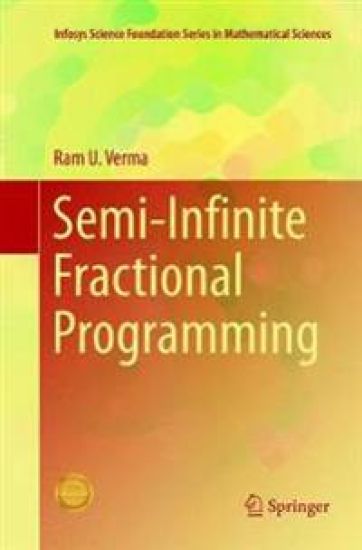
This book presents a smooth and unified transitional framework from generalised fractional programming, with a finite number of variables and a finite number of constraints, to semi-infinite fractional programming, where a number of variables are finite but with infinite constraints. It focuses on empowering graduate students, faculty and other research enthusiasts to pursue more accelerated research advances with significant interdisciplinary applications without borders. In terms of developing general frameworks for theoretical foundations and real-world applications, it discusses a number of new classes of generalised second-order invex functions and second-order univex functions, new sets of second-order necessary optimality conditions, second-order sufficient optimality conditions, and second-order duality models for establishing numerous duality theorems for discrete minmax (or maxmin) semi-infinite fractional programming problems. In the current interdisciplinary supercomputer-oriented research environment, semi-infinite fractional programming is among the most rapidly expanding research areas in terms of its multi-facet applications empowerment for real-world problems, which may stem from many control problems in robotics, outer approximation in geometry, and portfolio problems in economics, that can be transformed into semi-infinite problems as well as handled by transforming them into semi-infinite fractional programming problems. As a matter of fact, in mathematical optimisation programs, a fractional programming (or program) is a generalisation to linear fractional programming. These problems lay the theoretical foundation that enables us to fully investigate the second-order optimality and duality aspects of our principal fractional programming problem as well as its semi-infinite counterpart.
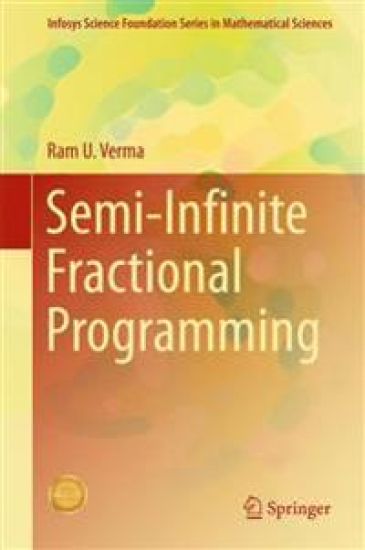
This book presents a smooth and unified transitional framework from generalised fractional programming, with a finite number of variables and a finite number of constraints, to semi-infinite fractional programming, where a number of variables are finite but with infinite constraints. It focuses on empowering graduate students, faculty and other research enthusiasts to pursue more accelerated research advances with significant interdisciplinary applications without borders. In terms of developing general frameworks for theoretical foundations and real-world applications, it discusses a number of new classes of generalised second-order invex functions and second-order univex functions, new sets of second-order necessary optimality conditions, second-order sufficient optimality conditions, and second-order duality models for establishing numerous duality theorems for discrete minmax (or maxmin) semi-infinite fractional programming problems. In the current interdisciplinary supercomputer-oriented research environment, semi-infinite fractional programming is among the most rapidly expanding research areas in terms of its multi-facet applications empowerment for real-world problems, which may stem from many control problems in robotics, outer approximation in geometry, and portfolio problems in economics, that can be transformed into semi-infinite problems as well as handled by transforming them into semi-infinite fractional programming problems. As a matter of fact, in mathematical optimisation programs, a fractional programming (or program) is a generalisation to linear fractional programming. These problems lay the theoretical foundation that enables us to fully investigate the second-order optimality and duality aspects of our principal fractional programming problem as well as its semi-infinite counterpart.
Generalized Fractional Programming
Gaston M. N'Guerekata; Ram U. Verma
Nova Science Pub Inc
2017
sidottu