Kirjojen hintavertailu – 12 903 725 kirjaa ja 27 kauppaa

Kirjailija

Ramesh Thakur

Kirjat ja teokset yhdessä paikassa: 22 kirjaa, julkaisuja vuosilta 2010–2026, suosituimpiin kuuluu Global Governance and the UN. Vertaile teosten hintoja ja tarkista saatavuus suomalaisista kirjakaupoista.

22 kirjaa

Kirjojen julkaisuvuodet: 2010–2026.

Global Governance and the UN

Global Governance and the UN

Thomas G. Weiss; Ramesh Thakur; John Gerard Ruggie

Indiana University Press
2010
pokkari
In the 21st century, the world is faced with threats of global scale that cannot be confronted without collective action. Although global government as such does not exist, formal and informal institutions, practices, and initiatives—together forming "global governance"—bring a greater measure of predictability, stability, and order to trans-border issues than might be expected. Yet, there are significant gaps between many current global problems and available solutions. Thomas G. Weiss and Ramesh Thakur analyze the UN's role in addressing such knowledge, normative, policy, institutional, and compliance lapses. The UN's relationship to these five global governance gaps is explored through case studies of some of the most burning problems of our age, including terrorism, nuclear proliferation, humanitarian crises, development aid, climate change, human rights, and HIV/AIDS.

Reshaping Regional Relations

Reshaping Regional Relations

Ramesh Thakur; Carlyle A. Thayer

Routledge
2021
nidottu
Reshaping Regional Relations summarizes the cause and consequences of changes in Asia-Pacific region. It introduces the lead player in regional change and outlines strategic, military, political and economical issues that constitute the regional agenda in the 1990s.
The Soviet Union As An Asianpacific Power

The Soviet Union As An Asianpacific Power

Ramesh Thakur; Carlyle A. Thayer; G J Gill; Amin Saikal

Routledge
2020
nidottu
This volume provides a useful analysis of the domestic dimension of Soviet foreign policy in Asia/Pacific. It considers the implications of Gorbachev's 1986 Vladivostok Initiative on Northeast Asia, Southeast Asia, South Asia, and the South Pacific.
In Defence Of New Zealand

In Defence Of New Zealand

Ramesh Thakur

Routledge
2020
nidottu
This book provides a timely, thoughtful and wide-ranging study of the issues of nuclear policies, overall strategy, and the value of the Australia, New Zealand and the United States alliance. It also presents alternatives to traditional New Zealand defence policies, neutrality, and nonalignment.
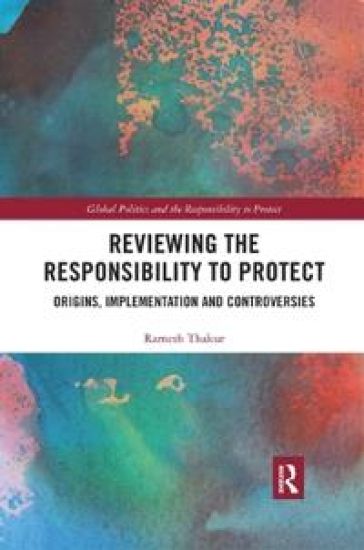
Reviewing the Responsibility to Protect
This volume is a collection of some of the key essays by Ramesh Thakur on the origins, implementation and future prospects of the Responsibility to Protect (R2P) norm. The book offers a comprehensive yet accessible review of the origins, evolution, advances and shortcomings of the R2P principle. A literature review is followed by an overview of the background, meaning and development of R2P. With a focus on the International Commission on Intervention and State Sovereignty (ICISS), Part I analyses the features of, and explains the factors that make for success and failure of commission diplomacy. Part II discusses the controversies surrounding efforts to implement R2P, including the role and importance of emerging powers. Part III describes the remaining protection gaps and explains why R2P will remain relevant because it is essentially demand driven. Finally, the book concludes with a look back at the origins of R2P and looks ahead to possible future directions. This book will be essential for students of the Responsibility to Protect, and of much interest to students of global governance, human rights, international law and international relations.
Reshaping Regional Relations

Reshaping Regional Relations

Ramesh Thakur; Carlyle A. Thayer

Routledge
2019
sidottu
Reshaping Regional Relations summarizes the cause and consequences of changes in Asia-Pacific region. It introduces the lead player in regional change and outlines strategic, military, political and economical issues that constitute the regional agenda in the 1990s.
International Peacekeeping In Lebanon
Examining the efficacy of U. N. peace efforts, Dr. Ramesh Thakur compares limited peacekeeping through U. N. authority with more coercive means such as the Multinational Force (MNF) in Lebanon. He finds that the role of the U. S.-led MNF coalition cannot be justified in terms of great-power responsibility for ensuring a stable international order, since the coalition has attempted to substitute military power for authoritative peacekeeping. When MNF legitimacy was questioned and authority was challenged, the MNF's use of force in response to those challenges switched the coalition's role from third-party peacekeeper to factional participant. As a result, every successive attempt to strengthen the MNF mandate has further subordinated the concept of neutral international peacekeeping to calculated support of national interests. If reasoned attempts to keep the peace are not to collapse into exercises in national self-interest, then peacekeeping responsibilities must remain with the U. N., supported by the great powers: Only the U. N. can provide an authoritative exposition of values within the context of international society and bestow international legitimacy upon peacekeeping activities; only the great powers can back the U. N. with requisite force.
In Defence of New Zealand

In Defence of New Zealand

Ramesh Thakur

Routledge
2019
sidottu
Nuclear-free zones, neutrality, and nonalignment are catchwords that recently have earned unprecedented international publicity for New Zealand's foreign policy. That country's defence policy has also been subjected to its most searching scrutiny since World War II. In this book, Dr. Ramesh Thakur addresses in depth the issues underlying worldwide interest in the area and places his study of New Zealand policy in the global nuclear context. The ANZUS alliance and the 1951 treaty that created it are attended by a range of collaborative activities in defence, intelligence, naval exercises, and C3I facilities. Dr. Thakur weighs the values and opportunity costs of ANZUS for New Zealand's pursuing a nonaligned or neutral policy and analyses the 1985 establishment of a nuclear-free zone for the South Pacific in light of similar precedents elsewhere. Dr. Thakur concludes that rather than indicating a radically new course, a thorough review of New Zealand's defence and foreign policies may well provide renewed justification for existing alliance structures.
The Soviet Union As An Asianpacific Power

The Soviet Union As An Asianpacific Power

Ramesh Thakur; Carlyle A. Thayer; G J Gill; Amin Saikal

Routledge
2019
sidottu
This volume provides a useful analysis of the domestic dimension of Soviet foreign policy in Asia/Pacific. It considers the implications of Gorbachev's 1986 Vladivostok Initiative on Northeast Asia, Southeast Asia, South Asia, and the South Pacific.
Reviewing the Responsibility to Protect
This volume is a collection of some of the key essays by Ramesh Thakur on the origins, implementation and future prospects of the Responsibility to Protect (R2P) norm. The book offers a comprehensive yet accessible review of the origins, evolution, advances and shortcomings of the R2P principle. A literature review is followed by an overview of the background, meaning and development of R2P. With a focus on the International Commission on Intervention and State Sovereignty (ICISS), Part I analyses the features of, and explains the factors that make for success and failure of commission diplomacy. Part II discusses the controversies surrounding efforts to implement R2P, including the role and importance of emerging powers. Part III describes the remaining protection gaps and explains why R2P will remain relevant because it is essentially demand driven. Finally, the book concludes with a look back at the origins of R2P and looks ahead to possible future directions. This book will be essential for students of the Responsibility to Protect, and of much interest to students of global governance, human rights, international law and international relations.
The United Nations, Peace and Security

The United Nations, Peace and Security

Ramesh Thakur

Cambridge University Press
2016
sidottu
Ending humanitarian atrocities has become as important for the United Nations as preventing interstate war. This book examines the transformation of UN operations, analysing its changing role and structure. Ramesh Thakur asks why, when and how force may be used, and argues that the growing gulf between legality and legitimacy is evidence of an eroded sense of international community. He considers the tension between the United States, with its capacity to use force and project power, and the United Nations, as the centre of the international law enforcement system. He asserts the central importance of the rule of law and a rules-based order focused on the United Nations as the foundation of a civilised system of international relations. This book will be of interest to students of the United Nations and international organisations in politics, law and international relations departments, as well as policymakers in governmental and non-governmental international organisations.
The United Nations, Peace and Security

The United Nations, Peace and Security

Ramesh Thakur

Cambridge University Press
2016
pokkari
Ending humanitarian atrocities has become as important for the United Nations as preventing interstate war. This book examines the transformation of UN operations, analysing its changing role and structure. Ramesh Thakur asks why, when and how force may be used, and argues that the growing gulf between legality and legitimacy is evidence of an eroded sense of international community. He considers the tension between the United States, with its capacity to use force and project power, and the United Nations, as the centre of the international law enforcement system. He asserts the central importance of the rule of law and a rules-based order focused on the United Nations as the foundation of a civilised system of international relations. This book will be of interest to students of the United Nations and international organisations in politics, law and international relations departments, as well as policymakers in governmental and non-governmental international organisations.
Responsibility to Protect and Sovereignty
The responsibility to protect ('R2P') principle articulates the obligations of the international community to prevent conflict occurring, to intervene in conflicts, and to assist in rebuilding after conflicts. The doctrine is about protecting civilians in armed conflicts from four mass atrocity crimes: genocide, war crimes, crimes against humanity and ethnic cleansing. This book examines interventions in East Timor, Sri Lanka, Sudan and Kosovo. The chapters explore and question UN debates with respect to the doctrine both before and after its adoption in 2005; contrasting state attitudes to international military intervention; and what takes place after intervention. It also discusses the ability of the Security Council to access reliable information and credible and transparent processes to enable it to make a determination on the occurrence of atrocities in a Member State. Questioning whether there is a need to find a closer operational link between the responsibilities to prevent and react and a normative link between R2P and principles of international law, the contributions examine the effectiveness of the framework of R2P for international decision-making in response to mass atrocity crimes and ask how an international system to deal with threats and mass atrocities can be developed in the absence of a central authority. This book will be valuable to those interested in international law, human rights, and security, peace and conflict studies.
Nuclear Weapons and International Security
This volume brings together more than three decades of research and writings by Professor Ramesh Thakur on the challenges posed by nuclear weapons. Following an introduction to the current nuclear state of play, the book addresses the challenge of nuclear weapons in three parts. Part I describes the scholar-practitioner interface in trying to come to grips with this challenge, the main policy impact on security strategy, and the various future nuclear scenarios. Part II addresses regional nuclear challenges from the South Pacific to East, South and West Asia and thereby highlights serious deficiencies in the normative architecture of the nuclear arms control and disarmament regime. In the third and final part, the chapters discuss regional nuclear-weapon-free zones, NPT anomalies (and their implications for the future of the nuclear arms control regime) and, finally, assess the global governance architecture of nuclear security in light of the three Nuclear Security Summits between 2010 and 2014. The concluding chapter argues for moving towards a world of progressively reduced nuclear weapons in numbers, reduced salience of nuclear weapons in national security doctrines and deployments, and, ultimately, a denuclearized world. This book will be of much interest to students of nuclear proliferation, global governance, international organisations, diplomacy and security studies.
Nuclear Weapons and International Security
This volume brings together more than three decades of research and writings by Professor Ramesh Thakur on the challenges posed by nuclear weapons. Following an introduction to the current nuclear state of play, the book addresses the challenge of nuclear weapons in three parts. Part I describes the scholar-practitioner interface in trying to come to grips with this challenge, the main policy impact on security strategy, and the various future nuclear scenarios. Part II addresses regional nuclear challenges from the South Pacific to East, South and West Asia and thereby highlights serious deficiencies in the normative architecture of the nuclear arms control and disarmament regime. In the third and final part, the chapters discuss regional nuclear-weapon-free zones, NPT anomalies (and their implications for the future of the nuclear arms control regime) and, finally, assess the global governance architecture of nuclear security in light of the three Nuclear Security Summits between 2010 and 2014. The concluding chapter argues for moving towards a world of progressively reduced nuclear weapons in numbers, reduced salience of nuclear weapons in national security doctrines and deployments, and, ultimately, a denuclearized world. This book will be of much interest to students of nuclear proliferation, global governance, international organisations, diplomacy and security studies.
Responsibility to Protect and Sovereignty

Responsibility to Protect and Sovereignty

Ramesh Thakur

Ashgate Publishing Limited
2013
sidottu
The responsibility to protect ('R2P') principle articulates the obligations of the international community to prevent conflict occurring, to intervene in conflicts, and to assist in rebuilding after conflicts. The doctrine is about protecting civilians in armed conflicts from four mass atrocity crimes: genocide, war crimes, crimes against humanity and ethnic cleansing. This book examines interventions in East Timor, Sri Lanka, Sudan and Kosovo. The chapters explore and question UN debates with respect to the doctrine both before and after its adoption in 2005; contrasting state attitudes to international military intervention; and what takes place after intervention. It also discusses the ability of the Security Council to access reliable information and credible and transparent processes to enable it to make a determination on the occurrence of atrocities in a Member State. Questioning whether there is a need to find a closer operational link between the responsibilities to prevent and react and a normative link between R2P and principles of international law, the contributions examine the effectiveness of the framework of R2P for international decision-making in response to mass atrocity crimes and ask how an international system to deal with threats and mass atrocities can be developed in the absence of a central authority. This book will be valuable to those interested in international law, human rights, and security, peace and conflict studies.
The people vs. the state

The people vs. the state

Ramesh Thakur

United Nations
2011
nidottu
Responsibility to Protect (R2P) aims to convert international conscience into timely and decisive collective action to rescue vulnerable communities. The choice is not whether international interventions will take place but where, when, how and under whose authority. Given the nature and victims of modern armed conflict, protection of civilians and populations at risk of mass atrocities is a core United Nations imperative. But while the UN has international authority, it lacks military power. Although its military might well have unmatched global reach, the United States acting unilaterally lacks international authority. This publication argues that progress towards good international society requires that force be harnessed to authority as the R2P moves from a universally validated principle to a routinely actionable norm.