Kirjojen hintavertailu – 12 903 729 kirjaa ja 27 kauppaa

Kirjailija

Randolph B. Campbell

Kirjat ja teokset yhdessä paikassa: 6 kirjaa, julkaisuja vuosilta 1991–2022, suosituimpiin kuuluu Texas and Texans in World War II. Vertaile teosten hintoja ja tarkista saatavuus suomalaisista kirjakaupoista.

6 kirjaa

Kirjojen julkaisuvuodet: 1991–2022.

Texas and Texans in World War II

Texas and Texans in World War II

Randolph B. Campbell; Joseph G. Dawson; Bernadette Pruitt; Michael Hurd; Katherine Sharp Landdeck; Arnoldo De León; Zachary Montz; Houston Faust Mount II; Stephen M. Sloan; Henry C. Dethloff; Kelly E. Crager; Keith J. Volanto

Texas A M University Press
2022
sidottu
Texans in World War II offers an informative look at the challenges and changes faced by Texans on the home front during the Second World War. This collection of essays by leading scholars of Texas history covers topics from the African American and Tejano experience to organized labor, from the expanding opportunities for women to the importance of oil and agriculture. Texans in World War II makes local the frequently studied social history of wartime, bringing it home to Texas. An eye-opening read for Texans eager to learn more about this defining era in their state's history, this book will also prove deeply informative for scholars, students, and general readers seeking detailed, definitive information about World War II and its implications for daily life, economic growth, and social and political change in the Lone Star State.

Gone to Texas

Gone to Texas

Randolph B. Campbell

Oxford University Press Inc
2017
nidottu
Gone to Texas engagingly tells the story of the Lone Star State, from the arrival of humans in the Panhandle more than 12,000 years ago to the second decade of the twenty-first century. Focusing on the state's successive waves of immigrants, the book offers an inclusive view of the vast array of Texans, who often in conflict with each other and always in struggle with the land, created a history and idea of Texas.
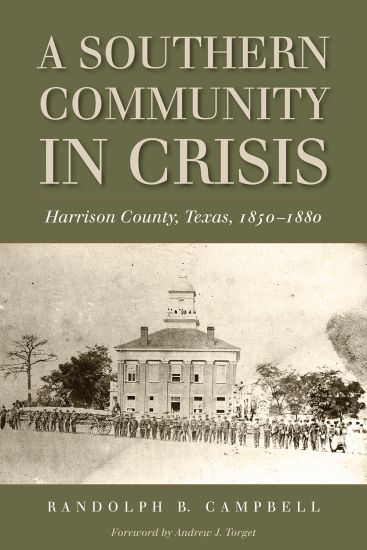
A Southern Community in Crisis

A Southern Community in Crisis

Randolph B. Campbell

Texas State Historical Association,U.S.
2016
nidottu
Historians have published countless studies of the American Civil War from 1861 to 1865 and the era of Reconstruction that followed those four years of brutally destructive conflict. Most of these works focus on events and developments at the national or state level, explaining and analyzing the causes of disunion, the course of the war, and the bitt er disputes that arose during restoration of the Union. Much less attention has been given to studying how ordinary people experienced the years from 1861 to 1876. What did secession, civil war, emancipation, victory for the United States, and Reconstruction mean at the local level in Texas? Exactly how much change—economic, social, and political—did the era bring to the focus of the study, Harrison County: a cotton-growing, planter-dominated community with the largest slave population of any county in the state? Providing an answer to that question is the basic purpose of A Southern Community in Crisis: Harrison County, Texas, 1850–1880 . First published by the Texas State Historical Association in 1983, the book is now available in paperback, with a foreword by Andrew J. Torget, one of the Lone Star State’s top young historians.
Wealth and Power in Antebellum Texas

Wealth and Power in Antebellum Texas

Randolph B. Campbell; Richard G. Lowe

Texas A M University Press
2000
nidottu
Americans have long lived with an optimistic view of their society, what might be termed the "egalitarian idea." The antebellum South, with its peculiar institution of Negro slavery, has stood in general as the most likely exception to this ideal, though the "planter vs. plain folk" debate has engaged generations of scholars. How closely did the South approximate the "egalitarian ideal"? And how did the South compare with the rest of the nation in terms of economic and political arrangements? Wealth and Power in Antebellum Texas investigates these questions for a relatively young and rapidly developing part of the slave South. Relying on quantitative evidence gathered from census records as well as on traditional historical materials, the authors examine all measures of the "egalitarian ideal" in the Lone Star state. Their close analysis of wealthholding, the interplay of economic and political relationships, and the direction and degree of change from 1850 to 1860 reveals a high and stable level of inequality in the distribution of wealth, a high concentration of wealthholding in Texas towns, and clear indication that those who held the greatest share of wealth also held the balance of political power. Where possible, comparisons have been made with other areas of the United States. Surprisingly, wealth in Texas before the Civil War was no more unequally distributed than it was elsewhere in the country, both North and South, during the same period. The "egalitarian ideal" may have been largely mythical in antebellum Texas, but it seems to have been equally mythical in the nation as a whole.
Grass Roots Reconstruction in Texas, 1865-1880

Grass Roots Reconstruction in Texas, 1865-1880

Randolph B. Campbell

Louisiana State University Press
1998
sidottu
Although many historians have studied Reconstruction, few have sought to determine how the turbulent era of reunification and readjustment after the Civil War was played out on a local level. In this groundbreaking work, award-winning historian Randolph B. Campbell examines six Texas counties during that period, revealing a diversity of experience that challenges popular generalizations. The counties Campbell explores, Dallas, Colorado, Harrison, Jefferson, McLennan, and Nueces, represent the various regions of Texas and thus its considerable geographic, economic, and demographic diversity. He ponders how the major post-Civil War policies, shaped in Washington and Austin, were interpreted in these outlying areas and thoughtfully measures the degree of change they brought to the lives of all residents, conservative whites, Republicans, and freedmen. Reconstruction at the grass roots in Texas, Campbell asserts, varied greatly from county to county, depending on such factors as demography, economic growth, and the extent of federal intervention. In the case of Texas, and possibly other states as well, Campbell concludes, assumptions about Reconstruction need to be qualified to recognise the distinct ways in which various localities experienced the period. Campbell also dispels common conceptions about Reconstruction, maintaining that whites were hurt far less than is often claimed and that at least one generation of African Americans bene-fitted a good deal more than is often recognised. Campbell's compelling work is the first systematic examination of Reconstruction at the county level. It provides convincing evidence for useful, general conclusions about how local conditions determined the way in which most citizens dealt with Reconstruction and its pivotal issues that forever shaped their state's politics and society.
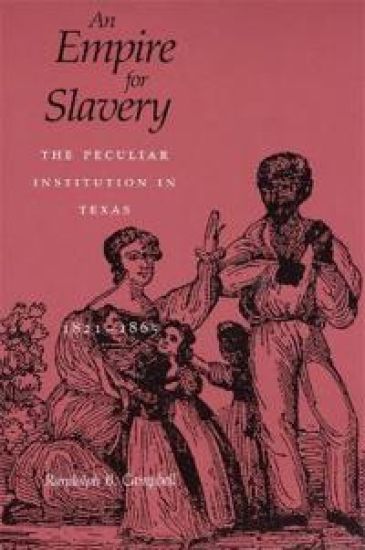
An Empire for Slavery

An Empire for Slavery

Randolph B. Campbell

Louisiana State University Press
1991
nidottu
Winner of the Coral Horton Tullis, Summerfield G. Roberts, and Friends of the Dallas Public Library AwardsBecause Texas emerged from the western frontier relatively late in the formation of the antebellum nation, it is frequently and incorrectly perceived as fundamentally western in its political and social orientation. In fact, most of the settlers of this area were emigrants from the South, and many of these people brought with them their slaves and all aspects of slavery as it had matured in their native states. In An Empire for Slavery, Randolph B. Campbell examines slavery in the antebellum South's newest state and reveals how significant slavery was to the history of Texas. The ""peculiar institution"" was perhaps the most important factor in determining the economic development and ideological orientation of the state in the years leading to the Civil War.