Kirjojen hintavertailu – 12 903 724 kirjaa ja 27 kauppaa
Kirjailija
Ravi Pratap Singh
Kirjat ja teokset yhdessä paikassa: 20 kirjaa, julkaisuja vuosilta 2020–2022, suosituimpiin kuuluu Estudio económico del cultivo del garbanzo en el distrito de Auraiya de U.P.. Vertaile teosten hintoja ja tarkista saatavuus suomalaisista kirjakaupoista.
O estudo foi iniciado em junho de 2017 para avaliar o "Efeito da qu mica e do ensacamento na qualidade da goiaba da esta o chuvosa (Psidium guajava Linn.) CV. Lucknow-49" na Principal Esta o Experimental e Laborat rio de Tecnologia P s-colheita de Horticultura, Universidade de Agricultura e Tecnologia de Narendra Deva, Faizabad (U. P.). Os frutos da esta o chuvosa ou da cultura da goiaba bahar Ambe s o muito pobres em qualidade, tendo um prazo de validade reduzido e o n mero de frutos est infestado de pragas e doen as, particularmente moscas da fruta e antracnose, respectivamente. Estes problemas ocorrem devido preval ncia de condi es quentes e h midas na esta o das chuvas. Para superar estes problemas, a presente investiga o foi formulada com nove tratamentos pr -colheita, a saber T1 (CaCl2 @ 2%), T2 ( cido salic lico @ 3%), T3 (polietileno + CaCl2 @ 2%), T4 (polietileno + cido salic lico @ 3%), T5 (polietileno azul + CaCl2 @ 2%), T6 (polietileno azul + cido salic lico @ 3%), T7 (polietileno violeta + CaCl2 @ 2%), T8 (polietileno violeta + cido salic lico @ 3%) e T9 (Controle). Os frutos tratados foram colhidos na fase de matura o e armazenados em condi es ambientais.
Die Studie wurde im Juni 2017 begonnen, um die "Auswirkung von Chemikalien und Verpackung auf die Qualit t von Guaven der Regenzeit (Psidium guajava Linn.) CV. Lucknow-49" an der Hauptversuchsstation und dem Labor f r Nacherntetechnologie des Gartenbaus, Narendra Deva University of Agriculture and Technology, Faizabad (U. P.). Die Fr chte der Regenzeit- oder Ambe bahar-Guave sind von sehr schlechter Qualit t, haben eine schlechte Lagerf higkeit und viele Fr chte sind von Sch dlingen und Krankheiten befallen, insbesondere von Fruchtfliegen und Anthraknose. Diese Probleme entstehen durch die warmen und feuchten Bedingungen in der Regenzeit. Um diese Probleme zu berwinden, wurden in der vorliegenden Untersuchung neun Vorerntebehandlungen durchgef hrt, n mlich T1 (CaCl2 @ 2 %), T2 (Salicyls ure @ 3 %), T3 (Poly thylen + CaCl2 @ 2 %), T4 (Poly thylen + Salicyls ure @ 3 %), T5 (blaues Poly thylen + CaCl2 @ 2 %), T6 (blaues Poly thylen + Salicyls ure @ 3 %), T7 (violettes Poly thylen + CaCl2 @ 2 %), T8 (violettes Poly thylen + Salicyls ure @ 3 %) und T9 (Kontrolle). Die behandelten Fr chte wurden im Reifestadium geerntet und bei Raumtemperatur gelagert.
L' tude a t commenc e partir de juin 2017 pour valuer " l'effet du produit chimique et de l'ensachage sur la qualit de la goyave de saison des pluies (Psidium guajava Linn.) CV. Lucknow-49" la station d'exp rimentation principale et au laboratoire de technologie post-r colte de l'horticulture, Universit d'agriculture et de technologie Narendra Deva, Faizabad (U. P.). Les fruits de la culture de goyave de saison des pluies ou Ambe bahar sont de tr s mauvaise qualit , ont une faible dur e de conservation et un grand nombre de fruits sont infest s d'insectes nuisibles et de maladies, en particulier les mouches des fruits et l'anthracnose respectivement. Ces probl mes sont dus la pr valence de conditions chaudes et humides pendant la saison des pluies. Pour surmonter ces probl mes, la pr sente tude a t formul e avec neuf traitements de pr -r colte, savoir T1 (CaCl2 @ 2%), T2 (acide salicylique @ 3%), T3 (polyth ne + CaCl2 @ 2%), T4 (polyth ne + acide salicylique @ 3%), T5 (polyth ne bleu + CaCl2 @ 2%), T6 (polyth ne bleu + acide salicylique @ 3%), T7 (polyth ne violet + CaCl2 @ 2%), T8 (polyth ne violet + acide salicylique @ 3%) et T9 (contr le). Les fruits trait s ont t r colt s au stade de maturit et stock s temp rature ambiante.
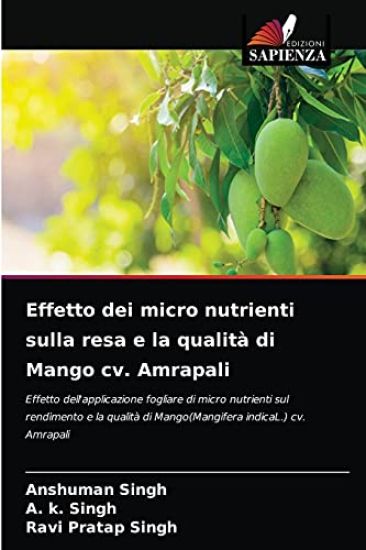
Il mango (MangiferaindicaL.) cv. Amrapali" considerato il re della frutta. Il mango possiede qualit nutrizionali e medicinali uniche, oltre ad essere una ricca fonte di carboidrati e di vitamine A e C. I microelementi giocano un ruolo importante nel migliorare la crescita e lo sviluppo dell'allegagione, il controllo della caduta dei frutti, la maturazione dei frutti e la qualit dei frutti. Il boro svolge un ruolo importante per il corretto sviluppo dell'ovulo, la crescita del tubo pollinico e aumenta il numero di frutti. Aiuta l'assorbimento del calcio e incoraggia l'utilizzo efficiente del calcio nelle piante. Aiuta anche nella sintesi delle proteine. Lo zinco gioca un ruolo importante nella crescita e nello sviluppo dei frutti. Il ferro gioca un ruolo importante associato allo sviluppo flavoproteico. L'intensit della caduta della frutta pu essere minimizzata e la crescita e lo sviluppo della frutta possono essere migliorati dall'alimentazione fogliare di micro nutrienti.
The study was started from June 2017 to assess the "Effect of chemical and bagging on quality of rainy season guava (Psidium guajava Linn.) CV. Lucknow-49" at the Main Experiment Station and Post Harvest Technology Laboratory of Horticulture, Narendra Deva University of Agriculture and Technology, Faizabad (U. P.). The fruits of rainy season or Ambe bahar guava crop are very poor in quality, having poor shelf life and numbers of fruits are infested with insect pests and diseases particularly fruit flies and anthracnose respectively. These problems occur due to prevalence of warm and humid condition in rainy season. To overcome these problems, the present investigation was formulated with nine pre-harvest treatments viz. T1 (CaCl2 @ 2%), T2 (salicylic acid @ 3% ), T3 (polythene + CaCl2 @ 2%), T4 (polythene + salicylic acid @ 3% ), T5 (blue polythene + CaCl2 @ 2% ), T6 (blue polythene + salicylic acid @ 3%), T7 (violet polythene + CaCl2 @ 2%), T8 (violet polythene + salicylic acid @ 3%) and T9 (Control). The treated fruits were harvested at ripe stage and stored at ambient condition.
Chickpea one of the important crops in U. P., as well as, in India. World-wide India ranks 1stin production of gram. In India, the total food production in 2013-14 was about 257.4 million tones out of these only 19.3 million tones was contributed by pulses. The production of cereals increase by 460 per cent since 1950-51 to give the year but the production of pulses in the country has increased only 178 per cent. The prices have increased considerably and the consumer is hard hit to buy his pulse requirements. Thus the availability of pulse per capita per day has proportionately decline from 71g (1955) to 36.9g (1998) against the minimum requirement of 70g per capita per day. District Auraiya was purposively selected and the block Auraiya having highest acreage under gram was selected purposively for the study. List of the villages from selected block were prepared along with acreage under Chickpea cultivation and 5 villages were selected randomly for study. In all 100 number of farmers were selected proportionally from each category of farmers and classified into three categories i.e. marginal (below 1 ha), small (1-2 ha), medium (2-4 ha & above).
Mango (MangiferaindicaL.) cv. Amrapali" is a considered to be the king of fruit. Mango possess unique nutritional and medicinal qualities apart from being a rich sources of carbohydrate as well as vitamins A and C. The micro nutrients plays as important role in improving the fruit set growth and development, control of fruit drops, fruit maturation and fruit quality. Boron plays an important role for proper development of ovule, pollen tube growth and increases well number of fruit set . It helps in the uptake of calcium and encourages efficient utilization of calcium in plants. It also helps in protein synthesis. Zinc plays an important role in growth and development of fruits. Iron plays an important role associated with the development flavoprotein. The intensity of fruit drop can be minimized and growth and development of fruit can be enhanced by foliar feeding of micro nutrients.
Bael fruit (Aegle marmelos Correa) is a tropical fruit native to south-east Asia and belongs to family Rutaceae . It is an important indigenous fruit of India. It is also known as 'Bengal Quince'. Aegle, the genous of bael is monotypic. The trifoliate leaves symbolize the trident the Shiva holds in his right hand. The fruit were used in place of Coconuts before large-scale rail transportation become available. The fruit is said to resemble a skull with a white, bone-like outer shell and a soft inner part. The importance of bael lies in its curative properties, which make one of the important medicinal plants of India. All the parts of the tree (stem, bark, leaves, roots, and fruits) at some stages of maturity and ripening, has some important use in many Ayurveda and Unani patented drugs in India for treatment of a variety of diseases. For medicinal use, the young fruits, while still tender, are commonly sliced horizontally and sun-dried and sold in local markets.