Kirjojen hintavertailu – 12 903 725 kirjaa ja 27 kauppaa

Kirjailija

Raymond Boudon

Kirjat ja teokset yhdessä paikassa: 16 kirjaa, julkaisuja vuosilta 1981–2022, suosituimpiin kuuluu The Crisis in Sociology. Vertaile teosten hintoja ja tarkista saatavuus suomalaisista kirjakaupoista.

16 kirjaa

Kirjojen julkaisuvuodet: 1981–2022.

The Origin of Values

The Origin of Values

Raymond Boudon

Routledge
2017
sidottu
Values have always been a central topic in both philosophy and the social sciences. Statements about what is good or bad, fair or unfair, legitimate or illegitimate, express clear beliefs about human existence. The fact that values differ from culture to culture and century to century opens many questions. In The Origin of Values, Raymond Boudon offers empirical, data-based analysis of existing theories about values, while developing his own perspective as to why people accept or reject value statements. Boudon classifies the main theories of value, including those based on firm belief, social or biological factors, and rational or utilitarian attitudes. He discusses the popular and widely influential Rational Choice Model and critiques the postmodernist approach. Boudon investigates why relativism has become so powerful and contrasts it with the naturalism represented by the work of James Q. Wilson on moral sensibility. He follows with a constructive attempt to develop a new theory, beginning with Weber's idea of non-instrumental rationality as the basis for a more complex idea of rationality. Applying Boudon's own and existing theories of value to political issues and social ideas the end of apartheid, the death penalty, multiculturalism, communitarianismThe Origin of Values is a significant work. Boudon fulfills a major task of social science: explanation of collective belief. His book will be of interest to sociologists, philosophers, psychologists, and political scientists.

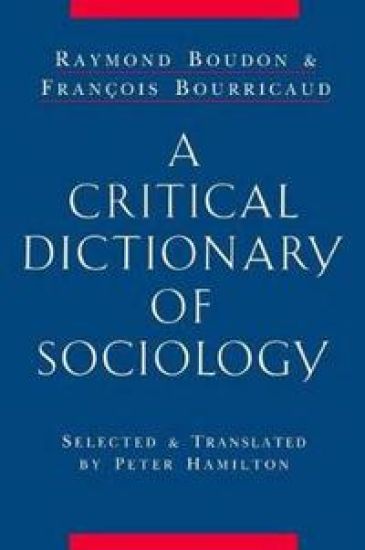
A Critical Dictionary of Sociology

A Critical Dictionary of Sociology

Raymond Boudon; Francois Bourricaud

Routledge
2015
nidottu
Unlike most other sociology or social science dictionaries, in this translation of the Critical Dictionary of Sociology, taken from the second French edition of the Dictionary and edited by the English sociologist Peter Hamilton, the critical value of this distinctive work is at last made available for a wider audience. Each entry grapples directly with an issue, whether theoretical, epistemological, philosophical, political or empirical, and provides a strong statement of what the authors think about it. The discussions are considered but argumentative. By reaffirming that a non-marxist style of critique is still possible, Boudon and Bourricaud have presented a distinctive approach to the key issues which confront the societies of the Twentieth and Twenty-First centuries. For some this work will be a textbook, for others an indispensable sourcebook of sociological concepts, and for most a way of opening our eyes to new dimensions in our understanding of the great ideas and theories of sociology.
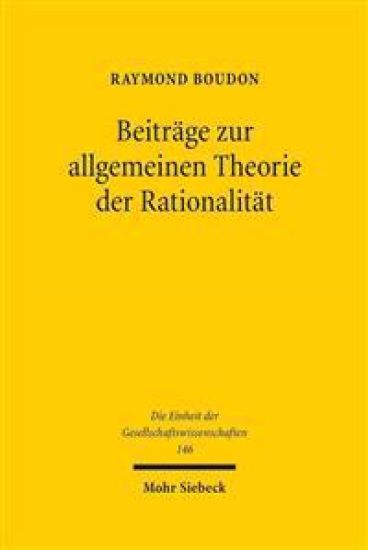
Beiträge zur allgemeinen Theorie der Rationalität
Raymond Boudon geht der vielleicht grundsätzlichsten Frage der Sozialwissenschaften nach: Wie können soziale Phänomene, verstanden als Produkte menschlichen Handelns, zufriedenstellend erklärt werden? Und wie können insbesondere Phänomene, die man spontan als "irrational" qualifiziert - wie Regentänze oder religiöse Glaubensüberzeugungen - rational begründet werden? Ausgangspunkt ist die Einsicht, dass sich die Sozialtheorie in einer tiefen Krise befindet und die klassische Rational Choice-Theorie und deren Begriff der instrumentellen Rationalität nicht das halten konnten, was sie ursprünglich versprochen hatten. Der Autor entwickelt eine "allgemeine Theorie der Rationalität", die den Rationalitätsbegriff um eine kognitive und eine axiologische Dimension erweitert. Soziale Phänomene erklären sich demnach immer durch subjektiv gewichtige und objektiv nachvollziehbare Gründe für Individuen, an bestimmte Überzeugungen zu glauben oder bestimmte Dinge zu tun. Überzeugungen und Handlungen, die spontan irrational erscheinen, stellen sich so als rational heraus. Boudon präsentiert Anwendungsbeispiele dieser Rationalitätstheorie, von denen sich viele bereits bei soziologischen Klassikern wie Tocqueville, Weber oder Durkheim finden. Er wählt diese Klassiker bewusst und zeigt, dass die bedeutendsten Erkenntnisse der Sozialwissenschaften dem Umstand zu verdanken sind, das hier vorgeschlagene Analyseparadigma implizit zugrunde gelegt zu haben.
The Origin of Values

The Origin of Values

Raymond Boudon

AldineTransaction
2013
nidottu
Values have always been a central topic in both philosophy and the social sciences. Statements about what is good or bad, fair or unfair, legitimate or illegitimate, express clear beliefs about human existence. The fact that values differ from culture to culture and century to century opens many questions. In The Origin of Values, Raymond Boudon offers empirical, data-based analysis of existing theories about values, while developing his own perspective as to why people accept or reject value statements. Boudon classifies the main theories of value, including those based on firm belief, social or biological factors, and rational or utilitarian attitudes. He discusses the popular and widely influential Rational Choice Model and critiques the postmodernist approach. Boudon investigates why relativism has become so powerful and contrasts it with the naturalism represented by the work of James Q. Wilson on moral sensibility. He follows with a constructive attempt to develop a new theory, beginning with Weber's idea of non-instrumental rationality as the basis for a more complex idea of rationality. Applying Boudon's own and existing theories of value to political issues and social ideas—the end of apartheid, the death penalty, multiculturalism, communitarianism—The Origin of Values is a significant work. Boudon fulfills a major task of social science: explanation of collective belief. His book will be of interest to sociologists, philosophers, psychologists, and political scientists.

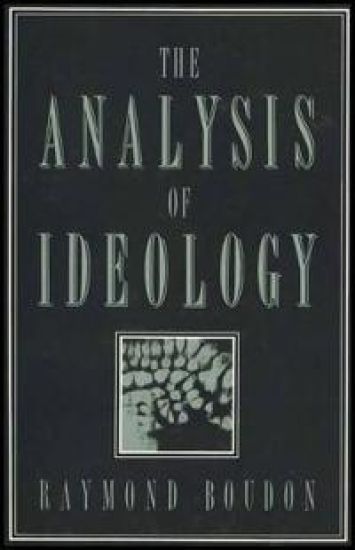
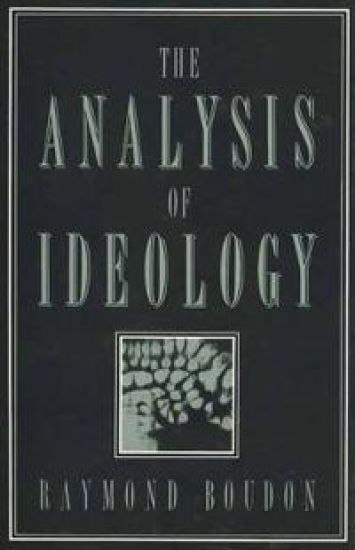
The Analysis of Ideology

The Analysis of Ideology

Raymond Boudon

Polity Press
2013
nidottu
This work, by one of Europe's foremost social theorists, presents a critical history of the concept of ideology. The author's discussion ranges from the early conceptions of ideology to its current usage in the works of Barthes, Foucault, Habermas and others. Boudon develops a distinctive and original approach to the analysis of ideology. Drawing on a series of case studies, he seeks to explain how and why social actors adhere so readily to false or dubious ideas. In opposition to those views which associate ideology with irrationalism, Boudon develops a rationalist theory which helps to explain why certain ideas are believed by individuals and are thereby effective in the social world. Rigorously argued and clearly written, this work is a major restatement of Boudon's theoretical views and a timely intervention in current debates. It will be of particular interest to students of sociology, politics and philosophy.
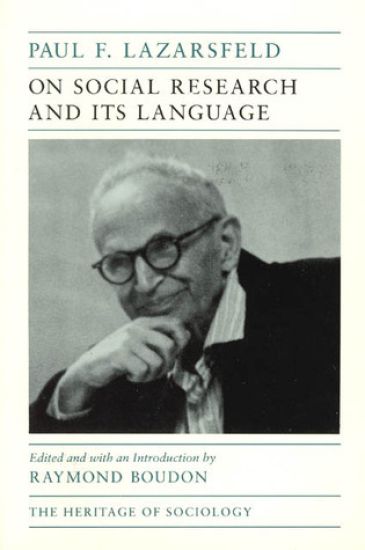
On Social Research and Its Language

On Social Research and Its Language

Paul F. Lazarsfeld; Raymond Boudon

University of Chicago Press
1993
nidottu
Without Paul F. Lazarsfeld the social sciences would not be what they are today. In his work on unemployment, voting, consumer behaviour, and social influence, among other subjects, his methodological emphasis on vigorously controlled scientific language and structures transformed social research worldwide. His criticism of observational, conceptual, and inferential procedures in sociology led to the formation of universally applied observational and analytical techniques. The 18 essays in "On Social Research and Its Language" illustrate the diversity of Lazarsfeld's substantive, methodological, and organizational interests. Spanning the years 1933 to 1972, they encompass his own works of social research, as well as writings on methodology and the history and sociology of social research. In addition, Raymond Boudon provides a revealing biography of Lazarsfeld and his influence on sociology.
Theories of Social Change

Theories of Social Change

Raymond Boudon

Polity Press
1991
nidottu
Now available in paperback, Theories of Social Change presents a classic statement of Boudon's stance in social theory and empirical sociology. Boudon criticizes the theories of social change that dominated sociology between the early 1950s and the late 1970s, and elaborates his own distinctive account. Suitable for academics, students and researchers in sociology, politics, economics and anthropology.
A Critical Dictionary of Sociology

A Critical Dictionary of Sociology

Raymond Boudon; Francois Bourricaud

Routledge
1989
sidottu
Unlike most other sociology or social science dictionaries, in this translation of the Critical Dictionary of Sociology, taken from the second French edition of the Dictionary and edited by the English sociologist Peter Hamilton, the critical value of this distinctive work is at last made available for a wider audience. Each entry grapples directly with an issue, whether theoretical, epistemological, philosophical, political or empirical, and provides a strong statement of what the authors think about it. The discussions are considered but argumentative. By reaffirming that a non-marxist style of critique is still possible, Boudon and Bourricaud have presented a distinctive approach to the key issues which confront the societies of the Twentieth and Twenty-First centuries. For some this work will be a textbook, for others an indispensable sourcebook of sociological concepts, and for most a way of opening our eyes to new dimensions in our understanding of the great ideas and theories of sociology.
The Analysis of Ideology

The Analysis of Ideology

Raymond Boudon

Polity Press
1989
sidottu
This work, by one of Europe's foremost social theorists, presents a critical history of the concept of ideology. The author's discussion ranges from the early conceptions of ideology to its current usage in the works of Barthes, Foucault, Habermas and others. Boudon develops a distinctive and original approach to the analysis of ideology. Drawing on a series of case studies, he seeks to explain how and why social actors adhere so readily to false or dubious ideas. In opposition to those views which associate ideology with irrationalism, Boudon develops a rationalist theory which helps to explain why certain ideas are believed by individuals and are thereby effective in the social world. Rigorously argued and clearly written, this work is a major restatement of Boudon's theoretical views and a timely intervention in current debates. It will be of particular interest to students of sociology, politics and philosophy.