Kirjojen hintavertailu – 12 859 819 kirjaa ja 27 kauppaa

Kirjailija

Raymond Taras

Kirjat ja teokset yhdessä paikassa: 18 kirjaa, julkaisuja vuosilta 1984–2025, suosituimpiin kuuluu Thucydides' Meditations on Fear. Vertaile teosten hintoja ja tarkista saatavuus suomalaisista kirjakaupoista.

18 kirjaa

Kirjojen julkaisuvuodet: 1984–2025.

Political Fear in a World in Crisis

Political Fear in a World in Crisis

Raymond Taras

BLOOMSBURY PUBLISHING PLC
2025
nidottu
Fear is a pervasive term used to describe insecurity, threat, and angst. It is applied in many different ways and to particular country contexts but its specificity is lost when used in a malleable way. Thucydides, the author of The History of the Peloponnesian War who published his study around 400 BC knew this malleability problem. The first real historian offering a dispassionate account of fear and war in which the gods played no part, the Athenian introduced several key concepts, rarely used today, originating in the understanding of fear. Revisiting these ideas can be important in deconstructing political fears in our times. This book applies Thucydides’ principal concepts to the author’s research in six states usually described as Western: Britain, Russia, Germany, Australia, Japan, and the US. The result is a unique and subtle comparative study of political fear. The sources of fear differ, predictably, from state to state. Political fear’s main competitor today is liberalism, a dominant philosophy that may become a victim of its own success. Today, liberalism insists on the greatest possible freedom from external constraints apart from maintaining order among unfettered individuals. Findings from this comparative study can help explain how the juncture and friction of xenophobia and liberalism has critical implications for our future.

Political Fear in a World in Crisis

Political Fear in a World in Crisis

Raymond Taras

BLOOMSBURY PUBLISHING PLC
2025
sidottu
Fear is a pervasive term used to describe insecurity, threat, and angst. It is applied in many different ways and to particular country contexts but its specificity is lost when used in a malleable way. Thucydides, the author of The History of the Peloponnesian War who published his study around 400 BC knew this malleability problem. The first real historian offering a dispassionate account of fear and war in which the gods played no part, the Athenian introduced several key concepts, rarely used today, originating in the understanding of fear. Revisiting these ideas can be important in deconstructing political fears in our times. This book applies Thucydides’ principal concepts to the author’s research in six states usually described as Western: Britain, Russia, Germany, Australia, Japan, and the US. The result is a unique and subtle comparative study of political fear. The sources of fear differ, predictably, from state to state. Political fear’s main competitor today is liberalism, a dominant philosophy that may become a victim of its own success. Today, liberalism insists on the greatest possible freedom from external constraints apart from maintaining order among unfettered individuals. Findings from this comparative study can help explain how the juncture and friction of xenophobia and liberalism has critical implications for our future.

Thucydides' Meditations on Fear

Thucydides' Meditations on Fear

Raymond Taras

ANTHEM PRESS
2023
nidottu
Understanding contemporary global politics by connecting them to the meditations of a classical Greek philosopher may seem farfetched and counterintuitive. But for political theorists, policymakers, the new influencers, journalists and engaged students, Thucydides’ ancient wisdom provides insights into diagnosing and even undermining an endemic of political fear spreading across the world’s borders. With his help, this book probes six case studies of aspiring great powers and the brittle identities that they may have unwittingly constructed. Raymond Taras questions the motives of the manipulators of fear whether found in in authoritarian states or increasingly in backsliding liberal democratic ones. The urgency of returning to and respecting tolerance in states establishing relations with arriving refugees and migrants takes on critical importance.
Thucydides' Meditations on Fear

Thucydides' Meditations on Fear

Raymond Taras

ANTHEM PRESS
2023
sidottu
Understanding contemporary global politics by connecting them to the meditations of a classical Greek philosopher may seem farfetched and counterintuitive. But for political theorists, policymakers, the new influencers, journalists and engaged students, Thucydides’ ancient wisdom provides insights into diagnosing and even undermining an endemic of political fear spreading across the world’s borders. With his help, this book probes six case studies of aspiring great powers and the brittle identities that they may have unwittingly constructed. Raymond Taras questions the motives of the manipulators of fear whether found in in authoritarian states or increasingly in backsliding liberal democratic ones. The urgency of returning to and respecting tolerance in states establishing relations with arriving refugees and migrants takes on critical importance.
Consolidating Democracy In Poland

Consolidating Democracy In Poland

Raymond Taras

Routledge
2020
nidottu
This book describes the features of Poland's democratic system: political institutions, parties, elections, and leaders that have shaped the transition from communism. It examines the Walesa phenomenon and the uneasy relationship between the presidency, parliament, and the prime minister.
Democracy In Poland

Democracy In Poland

Raymond Taras; Marjorie Castle

Routledge
2019
sidottu
Ever-changing election rules, a highly fluid party system, a constitution considered illegitimate by more than one major political actor, polarized political elites, and a system of corruption that has grown up together with the young democracy itself -these characterize contemporary Polish politics. At the same time Poland is frequently identified as the most successful example of a transition from communism to capitalism, having led this series of world-changing transitions. It has distanced itself from a turbulent history as pawn in Eastern Europe's international politics to become a leading candidate for membership in the exclusive European Union club. As Polish democratic politics evolves it is taking unexpected forms and producing equally unexpected results. Through a comprehensive analysis of politics in this young European democracy, Marjorie Castle and Ray Taras explain the complexity and uncertainty of political processes and outcomes in Poland. Poland'spast -the flawed Second Republic established after World War I, as well as the imperfect independence in the Soviet shadow following World War II's devastation - dramatizes the unique historic opportunity it was given in 1989 to determine its own political future and perhaps eventually become a major European power. Choices made in 1989 and thereafter would not only construct a new democracy but shape and limit its possibilities. The primary focus here is on contemporary politics: what the fundamental political cleavages are, whether parties adequately represent popular interests, who the political elites are and what games they play, whatinfluence the Catholic Church still holds in an aspiring Western-style secular republic, and what policy challenges face Poland in the future. Inimitable political leaders, changing political arenas, and complexpolicy-making processes come to life through a fascinating narrative characterized by an insider's insight.
Consolidating Democracy In Poland

Consolidating Democracy In Poland

Raymond Taras

Routledge
2019
sidottu
A comprehensive analysis of politics in a young European democracy, this book describes the principal features of Poland’s democratic system—the political institutions, parties, elections, and leaders that have shaped the transition from communism. Raymond Taras examines the complex WaÅ‚psa phenomenon; the comeback of the communists; and the uneasy
Nationhood, Migration and Global Politics

Nationhood, Migration and Global Politics

Raymond Taras

Edinburgh University Press
2018
nidottu
Raymond Taras puts forward a new definition of nationhood that sets it apart from national identity, nationalism and diversity. Based on rich case studies of immigration worldwide, Taras shows that nationhood occurs when the receiving state negotiates ethnic differences to form a natural bond with immigrants, rather than insisting on blind loyalty to the majority culture. Drawing on extensive research in transnationalism and ethnic conflict around the world, Taras re-evaluates the concepts of nation and nationalism in light of the major demographic changes brought about by global migration. The result is a framework for understanding the emergence of postmodern nationhood in the era of globalisation and beyond. The goal is a broad, value-added society of diverse peoples and successful prevention of criminality, ghettoization, extremism and even radicalisation through reasonable immigrant integration.
Nationhood, Migration and Global Politics

Nationhood, Migration and Global Politics

Raymond Taras

Edinburgh University Press
2018
sidottu
Raymond Taras puts forward a new definition of nationhood that sets it apart from national identity, nationalism and diversity. Based on rich case studies of immigration worldwide, Taras shows that nationhood occurs when the receiving state negotiates ethnic differences to form a natural bond with immigrants, rather than insisting on blind loyalty to the majority culture. Drawing on extensive research in transnationalism and ethnic conflict around the world, Taras re-evaluates the concepts of nation and nationalism in light of the major demographic changes brought about by global migration. The result is a framework for understanding the emergence of postmodern nationhood in the era of globalisation and beyond. The goal is a broad, value-added society of diverse peoples and successful prevention of criminality, ghettoization, extremism and even radicalisation through reasonable immigrant integration.
Understanding Ethnic Conflict

Understanding Ethnic Conflict

Raymond Taras; Rajat Ganguly

Routledge
2017
sidottu
Understanding Ethnic Conflict provides all the key concepts needed to understand conflict among ethnic groups. Including approaches from both comparative politics and international relations, this text offers a model of ethnic conflict's internationalization by showing how domestic and international actors influence a country's ethnic and sectarian divisions. Illustrating this model in five original case studies, the unique combination of theory and application in Understanding Ethnic Conflict facilitates more critical analysis of contemporary ethnic conflicts and the world's response to them.
Fear and the Making of Foreign Policy

Fear and the Making of Foreign Policy

Raymond Taras

Edinburgh University Press
2015
nidottu
This is a book about conflicts and fears: how domestic reasons are drawing countries in Europe into international events. There has been much research into why the U. S. and U. K. militaries intervened in Iraq, Afghanistan, and other conflict zones. But what explains France's newfound international activism, which is taking its military to Libya, Mali and deeper into Africa? Why has Poland become deeply engaged in Ukraine's politics? Why is Sweden, which has not fought a war since 1814, concerned with the fierce internal wars in Iraq and Syria? Can these actions be explained as countries simply protecting their national interests, or could domestic xenophobia also be playing a part? In 'Fear and the Making of Foreign Policy', Raymond Taras explains the causal mechanisms propelling these three EU states to become engaged in outside conflicts and tells the story of when and why xenophobia at home is converted into xenophobia abroad.
Fear and the Making of Foreign Policy

Fear and the Making of Foreign Policy

Raymond Taras

Edinburgh University Press
2015
sidottu
This is a book about conflicts and fears: how domestic reasons are drawing countries in Europe into international events. There has been much research into why the U. S. and U. K. militaries intervened in Iraq, Afghanistan, and other conflict zones. But what explains France's newfound international activism, which is taking its military to Libya, Mali and deeper into Africa? Why has Poland become deeply engaged in Ukraine's politics? Why is Sweden, which has not fought a war since 1814, concerned with the fierce internal wars in Iraq and Syria? Can these actions be explained as countries simply protecting their national interests, or could domestic xenophobia also be playing a part? In 'Fear and the Making of Foreign Policy', Raymond Taras explains the causal mechanisms propelling these three EU states to become engaged in outside conflicts and tells the story of when and why xenophobia at home is converted into xenophobia abroad.
The Taliban

The Taliban

Mark Silinsky; Raymond Taras

Praeger Publishers Inc
2014
sidottu
Understand the complexities of the most lethal insurgent group of America's longest war—the Taliban. Battle hardened, tribally oriented, and deeply committed to its cause, the Taliban has proven itself resourceful, adaptable, and often successful. As such, the Taliban presents a counterinsurgency puzzle for which the United States has yet to identify effective military tactics, information operations, and Coalition developmental policies. Written by one of the Department of the Army's leading intelligence and military analysts on the Taliban, this book covers the group's complete history, including its formation, ideology, and political power, as well as the origins of its current conflict with the United States. The work carefully analyzes the agenda, capabilities, and support base of the Taliban; forecasts the group's likely course of action to retake Afghanistan; and details the Coalition forces' probable counterinsurgency responses. Author Mark Silinsky also reviews the successes and failures of the latest U. S. counterinsurgency doctrine to extrapolate the best strategies for future counterinsurgency campaigns.
Xenophobia and Islamophobia in Europe

Xenophobia and Islamophobia in Europe

Raymond Taras

Edinburgh University Press
2012
nidottu
Is European anti-Muslim attitudes: the voice of public protest against out-of-touch elites? Are anti-Muslim attitudes becoming the spectre that is haunting Europe? Is Islamophobia as widespread and virulent as is made out? Or some EU societies are more prejudiced than others? To what extent are European fears about unmanaged immigration the basis for scapegoating Muslim communities? And is there an anti-elitest dimension to European's protest about rapid demographic change occurring in their countries? This cross-national analysis of Islamophobia looks at these questions in an innovative, even-handed way, steering clear of politically-correct cliches and stereotypes. It cautions that Islamophobia is a serious threat to European values and norms, and must be tackled by future immigration and integration policy. This is the first full, comparative study of Islamophobic and xenophobic attitudes in Europe: their origins and consequences. It explores the growing opposition to immigration across Europe, with a special focus on the cases of France and Germany. The textbook features include tables of comparative data and sidebars illustrating key issues.
Xenophobia and Islamophobia in Europe

Xenophobia and Islamophobia in Europe

Raymond Taras

Edinburgh University Press
2012
sidottu
Is European anti-Muslim attitudes: the voice of public protest against out-of-touch elites? Are anti-Muslim attitudes becoming the spectre that is haunting Europe? Is Islamophobia as widespread and virulent as is made out? Or some EU societies are more prejudiced than others? To what extent are European fears about unmanaged immigration the basis for scapegoating Muslim communities? And is there an anti-elitest dimension to European's protest about rapid demographic change occurring in their countries? This cross-national analysis of Islamophobia looks at these questions in an innovative, even-handed way, steering clear of politically-correct cliches and stereotypes. It cautions that Islamophobia is a serious threat to European values and norms, and must be tackled by future immigration and integration policy. This is the first full, comparative study of Islamophobic and xenophobic attitudes in Europe: their origins and consequences. It explores the growing opposition to immigration across Europe, with a special focus on the cases of France and Germany. The textbook features include tables of comparative data and sidebars illustrating key issues.
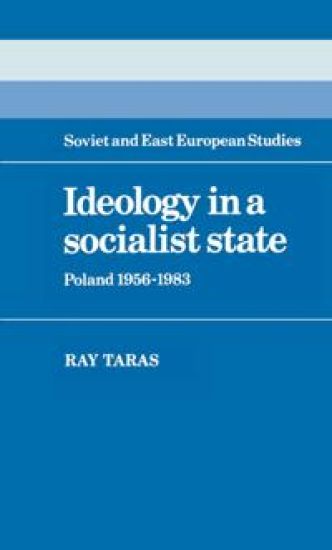
Ideology in a Socialist State

Ideology in a Socialist State

Raymond Taras

Cambridge University Press
2008
pokkari
Ideology in a Socialist State describes the changes in the ideology of Poland's rulers from the October events of 1956 to the lifting of martial law in 1983. Ideology has been one of the most debated and equivocal concepts in social science, yet this is one of the first attempts to examine it in a systematic, longitudinal and empirical way. Dr Taras analyses how central principles of Marxism-Leninism (the leading role of the party, party influence on trade unions, the church, culture and science) were interpreted by Poland's political leaders. Ideological change, he suggests, represents the chief means adopted by, the regime to respond to a postwar cycle of crises. The rulers' ideology is also linked to political developments in other socialist states (the 1968 Czech reform movement, Soviet doctrinal shifts). Taras concludes that as a result of both external and internal factors, ideology in Poland underwent a combination of transformations, innovations and reification that has produced a new hybrid and highly unstable ideology - Leninist Marxism of People's Poland. This puts the tumultuous Polish events of 1981–3 into historical perspective and focuses on the response of the party leadership to the challenge of Solidarity, and of martial law.
Democracy In Poland

Democracy In Poland

Marjorie Castle; Raymond Taras

Westview Press Inc
2002
pokkari
Ever-changing election rules, a highly fluid party system, a constitution considered illegitimate by more than one major political actor, polarized political elites, and a system of corruption that has grown up together with the young democracy itself - these characterize contemporary Polish politics. At the same time Poland is frequently identified as the most successful example of a transition from communism to capitalism, having led this series of world-changing transitions. It has distanced itself from a turbulent history as pawn in Eastern Europe's international politics to become a leading candidate for membership in the exclusive European Union club. As Polish democratic politics evolves it is taking unexpected forms and producing equally unexpected results. Through a comprehensive analysis of politics in this young European democracy, Marjorie Castle and Ray Taras explain the complexity and uncertainty of political processes and outcomes in Poland. Poland'spast - the flawed Second Republic established after World War I, as well as the imperfect independence in the Soviet shadow following World War II's devastation - dramatizes the unique historic opportunity it was given in 1989 to determine its own political future and perhaps eventually become a major European power. Choices made in 1989 and thereafter would not only construct a new democracy but shape and limit its possibilities. The primary focus here is on contemporary politics: what the fundamental political cleavages are, whether parties adequately represent popular interests, who the political elites are and what games they play, whatinfluence the Catholic Church still holds in an aspiring Western-style secular republic, and what policy challenges face Poland in the future. Inimitable political leaders, changing political arenas, and complexpolicy-making processes come to life through a fascinating narrative characterized by an insider's insight.
Ideology in a Socialist State

Ideology in a Socialist State

Raymond Taras

Cambridge University Press
1984
sidottu
Ideology in a Socialist Slate describes the changes in the ideology of Poland’s rulers from the October events of 1956 to the lifting of martial law in 1983. Ideology has been one of the most debated and equivocal concepts in social science, yet this is one of the first attempts to examine it in a systematic, longitudinal and empirical way. Dr Taras analyses how central principles of Marxism-Leninism (the leading role of the party, party influence on trade unions, the church, culture and science) interpreted by Poland’s political leaders. Ideological change, he suggests, represents the chief means adopted by, the regime to respond to a postwar cycle of crises. The rulers’ ideology is also linked to political developments in other socialist states (the 1968 Czech reform movement, Soviet doctrinal shifts). Taras concludes that as a result of both external and internal factors, ideology in Poland underwent a combination of transformations, innovations and reification that has produced a new hybrid and highly unstable ideology - Leninist Marxism of People’s Poland. This puts the tumultuous Polish events of 1981–3 into historical perspective and focuses on the response of the party leadership to the challenge of Solidarity, and of martial law.