Kirjojen hintavertailu – 12 903 725 kirjaa ja 27 kauppaa

Kirjailija

Razvan A. Mezei

Kirjat ja teokset yhdessä paikassa: 3 kirjaa, julkaisuja vuosilta 2015–2016, suosituimpiin kuuluu Numerical Analysis Using Sage. Vertaile teosten hintoja ja tarkista saatavuus suomalaisista kirjakaupoista.

3 kirjaa

Kirjojen julkaisuvuodet: 2015–2016.

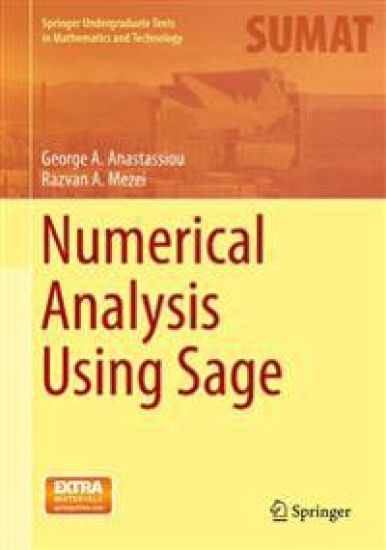
Numerical Analysis Using Sage

Numerical Analysis Using Sage

George A. Anastassiou; Razvan A. Mezei

Springer International Publishing AG
2016
nidottu
This is the first numerical analysis text to use Sage for the implementation of algorithms and can be used in a one-semester course for undergraduates in mathematics, math education, computer science/information technology, engineering, and physical sciences. The primary aim of this text is to simplify understanding of the theories and ideas from a numerical analysis/numerical methods course via a modern programming language like Sage. Aside from the presentation of fundamental theoretical notions of numerical analysis throughout the text, each chapter concludes with several exercises that are oriented to real-world application. Answers may be verified using Sage. The presented code, written in core components of Sage, are backward compatible, i.e., easily applicable to other software systems such as Mathematica®. Sage is open source software and uses Python-like syntax. Previous Python programming experience is not a requirement for the reader, though familiarity withany programming language is a plus. Moreover, the code can be written using any web browser and is therefore useful with Laptops, Tablets, iPhones, Smartphones, etc. All Sage code that is presented in the text is openly available on SpringerLink.com.
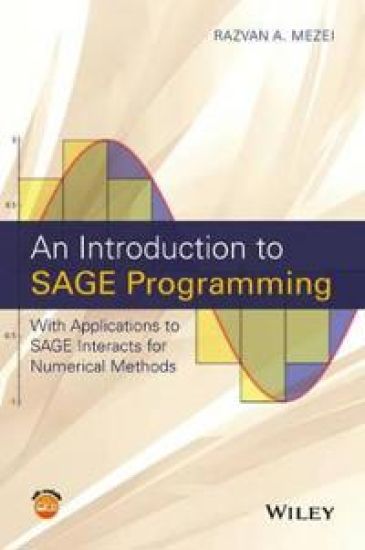
An Introduction to SAGE Programming

An Introduction to SAGE Programming

Razvan A. Mezei

Wiley-Blackwell
2016
sidottu
Features a simplified presentation of numerical methods by introducing and implementing SAGE programs An Introduction to SAGE Programming: With Applications to SAGE Interacts for Numerical Methods emphasizes how to implement numerical methods using SAGE Math and SAGE Interacts and also addresses the fundamentals of computer programming, including if statements, loops, functions, and interacts. The book also provides a unique introduction to SAGE and its computer algebra system capabilities; discusses second and higher order equations and estimate limits; and determines derivatives, integrals, and summations. Providing critical resources for developing successful interactive SAGE numerical computations, the book is accessible without delving into the mathematical rigor of numerical methods. The author illustrates the benefits of utilizing the SAGE language for calculus and the numerical analysis of various methods such as bisection methods, numerical integration, Taylor’s expansions, and Newton’s iterations. Providing an introduction to the terminology and concepts involved, An Introduction to SAGE Programming: With Applications to SAGE Interacts for Numerical Methods also features: An introduction to computer programming using SAGEMany practical examples throughout to illustrate the application of SAGE Interacts for various numerical methodsDiscussions on how to use SAGE Interacts and SAGE Cloud in order to create mathematical demonstrationsNumerous homework problems and exercises that allow readers to practice their programming skillsetA companion website that includes related SAGE programming code and select solutions to the homework problems and exercises An Introduction to SAGE Programming: With Applications to SAGE Interacts for Numerical Methods is an ideal reference for applied mathematicians who need to employ SAGE for the study of numerical methods and analysis. The book is also an appropriate supplemental textbook for upper-undergraduate and graduate-level courses in numerical methods.
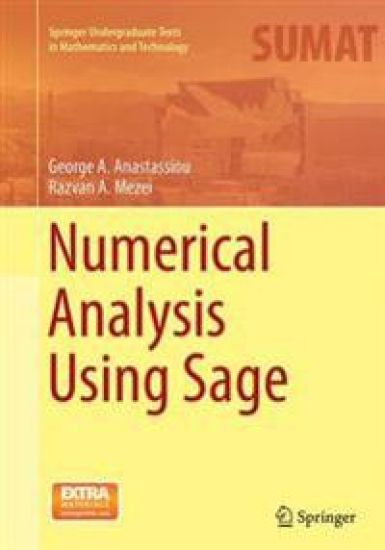
Numerical Analysis Using Sage

Numerical Analysis Using Sage

George A. Anastassiou; Razvan A. Mezei

Springer International Publishing AG
2015
sidottu
This is the first numerical analysis text to use Sage for the implementation of algorithms and can be used in a one-semester course for undergraduates in mathematics, math education, computer science/information technology, engineering, and physical sciences. The primary aim of this text is to simplify understanding of the theories and ideas from a numerical analysis/numerical methods course via a modern programming language like Sage. Aside from the presentation of fundamental theoretical notions of numerical analysis throughout the text, each chapter concludes with several exercises that are oriented to real-world application. Answers may be verified using Sage. The presented code, written in core components of Sage, are backward compatible, i.e., easily applicable to other software systems such as Mathematica®. Sage is open source software and uses Python-like syntax. Previous Python programming experience is not a requirement for the reader, though familiarity withany programming language is a plus. Moreover, the code can be written using any web browser and is therefore useful with Laptops, Tablets, iPhones, Smartphones, etc. All Sage code that is presented in the text is openly available on SpringerLink.com.