Kirjojen hintavertailu – 12 859 819 kirjaa ja 27 kauppaa

Kirjailija

Rebecca Comay

Kirjat ja teokset yhdessä paikassa: 6 kirjaa, julkaisuja vuosilta 1999–2026, suosituimpiin kuuluu On Persistence. Vertaile teosten hintoja ja tarkista saatavuus suomalaisista kirjakaupoista.

6 kirjaa

Kirjojen julkaisuvuodet: 1999–2026.

On Persistence

On Persistence

Rebecca Comay

SEAGULL BOOKS LONDON LTD
2026
sidottu
A bold meditation on endurance as interruption rather than progress, offering a radical rethinking of time, agency, and survival. On Persistence is an exploration into the elusive, unruly force of endurance—not as moral virtue or capitalist work ethic, but as a temporal and affective structure that resists assimilation. In these wide-ranging philosophical and literary essays, Rebecca Comay interrogates what it means to persist when progress stalls and resolution fails to arrive. Engaging figures from Freud to Beckett, Proust to Benjamin, Hamlet to Niobe, Comay tracks the strange temporality of suspended life: interminable mourning, unfinished projects, the persistence of the past, the undead stirrings of the death drive. What emerges is a radically different model of time—neither static nor teleological, but a form of interruption that opens space for rethinking agency, grief, resistance, and repair. On Persistence offers a profound meditation on what it means to endure—and to endure differently—in a time that demands something else of us.
On Persistence

On Persistence

Rebecca Comay

SEAGULL BOOKS LONDON LTD
2026
nidottu
A bold meditation on endurance as interruption rather than progress, offering a radical rethinking of time, agency, and survival. On Persistence is an exploration into the elusive, unruly force of endurance—not as moral virtue or capitalist work ethic, but as a temporal and affective structure that resists assimilation. In these wide-ranging philosophical and literary essays, Rebecca Comay interrogates what it means to persist when progress stalls and resolution fails to arrive. Engaging figures from Freud to Beckett, Proust to Benjamin, Hamlet to Niobe, Comay tracks the strange temporality of suspended life: interminable mourning, unfinished projects, the persistence of the past, the undead stirrings of the death drive. What emerges is a radically different model of time—neither static nor teleological, but a form of interruption that opens space for rethinking agency, grief, resistance, and repair. On Persistence offers a profound meditation on what it means to endure—and to endure differently—in a time that demands something else of us.
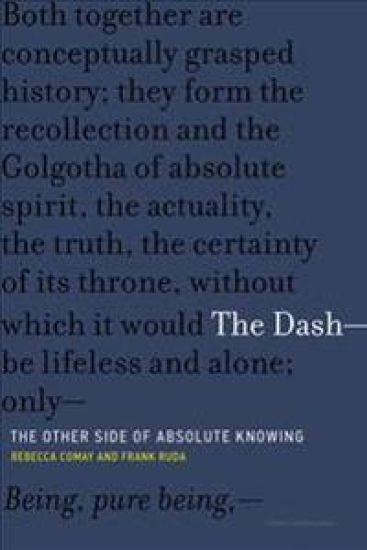
The Dash—The Other Side of Absolute Knowing

The Dash—The Other Side of Absolute Knowing

Rebecca Comay; Frank Ruda

MIT Press
2018
pokkari
An argument that what is usually dismissed as the "mystical shell" of Hegel's thought-the concept of absolute knowledge-is actually its most "rational kernel." This book sets out from a counterintuitive premise: the "mystical shell" of Hegel's system proves to be its most "rational kernel." Hegel's radicalism is located precisely at the point where his thought seems to regress most. Most current readings try to update Hegel's thought by pruning back his grandiose claims to "absolute knowing." Comay and Ruda invert this deflationary gesture by inflating what seems to be most trivial: the absolute is grasped only in the minutiae of its most mundane appearances. Reading Hegel without presupposition, without eliminating anything in advance or making any decision about what is essential and what is inessential, what is living and what is dead, they explore his presentation of the absolute to the letter. The Dash is organized around a pair of seemingly innocuous details. Hegel punctuates strangely. He ends the Phenomenology of Spirit with a dash, and he begins the Science of Logic with a dash. This distinctive punctuation reveals an ambiguity at the heart of absolute knowing. The dash combines hesitation and acceleration. Its orientation is simultaneously retrospective and prospective. It both holds back and propels. It severs and connects. It demurs and insists. It interrupts and prolongs. It generates nonsequiturs and produces explanations. It leads in all directions: continuation, deviation, meaningless termination. This challenges every cliche about the Hegelian dialectic as a machine of uninterrupted teleological progress. The dialectical movement is, rather, structured by intermittency, interruption, hesitation, blockage, abruption, and random, unpredictable change-a rhythm that displays all the vicissitudes of the Freudian drive.
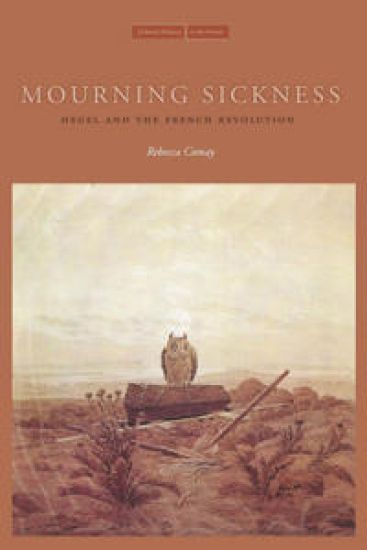
Mourning Sickness

Mourning Sickness

Rebecca Comay

Stanford University Press
2010
sidottu
This book explores Hegel's response to the French Revolutionary Terror and its impact on Germany. Like many of his contemporaries, Hegel was struck by the seeming parallel between the political upheaval in France and the upheaval in German philosophy inaugurated by the Protestant Reformation and brought to a climax by German Idealism. Many thinkers reasoned that a political revolution would be unnecessary in Germany, because this intellectual "revolution" had preempted it. Having already been through its own cataclysm, Germany would be able to extract the energy of the Revolution and channel its radicalism into thought. Hegel comes close to making such an argument too. But he also offers a powerful analysis of how this kind of secondhand history gets generated in the first place, and shows what is stake. This is what makes him uniquely interesting among his contemporaries: he demonstrates how a fantasy can be simultaneously deconstructed and enjoyed. Mourning Sickness provides a new reading of Hegel in the light of contemporary theories of historical trauma. It explores the ways in which major historical events are experienced vicariously, and the fantasies we use to make sense of them. Comay brings Hegel into relation with the most burning contemporary discussions around catastrophe, witness, memory, and the role of culture in shaping political experience.
Mourning Sickness

Mourning Sickness

Rebecca Comay

Stanford University Press
2010
pokkari
This book explores Hegel's response to the French Revolutionary Terror and its impact on Germany. Like many of his contemporaries, Hegel was struck by the seeming parallel between the political upheaval in France and the upheaval in German philosophy inaugurated by the Protestant Reformation and brought to a climax by German Idealism. Many thinkers reasoned that a political revolution would be unnecessary in Germany, because this intellectual "revolution" had preempted it. Having already been through its own cataclysm, Germany would be able to extract the energy of the Revolution and channel its radicalism into thought. Hegel comes close to making such an argument too. But he also offers a powerful analysis of how this kind of secondhand history gets generated in the first place, and shows what is stake. This is what makes him uniquely interesting among his contemporaries: he demonstrates how a fantasy can be simultaneously deconstructed and enjoyed. Mourning Sickness provides a new reading of Hegel in the light of contemporary theories of historical trauma. It explores the ways in which major historical events are experienced vicariously, and the fantasies we use to make sense of them. Comay brings Hegel into relation with the most burning contemporary discussions around catastrophe, witness, memory, and the role of culture in shaping political experience.
Endings

Endings

Rebecca Comay

Northwestern University Press
1999
nidottu
This collection of ten essays and an extended introduction aims to show how Hegel and Heidegger offer ways of thinking historically that understand such thinking not merely as extensions and elaborations of a given paradigm, but as actively engaged in the critical and transformative revisioning of the world. Beginning from the point where Heidegger encountered Hegel, this volume of essays addresses the respective philosophies of the two men. Leading scholars provide a variety of models from which to view the unique relationship between the bodies of thought of Heidegger and Hegel.