Kirjojen hintavertailu – 12 859 828 kirjaa ja 27 kauppaa

Kirjailija

Rein Taagepera

Kirjat ja teokset yhdessä paikassa: 15 kirjaa, julkaisuja vuosilta 1984–2024, suosituimpiin kuuluu Softening without Liberalization in the Soviet Union. Vertaile teosten hintoja ja tarkista saatavuus suomalaisista kirjakaupoista.

15 kirjaa

Kirjojen julkaisuvuodet: 1984–2024.

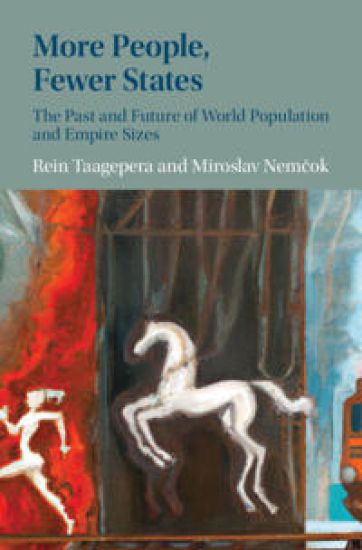
More People, Fewer States

More People, Fewer States

Rein Taagepera; Miroslav Nemcok

Cambridge University Press
2024
pokkari
The long-term development of political systems over extended time periods has been somewhat neglected. More People, Fewer States examines world history through population explosion and empire size changes across 5000 years of socio-technological development, revealing three distinct phases: Runner, Rider, and Engineer empires. A careful comparative approach reveals that Old Egypt, Achaemenid, Caliphate, Mongol, and Britain each achieved remarkable yet rarely acknowledged expansions, leading to their successive record empire sizes. If identified past trends persist, a potential single world state could emerge by 4600, although environmental concerns may intervene. Focusing on population dynamics and area metrics of states, this book provides a novel framework for evaluating the growth, structure, and decline of empires. It not only illuminates ancient historical space but also ventures into future projections, making it an essential read for scholars interested in the long-term evolution of political systems.
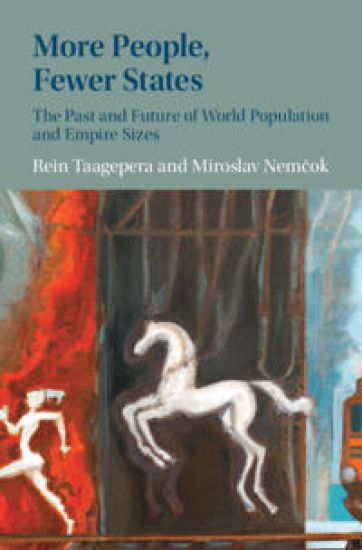
More People, Fewer States

More People, Fewer States

Rein Taagepera; Miroslav Nemcok

Cambridge University Press
2024
sidottu
The long-term development of political systems over extended time periods has been somewhat neglected. More People, Fewer States examines world history through population explosion and empire size changes across 5000 years of socio-technological development, revealing three distinct phases: Runner, Rider, and Engineer empires. A careful comparative approach reveals that Old Egypt, Achaemenid, Caliphate, Mongol, and Britain each achieved remarkable yet rarely acknowledged expansions, leading to their successive record empire sizes. If identified past trends persist, a potential single world state could emerge by 4600, although environmental concerns may intervene. Focusing on population dynamics and area metrics of states, this book provides a novel framework for evaluating the growth, structure, and decline of empires. It not only illuminates ancient historical space but also ventures into future projections, making it an essential read for scholars interested in the long-term evolution of political systems.
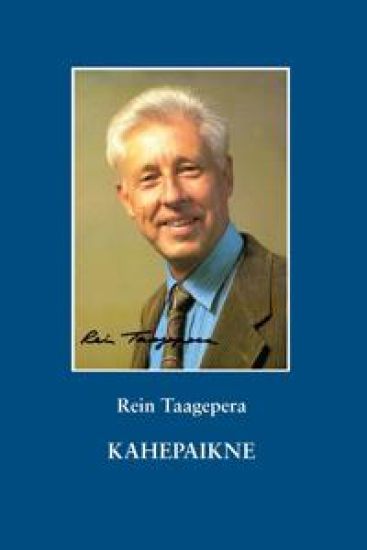
Kahepaikne. mälestusi 1991-2001

Kahepaikne. mälestusi 1991-2001

Rein Taagepera

Ilmamaa
2024
sidottu
Rein Taagepera on oma järjekordse mälestusteraamatuga jõudnud aega, mil Saksamaal, Marokos, Kanadas, Soomes ja lõpuks USA-s elanud, võõra võimu poolt tõrjutud pagulasest saab 1991 "väliseestlane". Kodutee oli just nagu avali ja pagulased katsusid naasta. Onnestus see aga ainult poole eluga. Ees ootasid sotsiaalteaduskond Tartus, sekka ootamatu presidendikampaania ja nõukajärgse olme omapärad. Selle kõrvale jäi retk Udmurtiasse ja naasmine Marrakeshi, Eesti Californiaga kõrvuti aastatuhande lõpul, kahepaiksuse vaev ja võimalused. Raamatu fotomaterjal on autori erakogust.
Kui ajalugu liikuma hakkas

Kui ajalugu liikuma hakkas

Rein Taagepera

UNKNOWN
2022
sidottu
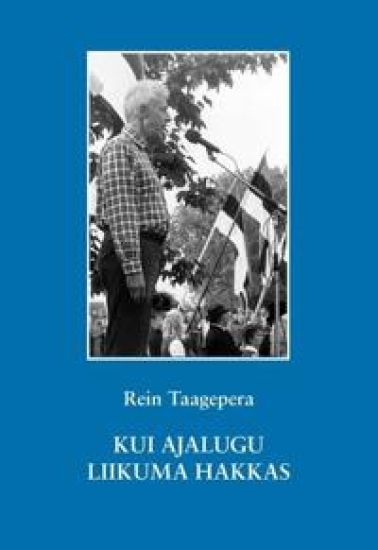
Rein Taagepera uus mälestusteraamat viib meid aega, mil Eesti jaoks nagu 40 aastaks kinni külmunud ajakulg uuesti liikuma hakkas ja viie aastaga rahvusvaheliselt tunnustatud Eesti Vabariigi taastumiseni viis, et siis jälle aeglustuda. Need on mälestused mehelt, kes 40 aasta jooksul kordagi Eestisse ei pääsenud ja järgneva viie aasta kestel vähem kui viis kuud Eestis veeta sai, kuid ometi poliitiliste tegelaste edetabelis detsembris 1991 eestlaste silmis neljandaks tõusis. Raamatu fotod on pärit autori erakogust. Esikaanel: autor esinemas Karksi-Nuias Balti keti eel 23.08.1989.
Estonia

Estonia

Rein Taagepera

Routledge
2019
sidottu
After breaking free from the Bolsheviks in 1918, Estonia enjoyed independence until 1940, when the country was subsumed by the Soviet Union. Not until 1991 was Estonia able to make its next successful bid for sovereignty. In this book, Rein Taagepera traces the evolution of Estonia from prehistory to the present, when a radical turn of events in th
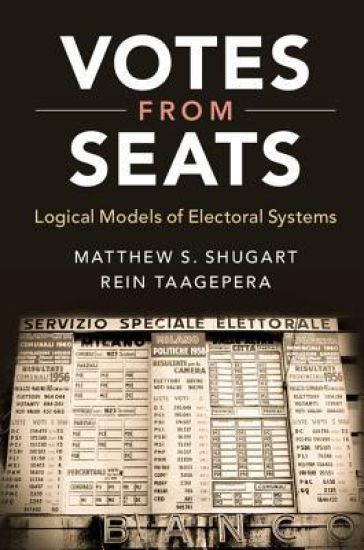
Votes from Seats

Votes from Seats

Matthew S. Shugart; Rein Taagepera

Cambridge University Press
2017
sidottu
Take the number of seats in a representative assembly and the number of seats in districts through which this assembly is elected. From just these two numbers, the authors of Votes from Seats show that it is possible to deduce the number of parties in the assembly and in the electorate, as well as the size of the largest party. Inside parties, the vote distributions of individual candidates likewise follow predictable patterns. Four laws of party seats and votes are constructed by logic and tested, using scientific approaches rare in social sciences. Both complex and simple electoral systems are covered, and the book offers a set of 'best practices' for electoral system design. The ability to predict so much from so little, and to apply to countries worldwide, is an advance in the systematic analysis of a core institutional feature found in any democracy, and points the way towards making social sciences more predictive.
Votes from Seats

Votes from Seats

Matthew S. Shugart; Rein Taagepera

Cambridge University Press
2017
pokkari
Take the number of seats in a representative assembly and the number of seats in districts through which this assembly is elected. From just these two numbers, the authors of Votes from Seats show that it is possible to deduce the number of parties in the assembly and in the electorate, as well as the size of the largest party. Inside parties, the vote distributions of individual candidates likewise follow predictable patterns. Four laws of party seats and votes are constructed by logic and tested, using scientific approaches rare in social sciences. Both complex and simple electoral systems are covered, and the book offers a set of 'best practices' for electoral system design. The ability to predict so much from so little, and to apply to countries worldwide, is an advance in the systematic analysis of a core institutional feature found in any democracy, and points the way towards making social sciences more predictive.
Making Social Sciences More Scientific

Making Social Sciences More Scientific

Rein Taagepera

Oxford University Press
2008
sidottu
In his challenging new book Rein Taagepera argues that society needs more from social sciences than they have delivered. One reason for falling short is that social sciences have depended excessively on regression and other statistical approaches, neglecting logical model building. Science is not only about the empirical 'What is?' but also very much about the conceptual 'How should it be on logical grounds?' Statistical approaches are essentially descriptive, while quantitatively formulated logical models are predictive in an explanatory way. Why Social Sciences Are Not Scientific Enough contrasts the predominance of statistics in today's social sciences and predominance of quantitatively predictive logical models in physics. It shows how to construct predictive models and gives social science examples. Why Social Sciences Are Not Scientific Enough is useful to students who wish to learn the basics of the scientific method and to all those researchers who look for ways to do better social science.
Predicting Party Sizes

Predicting Party Sizes

Rein Taagepera

Oxford University Press
2007
sidottu
For a given electoral system, what average number and sizes of parties and government duration can we expect? Predicting Party Sizes is the first book to make specific predictions that agree with world averages. The basic factors are the numbers of seats in the assembly and in the average electoral district. While previous models tell us only the direction in which to change the electoral system, the present ones also tell us by how much they must be changed so as to obtain the desired change in average number of parties and cabinet duration. Hence, combined with known particularities of a country, they can be used for informed institutional design. The book is useful to three types of readers: political science students learning the basics of electoral systems and their political consequences; practitioners of politics who consider changing the electoral laws; and researchers intent on connecting electoral and party systems. The book is structured accordingly. Chapters start with advice and recipes for practicing politicians, in non-technical language. The main text gives students an overview of electoral systems, worldwide, and supplies evidence for models that tie simple electoral systems (First-Past-The-Post and List Proportional Representation) to the number and sizes of parties and government duration. Chapter appendices present derivations of these models and other more technical issues of interest to researchers.
Finno-Ugric Republics and the Russian State

Finno-Ugric Republics and the Russian State

Rein Taagepera

C Hurst Co Publishers Ltd
1999
sidottu
This text provides a survey of the peoples who speak Finno-Ugric languages and have titular republics or autonomous regions within the post-Soviet Russian federation. Their languages have set them apart from their Turkic and Russian neighbours and helped to preserve their distinct identity, including their animist religious practices. Previous works on this subject were written before the demise of the USSR so that information on the subject was screened by Soviet censors. In particular, this book explores the principal threats now facing these peoples - as much environmental as political. Although communism has gone, the exploitation of natural resources threatens the region's ecology, while the new rulers in the Kremlin seem set to continue their predecessors' oppressive policies towards the Finno-Ugrians. The book is written with commitment to the threatened human and political rights of these endangered peoples.
Baltic States

Baltic States

Romuald J. Misiunas; Rein Taagepera

C Hurst Co Publishers Ltd
1993
nidottu
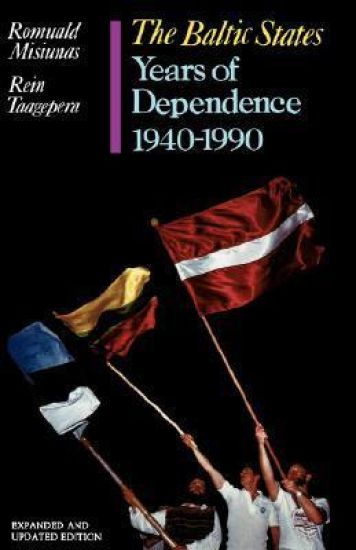
The independence of the Baltic states ended when Stalin occupied and annexed Lithuania, Latvia and Estonia to the USSR in 1940. In 1991, after four years of intense but peaceful struggle that contributed to the demise of the Soviet Union, the Baltic states regained their independence. In this updated edition of their renowned "The Baltic States: Years of Dependence, 1940-1980", Romuald Misiunas and Rain Taagepera bring the story up to the 1990s. The authors describe and analyze how the Baltic nations survived 50 years of social disruption, language discrimination and Russian colonialism, and the effect of the Baltic states' stubborn invincibility on the Soviet Union. The history of Estonia, Latvia and Lithuania are integrated and compared, and some notable differences between the three countries are pointed out. With three new chapters, a revised preface a re-edited text and an appendix bringing the period of Soviet domination to a close, this expanded study covers a tumultuous period of political, economic, cultural and ecological reform. Misiunas and Taagepera offer a current, accessible perspective on the evolving changes in the Baltic states and the rise and fall of the Soviet empire.
The Baltic States

The Baltic States

Romuald Misiunas; Rein Taagepera

University of California Press
1993
pokkari
In this updated edition of their renowned The Baltic States, Romuald Misiunas and Rein Taagepera bring the story of Lithuania, Latvia, and Estonia up to the 1990s. The authors describe and analyze how the Baltic nations survived fifty years of social disruption, language discrimination, and Russian colonialism. The nations' histories are fully integrated and compared, and some notable differences between them are pointed out. With two new chapters, a revised preface, and an appendix on the end of Soviet domination, this expanded study covers a tumultuous period of political, economic, cultural, and ecological reform.
Estonia

Estonia

Rein Taagepera

Westview Press Inc
1993
nidottu
After breaking free from the Bolsheviks in 1918, Estonia enjoyed independence until 1940 when the country was subsumed by the Soviet Union. Not until 1991 was Estonia able to make its next successful bid for sovereignty. In this book, Rein Taagepera traces the evolution of Estonia from prehistory to the present, when a radical turn of events in the former Soviet Union once again altered the destiny of this Baltic nation. The author explores in depth the remarkable changes in Estonia since 1980, framing his analysis within the larger picture of the Soviet Union and its demise. He also examines the issue of ethnic tensions between Estonians and Russian colonists and speculates on how unrest will affect the future of the country. Throughout his analysis, the author weaves in such key questions as: Why did Sovietization fail? How did Estonia’s quest for autonomy affect Soviet dissolution? What role will the country play on the global stage? What will Estonia’s future hold?
Softening without Liberalization in the Soviet Union

Softening without Liberalization in the Soviet Union

Rein Taagepera

University Press of America
1984
sidottu
Examines the case of Soviet Estonian chemistry professor Juri Kukk, who died in prison three years after resigning from the Communist party. The author hypothesizes that Kukk's story illustrates how the Soviet regime has lately become dangerously erratic by becoming more hesitant in its acts without becoming more liberal in its outlook.