

Kirjailija
Reinhart Koselleck
Kirjat ja teokset yhdessä paikassa: 15 kirjaa, julkaisuja vuosilta 1998–2023, suosituimpiin kuuluu Zur Politischen Ikonologie Des Gewaltsamen Todes. Vertaile teosten hintoja ja tarkista saatavuus suomalaisista kirjakaupoista.
15 kirjaa
Kirjojen julkaisuvuodet: 1998–2023.
Sediments of Time features the most important essays by renowned German historian Reinhart Koselleck not previously available in English, several of them essential to his theory of history. The volume sheds new light on Koselleck's crucial concerns, including his theory of sediments of time; his theory of historical repetition, duration, and acceleration; his encounters with philosophical hermeneutics and political and legal thought; his concern with the limits of historical meaning; and his views on historical commemoration, including that of the Second World War and the Holocaust. A critical introduction addresses some of the challenges and potentials of Koselleck's reception in the Anglophone world.
Sediments of Time
Reinhart Koselleck
Stanford University Press
2018
pokkari
Halvin toimitettuna 38,20 €
Sediments of Time features the most important essays by renowned German historian Reinhart Koselleck not previously available in English, several of them essential to his theory of history. The volume sheds new light on Koselleck's crucial concerns, including his theory of sediments of time; his theory of historical repetition, duration, and acceleration; his encounters with philosophical hermeneutics and political and legal thought; his concern with the limits of historical meaning; and his views on historical commemoration, including that of the Second World War and the Holocaust. A critical introduction addresses some of the challenges and potentials of Koselleck's reception in the Anglophone world.
Der Band erzählt in 25 Untersuchungen die Geschichte der modernen Welt anhand der Begriffsgeschichten von ? Staat?, ? Revolution?, ? Aufklärung?, ? Emanzipation?, ? Bildung? und ? Utopie?. Stets wird dabei der Doppelstatus dieser Begriffe, ihre Indikatoren- und Faktorenrolle im historischen Prozeß, deutlich. Die semantisch-pragmatische Analyse der Begriffe macht Kontinuitäten ebenso wie Umschlagpunkte der Sozial- und Kulturgeschichte sichtbar und gibt so eine eigene Form geschichtlicher Erfahrung frei: Die Historie der Begriffe wird zum Medium der historischen Selbstaufklärung der Gegenwart.
Eigentlich sollte man ... beim Einsteigen in den Bus nicht drängeln, beim Einfädeln auch mal den anderen den Vortritt lassen ... Eigentlich ... Doch im Alltag sind wir sehr oft ungeduldig und hektisch, nicht konzentriert, abgelenkt durch Ärger oder Stress. Mit einem solchen moralischen und zwischenmenschlichen Dilemma richtig umgehen zu lernen, ist Anliegen dieser 12 Geschichten in deutscher und englischer Sprache. Jede Geschichte ist als eine komplette Unterrichtseinheit aufgebaut. Aus dem Inhalt: - Verantwortung im Straßenverkehr - Mutwillige Zerstörung öffentlicher Einrichtungen / Rowdytum - Discofahrten unter Alkohol - Unfallflucht - kein Kavaliersdelikt! - Versicherungspflicht und Mofa-Prüfbescheinigung - Veränderung am Fahrzeug - Walkman im Straßenverkehr verboten. Die Mappe eignet sich für die Fächer Deutsch, Englisch und Ethik in den Jahrgangsstufen 7 bis 12.
Modernity in the late eighteenth century transformed all domains of European life -intellectual, industrial, and social. Not least affected was the experience of time itself: ever-accelerating change left people with briefer intervals of time in which to gather new experiences and adapt. In this provocative and erudite book Reinhart Koselleck, a distinguished philosopher of history, explores the concept of historical time by posing the question: what kind of experience is opened up by the emergence of modernity? Relying on an extraordinary array of witnesses and texts from politicians, philosophers, theologians, and poets to Renaissance paintings and the dreams of German citizens during the Third Reich, Koselleck shows that, with the advent of modernity, the past and the future became 'relocated' in relation to each other. The promises of modernity -freedom, progress, infinite human improvement -produced a world accelerating toward an unknown and unknowable future within which awaited the possibility of achieving utopian fulfillment. History, Koselleck asserts, emerged in this crucial moment as a new temporality providing distinctly new ways of assimilating experience. In the present context of globalization and its resulting crises, the modern world once again faces a crisis in aligning the experience of past and present. To realize that each present was once an imagined future may help us once again place ourselves within a temporality organized by human thought and humane ends as much as by the contingencies of uncontrolled events.
Erfarenhet, tid och historia : om historiska tiders semantik
Reinhart Koselleck
Bokförlaget Daidalos
2004
nidottu
Det som intresserar Koselleck är inte »tid» som ett abstrakt, logiskt problem, utan »tider», i betydelsen olika, historiskt föränderliga sätt att erfara, föreställa sig och konceptualisera tiden. T.ex. är det stor skillnad mellan antikens cirkulära historieuppfattning, där perioder av uppgång och nedgång, lycka och olycka följer på varandra i en evig rundgång, och den moderna framstegstanken där historien tar form av en linjär process som oundvikligen leder fram mot vår egen tid. Den moderna världen kännetecknas enligt Koselleck av en grundläggande asymmetri mellan erfarenhetsrum och förväntningshorisont: den senare frigör sig från det förra, förväntningshorisonten är inte längre begränsad av de hittills gjorda erfarenheterna. Samtiden befinner sig i en brytning med det förflutna och öppnar sig mot framtiden. Denna asymmetri hänger enligt Koselleck samman med en acceleration av själva den historiska tiden. Ingående dokumenterar han framväxten av denna tidsupplevelse och hur den efter 1750 resulterar i uppkomsten av epokbegreppet »nya tiden» och i ett begrepp om »historien som sådan», eller historien i ental, till skillnad från den tidigare flertalsformen »historier». Den gamla föreställningen om historien som en exempelsamling som man kan lära av för nuet ersätts av föreställningen om historien som en process, en rörelse ? och dessutom som en accelerande rörelse där erfarenheter allt snabbare förlorar sin giltighet. Artiklarna i denna bok ingår, som fem av fjorton, i Vergangene Zukunft. Zur Semantik geschichtlicher Zeiten (1979). Boken är försett med en inledning av Helge Jordheim.
Reinhart Koselleck is one of the most important theorists of history and historiography of the last half century. His work has implications for contemporary cultural studies that extend far beyond discussions of the practical problems of historical method. He is the foremost exponent and practitioner of Begriffsgeschichte, a methodology of historical studies that focuses on the invention and development of the fundamental concepts underlying and informing a distinctively historical manner of being in the world. The eighteen essays in this volume illustrate the four theses of Koselleck's concept of history. First, historical process is marked by a distinctive kind of temporality different from that found in nature. This temporality is multileveled and subject to different rates of acceleration and deceleration, and functions not only as a matrix within which historical events happen but also as a causal force in the determination of social reality in its own right. Second, historical reality is social reality, an internally differentiated structure of functional relationships in which the rights and interests of one group collide with those of other groups, and lead to the kinds of conflict in which defeat is experienced as an ethical failure requiring reflection on "what went wrong" to determine the historical significance of the conflict itself. Third, the history of historiography is a history of the evolution of the language of historians. In this respect, Koselleck's work converges with that of Barthes, Foucault, and Derrida, all of whom stress the status of historiography as discourse rather than as discipline, and feature the constitutive nature of historical discourse as against its claim to literal truthfulness. Finally, the fourth aspect of Koselleck's notion of the concept of history is that a properly historicist concept of history is informed by the realization that what we call modernity is nothing more than an aspect of the discovery of history's concept in our age. The aporias of modernism—in arts and letters as well as in the human and natural sciences—are a function of the discovery of the historicity of both society and knowledge.
The Practice of Conceptual History
Reinhart Koselleck
Stanford University Press
2002
pokkari
Halvin toimitettuna 38,20 €
Reinhart Koselleck is one of the most important theorists of history and historiography of the last half century. His work has implications for contemporary cultural studies that extend far beyond discussions of the practical problems of historical method. He is the foremost exponent and practitioner of Begriffsgeschichte, a methodology of historical studies that focuses on the invention and development of the fundamental concepts underlying and informing a distinctively historical manner of being in the world. The eighteen essays in this volume illustrate the four theses of Koselleck's concept of history. First, historical process is marked by a distinctive kind of temporality different from that found in nature. This temporality is multileveled and subject to different rates of acceleration and deceleration, and functions not only as a matrix within which historical events happen but also as a causal force in the determination of social reality in its own right. Second, historical reality is social reality, an internally differentiated structure of functional relationships in which the rights and interests of one group collide with those of other groups, and lead to the kinds of conflict in which defeat is experienced as an ethical failure requiring reflection on "what went wrong" to determine the historical significance of the conflict itself. Third, the history of historiography is a history of the evolution of the language of historians. In this respect, Koselleck's work converges with that of Barthes, Foucault, and Derrida, all of whom stress the status of historiography as discourse rather than as discipline, and feature the constitutive nature of historical discourse as against its claim to literal truthfulness. Finally, the fourth aspect of Koselleck's notion of the concept of history is that a properly historicist concept of history is informed by the realization that what we call modernity is nothing more than an aspect of the discovery of history's concept in our age. The aporias of modernism—in arts and letters as well as in the human and natural sciences—are a function of the discovery of the historicity of both society and knowledge.
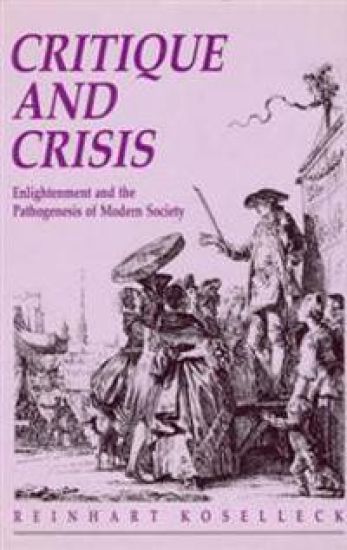
Critique and Crisis established Reinhart Koselleck's reputation as the most important German intellectual historian of the postwar period. This first English translation of Koselleck's tour de force demonstrates a chronological breadth, a philosophical depth, and an originality which are hardly equalled in any scholarly domain. It is a history of the Enlightenment in miniature, fundamental to our understanding of that period and its consequences. Like Tocqueville, Koselleck views Enlightenment intellectuals as an uprooted, unrealistic group of onlookers who sowed the seeds of the modern political tensions that first flowered in the French Revolution. He argues that it was the split that developed between state and society during the Enlightenment that fostered the emergence of this intellectual elite divorced from the realities of politics. Koselleck describes how this disjunction between political authority proper and its subjects led to private spheres that later became centers of moral authority and, eventually, models for political society that took little or no notice of the constraints under which politicians must inevitably work. In this way progressive bourgeois philosophy, which seemed to offer the promise of a unified and peaceful world, in fact produced just the opposite. The book provides a wealth of examples drawn from all of Europe to illustrate the still relevant message that we evade the constraints and the necessities of the political realm at our own risk. Critique and Crisis is included in the series Studies in Contemporary German Social Thought, edited by Thomas McCarthy.
Zur Politischen Ikonologie Des Gewaltsamen Todes
Reinhart Koselleck
Schwabe Verlagsgruppe AG
1998
nidottu