Kirjojen hintavertailu – 12 903 724 kirjaa ja 27 kauppaa

Kirjailija

Reinhold Martin

Kirjat ja teokset yhdessä paikassa: 13 kirjaa, julkaisuja vuosilta 2005–2021, suosituimpiin kuuluu Eero Saarinen. Vertaile teosten hintoja ja tarkista saatavuus suomalaisista kirjakaupoista.

13 kirjaa

Kirjojen julkaisuvuodet: 2005–2021.

Knowledge Worlds

Knowledge Worlds

Reinhold Martin

Columbia University Press
2021
sidottu
What do the technical practices, procedures, and systems that have shaped institutions of higher learning in the United States, from the Ivy League and women’s colleges to historically black colleges and land-grant universities, teach us about the production and distribution of knowledge? Addressing media theory, architectural history, and the history of academia, Knowledge Worlds reconceives the university as a media complex comprising a network of infrastructures and operations through which knowledge is made, conveyed, and withheld. Reinhold Martin argues that the material infrastructures of the modern university—the architecture of academic buildings, the configuration of seminar tables, the organization of campus plans—reveal the ways in which knowledge is created and reproduced in different kinds of institutions. He reconstructs changes in aesthetic strategies, pedagogical techniques, and political economy to show how the boundaries that govern higher education have shifted over the past two centuries. From colleges chartered as rights-bearing corporations to research universities conceived as knowledge factories, educating some has always depended upon excluding others. Knowledge Worlds shows how the division of intellectual labor was redrawn as new students entered, expertise circulated, science repurposed old myths, and humanists cultivated new forms of social and intellectual capital. Combining histories of architecture, technology, knowledge, and institutions into a critical media history, Martin traces the uneven movement in the academy from liberal to neoliberal reason.
Knowledge Worlds

Knowledge Worlds

Reinhold Martin

Columbia University Press
2021
pokkari
What do the technical practices, procedures, and systems that have shaped institutions of higher learning in the United States, from the Ivy League and women’s colleges to historically black colleges and land-grant universities, teach us about the production and distribution of knowledge? Addressing media theory, architectural history, and the history of academia, Knowledge Worlds reconceives the university as a media complex comprising a network of infrastructures and operations through which knowledge is made, conveyed, and withheld. Reinhold Martin argues that the material infrastructures of the modern university—the architecture of academic buildings, the configuration of seminar tables, the organization of campus plans—reveal the ways in which knowledge is created and reproduced in different kinds of institutions. He reconstructs changes in aesthetic strategies, pedagogical techniques, and political economy to show how the boundaries that govern higher education have shifted over the past two centuries. From colleges chartered as rights-bearing corporations to research universities conceived as knowledge factories, educating some has always depended upon excluding others. Knowledge Worlds shows how the division of intellectual labor was redrawn as new students entered, expertise circulated, science repurposed old myths, and humanists cultivated new forms of social and intellectual capital. Combining histories of architecture, technology, knowledge, and institutions into a critical media history, Martin traces the uneven movement in the academy from liberal to neoliberal reason.
Organize

Organize

Timon Beyes; Lisa Conrad; Reinhold Martin; Geert Lovink; Ned Rossiter

University of Minnesota Press
2019
pokkari
A pioneering systematic inquiry into-and mapping of-the field of media and organization Media organize things into patterns and relations. As intermediaries among people and between people and worlds, media shape sociotechnical orders. At the same time, media are organized: while they condition different organizational forms and processes, they, too, are formed and can be re-formed. This intimate relation of media and organizing is timeless. Yet arguably, digital media technologies repose the question of organization-and thus of power and domination, control and surveillance, disruption and emancipation. Bringing together leading media thinkers and organization theorists, this book interrogates organization as an effect and condition of media. How can we understand the recursive relation between media and organization? How can we think, explore, critique, and perhaps alter the organizational bodies and scripts that shape contemporary life? Organize will be of interest to scholars and students of new and old media, social organization, and technology. Moreover, the dialogical form of these essays provides a concise and path-breaking view on the recursive relation between technological media and social organization. The book therefore establishes and maps “media and organization” as a highly relevant field of inquiry, appealing to those with a critical interest in the technological conditioning of the social.
The Rent of Form

The Rent of Form

Pedro Fiori Arantes; Reinhold Martin

University of Minnesota Press
2019
pokkari
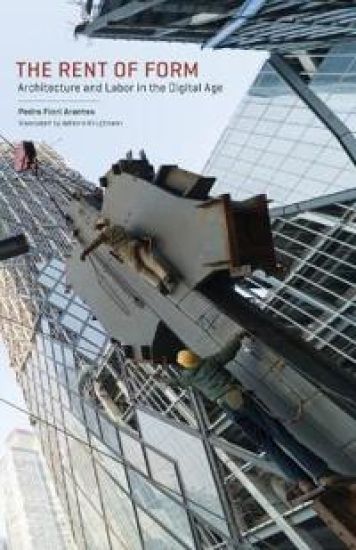
A critique of prominent architects’ approach to digitally driven design and labor practices over the past two decades With the advent of revolutionary digital design and production technologies, contemporary architects and their clients developed a taste for dramatic, unconventional forms. Seeking to amaze their audiences and promote their global brands, “starchitects” like Herzog & de Meuron and Frank Gehry have reaped substantial rewards through the pursuit of spectacle enabled by these new technologies. This process reached a climax in projects like Gehry’s Guggenheim Bilbao and the “Bilbao effect,” in which spectacular architectural designs became increasingly sought by municipal and institutional clients for their perceived capacity to enhance property values, which author Pedro Fiori Arantes calls the “rent of form.” Analyzing many major international architectural projects of the past twenty years, Arantes provides an in-depth account of how this “architecture of exception” has come to dominate today’s industry. Articulating an original, compelling critique of the capital and labor practices that enable many contemporary projects, Arantes explains how circulation (via image culture), consumption (particularly through tourism), the division of labor, and the distribution of wealth came to fix a certain notion of starchitecture at the center of the industry. Significantly, Arantes’s viewpoint is not that of Euro-American capitalism. Writing from the Global South, this Brazilian theorist offers a fresh perspective that advances ideas less commonly circulated in dominant, English-language academic and popular discourse. Asking key questions about the prevailing logics of finance capital, and revealing inconvenient truths about the changing labor of design and the treatment of construction workers around the world, The Rent of Form delivers a much-needed reevaluation of the astonishing buildings that have increasingly come to define world cities.
The Rent of Form

The Rent of Form

Pedro Fiori Arantes; Reinhold Martin

University of Minnesota Press
2019
sidottu
A critique of prominent architects’ approach to digitally driven design and labor practices over the past two decades With the advent of revolutionary digital design and production technologies, contemporary architects and their clients developed a taste for dramatic, unconventional forms. Seeking to amaze their audiences and promote their global brands, “starchitects” like Herzog & de Meuron and Frank Gehry have reaped substantial rewards through the pursuit of spectacle enabled by these new technologies. This process reached a climax in projects like Gehry’s Guggenheim Bilbao and the “Bilbao effect,” in which spectacular architectural designs became increasingly sought by municipal and institutional clients for their perceived capacity to enhance property values, which author Pedro Fiori Arantes calls the “rent of form.” Analyzing many major international architectural projects of the past twenty years, Arantes provides an in-depth account of how this “architecture of exception” has come to dominate today’s industry. Articulating an original, compelling critique of the capital and labor practices that enable many contemporary projects, Arantes explains how circulation (via image culture), consumption (particularly through tourism), the division of labor, and the distribution of wealth came to fix a certain notion of starchitecture at the center of the industry. Significantly, Arantes’s viewpoint is not that of Euro-American capitalism. Writing from the Global South, this Brazilian theorist offers a fresh perspective that advances ideas less commonly circulated in dominant, English-language academic and popular discourse. Asking key questions about the prevailing logics of finance capital, and revealing inconvenient truths about the changing labor of design and the treatment of construction workers around the world, The Rent of Form delivers a much-needed reevaluation of the astonishing buildings that have increasingly come to define world cities.
On Accident

On Accident

Edward Eigen; Reinhold Martin

MIT Press
2018
pokkari
Engaging essays that roam across uncertain territory, in search of sunken forests, unclassifiable islands, inflammable skies, plagiarized tabernacles, and other phenomena missing from architectural history. This collection by "architectural history's most beguiling essayist" (as Reinhold Martin calls the author in the book's foreword) illuminates the unfamiliar, the arcane, the obscure-phenomena largely missing from architectural and landscape history. These essays by Edward Eigen do not walk in a straight line, but roam across uncertain territory, discovering sunken forests, unclassifiable islands, inflammable skies, unvisited shores, plagiarized tabernacles. Taken together, these texts offer a group portrait of how certain things fall apart. We read about the statistical investigation of lightning strikes in France by the author-astronomer Camille Flammarion, which leads Eigen to reflect also on Foucault, Hamlet, and the role of the anecdote in architectural history. We learn about, among other things, Olmsted's role in transforming landscape gardening into landscape architecture; the connections among hedging, hedge funds, the High Line, and GPS bandwidth; timber-frame roofs and (spider) web-based learning; the archives of the Houses of Parliament through flood and fire; and what the 1898 disappearance and reappearance of the Trenton, New Jersey architect William W. Slack might tell us about the conflict between "the migratory impulse" and "love of home." Eigen compares his essays to the "gathering up of seeds that fell by the wayside." The seedlings that result create in the reader's imagination a dazzling display of the particular, the contingent, the incidental, and the singular, all in search of a narrative.
The Urban Apparatus

The Urban Apparatus

Reinhold Martin

University of Minnesota Press
2016
nidottu
Urbanization is a system of power and knowledge, and today’s city functions through the expansive material infrastructures of the urban order. In The Urban Apparatus, Reinhold Martin analyzes urbanization and the contemporary city in aesthetic, socioeconomic, and mediapolitical terms. He argues that understanding the city as infrastructure reveals urbanization to be a way of imparting functional, aesthetic, and cognitive order to a contradictory, doubly bound neoliberal regime. Blending critical philosophy, political theory, and media theory, The Urban Apparatus explores how the aesthetics of cities and their political economies overlap. In a series of ten essays, with a detailed theoretical introduction, Martin explores questions related to urban life, drawn from a wide range of global topics-from the fiscal crisis in Detroit to speculative development in Mumbai to the landscape of Mars, from discussions of race and the environment to housing and economic inequality. Each essay proposes a particular “mediator” (or a material complex) that is shaped by imaginative practices, each answering the question “What is a city, today?” The Urban Apparatus serves as an “urban” bookend to the architectural questions explored by Martin in his earlier book Utopia’s Ghost, and ultimately offers readers a way to think politically about urbanization.
The Urban Apparatus

The Urban Apparatus

Reinhold Martin

University of Minnesota Press
2016
sidottu
Urbanization is a system of power and knowledge, and today's city functions through the expansive material infrastructures of the urban order. In The Urban Apparatus, Reinhold Martin analyzes urbanization and the contemporary city in aesthetic, socioeconomic, and mediapolitical terms. He argues that understanding the city as infrastructure reveals urbanization to be a way of imparting functional, aesthetic, and cognitive order to a contradictory, doubly bound neoliberal regime. Blending critical philosophy, political theory, and media theory, The Urban Apparatus explores how the aesthetics of cities and their political economies overlap. In a series of ten essays, with a detailed theoretical introduction, Martin explores questions related to urban life, drawn from a wide range of global topics-from the fiscal crisis in Detroit to speculative development in Mumbai to the landscape of Mars, from discussions of race and the environment to housing and economic inequality. Each essay proposes a particular "mediator" (or a material complex) that is shaped by imaginative practices, each answering the question "What is a city, today?" The Urban Apparatus serves as an "urban" bookend to the architectural questions explored by Martin in his earlier book Utopia's Ghost, and ultimately offers readers a way to think politically about urbanization.
Mediators

Mediators

Reinhold Martin

University of Minnesota Press
2014
pokkari
Reinhold Martin’s Mediators is a series of linked meditations on the globalized city. Focusing on infrastructural, technical, and social systems, Martin explores how the aesthetics and the political economy of cities overlap and interact. He discusses a range of subjects, including the architecture of finance written into urban policy, regimes of enumeration that remix city and country, fictional ecologies that rewrite biopolitics, the ruins of socialism strewn amid the transnational commons, and memories of revolution stored in everyday urban hardware. For Martin, these mediators-the objects, processes, and imaginaries from which these phenomena emerge-serve to explain disparate fragments of a global urbanity. Forerunners: Ideas First is a thought-in-process series of breakthrough digital publications. Written between fresh ideas and finished books, Forerunners draws on scholarly work initiated in notable blogs, social media, conference plenaries, journal articles, and the synergy of academic exchange. This is gray literature publishing: where intense thinking, change, and speculation take place in scholarship.
Foreclosed

Foreclosed

Barry Bergdoll; Reinhold Martin

Museum of Modern Art
2012
nidottu
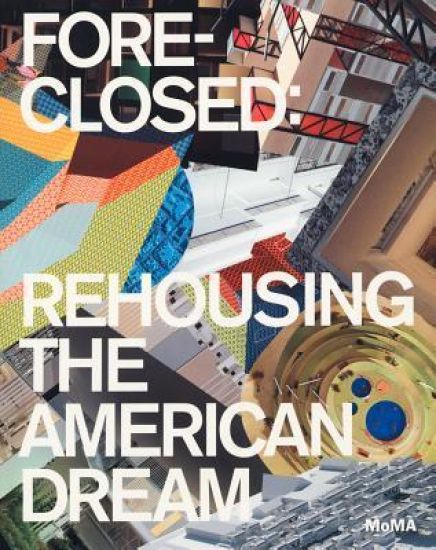
Foreclosed: Rehousing the American Dream is an exploration of new architectural possibilities for American cities and suburbs in the aftermath of the recent foreclosure crisis in the United States. During the summer of 2011, five interdisciplinary teams of architects, urban planners, ecologists, engineers, and landscape designers were enlisted by The Museum of Modern Art, New York, and MoMA PS1 to envision new housing infrastructures that could catalyze urban transformation, particularly in the country’s suburbs. Drawing on ideas proposed in The Buell Hypothesis, a research publication by Temple Hoyne Buell Center for the Study of American Architecture at Columbia University, each team focused on a specific ‘mega region’, a metropolitan area between two major cities, to come up with inventive solutions for the future of housing and cities, to be exhibited at MoMA in Spring 2012. This publication presents each of these proposals in detail, through photographs, drawings, and renderings as well as interviews with the team leaders. With essays by Barry Bergdoll, MoMA’s Philip Johnson Chief Curator of Architecture and Design, and Reinhold Martin, Director of the Temple Hoyne Buell Center, Foreclosed examines the relationship between land, infrastructures, and urban form in today’s cities and suburbs, and presents a potentially different future for housing in the United States.
Utopia's Ghost

Utopia's Ghost

Reinhold Martin

University of Minnesota Press
2010
nidottu
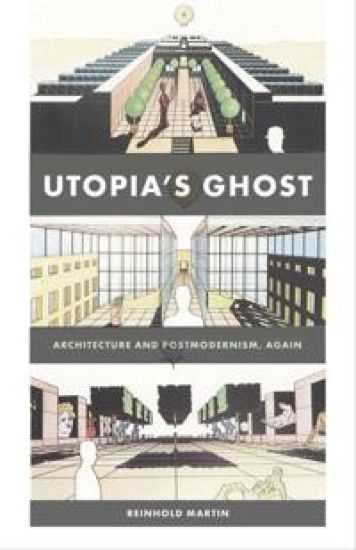
Architectural postmodernism had a significant impact on the broader development of postmodern thought: Utopia’s Ghost is a critical reconsideration of their relationship. Combining discourse analysis, historical reconstruction, and close readings of buildings, projects, and texts from the 1970s and 1980s, Reinhold Martin argues that retheorizing postmodern architecture gives us new insights into cultural postmodernism and its aftermath. Much of today’s discussion has turned to the recovery of modernity, but Martin writes in the Introduction, “Simply to historicize postmodernism seems inadequate and, in many ways, premature.” Utopia’s Ghost connects architecture to current debates on biopolitics, neoliberalism, and corporate globalization as they are haunted by the problem of utopia. Exploring a series of concepts-territory, history, language, image, materiality, subjectivity, and architecture itself-Martin shows how they reorganize the cultural imaginary and shape a contemporary biopolitics that ultimately precludes utopian thought. Written at the intersection of culture, politics, and the city, particularly in the context of corporate globalization, Utopia’s Ghost challenges dominant theoretical paradigms and opens new avenues for architectural scholarship and cultural analysis.
The Organizational Complex

The Organizational Complex

Reinhold Martin

MIT Press
2005
pokkari
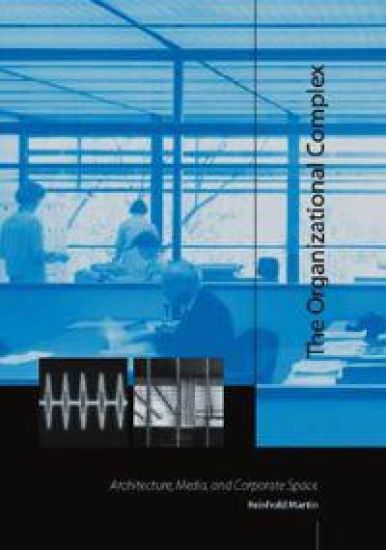
A historical and theoretical analysis of corporate architecture in the United States after the Second World War. The Organizational Complex is a historical and theoretical analysis of corporate architecture in the United States after the Second World War. Its title refers to the aesthetic and technological extension of the military-industrial complex, in which architecture, computers, and corporations formed a network of objects, images, and discourses that realigned social relations and transformed the postwar landscape. In-depth case studies of architect Eero Saarinen's work for General Motors, IBM, and Bell Laboratories and analyses of office buildings designed by Skidmore, Owings & Merrill trace the emergence of a systems-based model of organization in architecture, in which the modular curtain wall acts as both an organizational device and a carrier of the corporate image. Such an image-of the corporation as a flexible, integrated system-is seen to correspond with a "humanization" of corporate life, as corporations decentralize both spatially and administratively. Parallel analyses follow the assimilation of cybernetics into aesthetics in the writings of artist and visual theorist Gyorgy Kepes, as art merges with techno-science in the service of a dynamic new "pattern-seeing." Image and system thus converge in the organizational complex, while top-down power dissolves into networked, pattern-based control. Architecture, as one among many media technologies, supplies the patterns-images of organic integration designed to regulate new and unstable human-machine assemblages.