Kirjailija
René Appel
Kirjat ja teokset yhdessä paikassa: 6 kirjaa, julkaisuja vuosilta 1984–2024, suosituimpiin kuuluu Immigrant Children Learning Dutch. Vertaile teosten hintoja ja tarkista saatavuus suomalaisista kirjakaupoista.
Nimi esiintyy myös muodoissa: Rene Appel
6 kirjaa
Kirjojen julkaisuvuodet: 1984–2024.


Up-and-coming Amsterdam lawyer David Driessen thinks he's hit the jackpot when a wealthy client showers him with praise, glamour, and plenty of money. But David learns far too late that every gift from the shady realtor comes with a catch-and a price tag. As his gambling addiction, his constant need for cash, and his wife's infidelities combine to drag him deeper and deeper into his client's twisted world of money and despair, David struggles to stay ahead of it all... before his time runs out. In The Amsterdam Lawyer, Ren Appel-two-time winner of the Golden Noose, The Netherlands' equivalent of the Mystery Writers of America's Edgar Allan Poe Award-once again demonstrates the skill that led leading Dutch daily newspaper Algemeen Dagblad to proclaim him "the godfather of the Dutch psychological thriller.""A fascinating novel, bubbling over with greed, mistrust, and ruthlessness." Gijs Korevaar, Algemeen Dagblad"Ren Appel is a first-rate Dutch crime writer. The Amsterdam Lawyer is a compelling and twisted legal thriller, the first of what will hopefully be many of his books to appear in English." Steve Steinbock, reviewer for Ellery Queen's Mystery Magazine
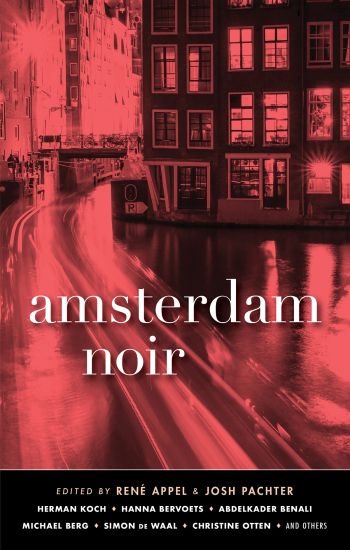
Akashic Books continues its award-winning series of original noir anthologies, launched in 2004 with Brooklyn Noir. Each book comprises all new stories, each one set in a distinct neighborhood or location within the respective city. Brand-new stories by: Michael Berg, Anneloes Timmerije, Murat Isik, Ren Appel, Josh Pachter, Simon de Waal, Hanna Bervoets, Karin Amatmoekrim, Christine Otten, Mensje van Keulen, Max van Olden, Theo Capel, Loes den Hollander, Herman Koch, Abdelkader Benali, and Walter van den Berg. From the introduction by Ren Appel and Josh Pachter: Amsterdam has the amenities and, to a certain extent, the feel of a major world city, but one of its most attractive features is its relatively small size. It's easy to navigate on feet, by bike, and via its excellent public transportation network, especially with the semicircular perimeter of its famous Grachtengordel, or ring of concentric canals. Like any other metropolis, though, Amsterdam also has its dark side, its shadowy corners--in other words, there is also an Amsterdam noir. No matter how beautiful, vital, and cheery a city might be, pure human emotions such as greed, jealousy, and the thirst for revenge will rear their ugly heads...with all their negative consequences. Amsterdam is a multidimensional city, populated by a wide assortment of social groups, and not all of those groups agree on what constitutes normal social values and mores. This results in a lively mix...and, as you will see, in problems.
Language Contact and Bilingualism
Rene Appel; Pieter C. Muysken
Amsterdam University Press
2006
nidottu
What happens – sociologically, linguistically, educationally, politically – when more than one language is in regular use in a community? How do speakers handle these languages simultaneously, and what influence does this language contact have on the languages involved? Although most people in the world use more than one language in everyday life, the approach to the study of language has usually been that monolingualism is the norm. The recent interest in bilingualism and language contact has led to a number of new approaches, based on research in communities in many different parts of the world. This book draws together this diverse research, looking at examples from many different situations, to present the topic in any easily accessible form. Language contact is looked at from four distinct perspectives. The authors consider bilingual societies; bilingual speakers; language use in the bilingual community; finally language itself (do languages change when in contact with each other? Can they borrow rules of grammar, or just words? How can new languages emerge from language contact?). The result is a clear, concise synthesis offering a much-needed overview of this lively area of language study.