
Kirjojen hintavertailu – 12 859 828 kirjaa ja 27 kauppaa

Kirjailija

Rene Kemp

Kirjat ja teokset yhdessä paikassa: 3 kirjaa, julkaisuja vuosilta 1997–2002, suosituimpiin kuuluu Experimenting for Sustainable Transport. Vertaile teosten hintoja ja tarkista saatavuus suomalaisista kirjakaupoista.

Nimi esiintyy myös muodoissa: René Kemp

3 kirjaa

Kirjojen julkaisuvuodet: 1997–2002.

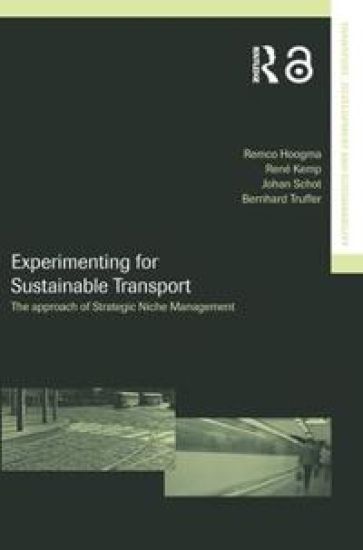
Experimenting for Sustainable Transport

Experimenting for Sustainable Transport

Remco Hoogma; Rene Kemp; Johan Schot; Bernhard Truffer

Routledge
2002
nidottu
Technological change is a central feature of modern societies and a powerful source for social change. There is an urgent task to direct these new technologies towards sustainability, but society lacks perspectives, instruments and policies to accomplish this. There is no blueprint for a sustainable future, and it is necessary to experiment with alternative paths that seem promising. Various new transport technologies promise to bring sustainability benefits. But as this book shows, important lessons are often overlooked because the experiments are not designed to challenge the basic assumptions about established patterns of transport choices. Learning how to organise the process of innovation implementation is essential if the maximum impact is to be achieved - it is here that strategic niche management offers new perspectives. The book uses a series of eight recent experiments with electric vehicles, carsharing schemes, bicycle pools and fleet management to illustrate the means by which technological change must be closely linked to social change if successful implementation is to take place. The basic divide between proponents of technological fixes and those in favour of behavioural change needs to be bridged, perhaps indicating a third way.
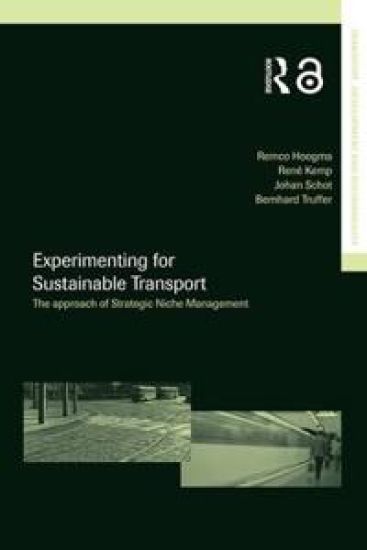
Experimenting for Sustainable Transport

Experimenting for Sustainable Transport

Remco Hoogma; Rene Kemp; Johan Schot; Bernhard Truffer

Routledge
2002
sidottu
Technological change is a central feature of modern societies and a powerful source for social change. There is an urgent task to direct these new technologies towards sustainability, but society lacks perspectives, instruments and policies to accomplish this. There is no blueprint for a sustainable future, and it is necessary to experiment with alternative paths that seem promising. Various new transport technologies promise to bring sustainability benefits. But as this book shows, important lessons are often overlooked because the experiments are not designed to challenge the basic assumptions about established patterns of transport choices. Learning how to organise the process of innovation implementation is essential if the maximum impact is to be achieved - it is here that strategic niche management offers new perspectives. The book uses a series of eight recent experiments with electric vehicles, carsharing schemes, bicycle pools and fleet management to illustrate the means by which technological change must be closely linked to social change if successful implementation is to take place. The basic divide between proponents of technological fixes and those in favour of behavioural change needs to be bridged, perhaps indicating a third way.
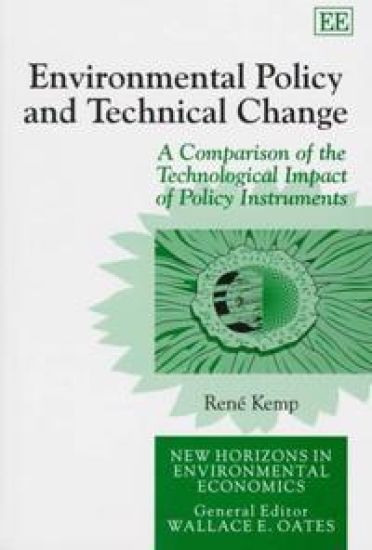
Environmental Policy and Technical Change

Environmental Policy and Technical Change

René Kemp

Edward Elgar Publishing Ltd
1997
sidottu
Environmental Policy and Technical Change assesses the impact of environmental policy on technical change in cleaner technology. It focuses in particular on the possibility of inducing radical change in technology - a topic that is likely to move to the centre of the policy debate as people discover that incremental changes are not enough to achieve environmental sustainability. This innovative book sheds new light on the relationship between clean technology and environmental policy. It adopts an approach which combines a balance of both theoretical models of innovation and diffusion with empirical case studies. Dr Kemp examines policies such as subsidies, tradeable quotas, pollution taxes and emission standards in how they affect technical choices. Suggestions are offered on how environmental policies may be (re)designed towards the efficient conservation of environmental qualities by encouraging innovation in environmental benign technology. This important book will be essential reading for both researchers and environmental economists concerned with environmental policy and technical innovation.