Kirjojen hintavertailu – 12 903 724 kirjaa ja 27 kauppaa

Kirjailija

Restif de la Bretonne

Kirjat ja teokset yhdessä paikassa: 28 kirjaa, julkaisuja vuosilta 2010–2025, suosituimpiin kuuluu Contes de Restif de la Bretonne; Le Pied de Fanchette, ou, le Soulier couleur de rose. Vertaile teosten hintoja ja tarkista saatavuus suomalaisista kirjakaupoista.

28 kirjaa

Kirjojen julkaisuvuodet: 2010–2025.

Contes de Restif de la Bretonne; Le Pied de Fanchette, ou, le Soulier couleur de rose
Contes de Restif de la Bretonne; Le Pied de Fanchette, ou, le Soulier couleur de rose"", constitue un phare dans le monde du livre, comblant le foss entre le pass et le pr sent. Autrefois consid r parmi les livres anciens, cet ouvrage classique, comme tant de livres anciens et oubli s, a fa onn notre compr hension de la culture et de l'histoire. exemple remarquable de livres d'histoire qui ont influenc des g n rations, et maintenant, gr ce au d vouement d'Alpha Editions, votre diteur de livres de confiance, il rena t dans un format frais et l gant. Nous avons soigneusement retap , remani et am lior ce livre pour qu'il soit bien plus qu'un simple titre lire. Vous pouvez d sormais profiter de pages claires et faciles lire, sans num risation floue ni texte d color . En choisissant cette dition, vous investissez dans plus qu'un livre: vous sauvegardez un h ritage. Votre soutien maintient en vie un morceau remarquable du patrimoine humain, garantissant que ses le ons et ses inspirations continuent de r sonner dans le futur.

Les nuits de Paris, ou le Spectateur nocturne. ... of 7

Les nuits de Paris, ou le Spectateur nocturne. ... of 7

Restif de la Bretonne

Hutson Street Press
2025
nidottu
The 18th century was a wealth of knowledge, exploration and rapidly growing technology and expanding record-keeping made possible by advances in the printing press. In its determination to preserve the century of revolution, Gale initiated a revolution of its own: digitization of epic proportions to preserve these invaluable works in the largest archive of its kind. Now for the first time these high-quality digital copies of original 18th century manuscripts are available in print, making them highly accessible to libraries, undergraduate students, and independent scholars. Western literary study flows out of eighteenth-century works by Alexander Pope, Daniel Defoe, Henry Fielding, Frances Burney, Denis Diderot, Johann Gottfried Herder, Johann Wolfgang von Goethe, and others. Experience the birth of the modern novel, or compare the development of language using dictionaries and grammar discourses. ++++ The below data was compiled from various identification fields in the bibliographic record of this title. This data is provided as an additional tool in helping to insure edition identification: ++++ British Library T064528 Seven vols. in fourteen parts with a supplementary volume 'La semaire nocturne', Paris, 1790. Londres: et se trouve a Paris, 1788-89. 7v.(3359p.), plates; 12 This work has been selected by scholars as being culturally important, and is part of the knowledge base of civilization as we know it. This work was reproduced from the original artifact, and remains as true to the original work as possible. Therefore, you will see the original copyright references, library stamps (as most of these works have been housed in our most important libraries around the world), and other notations in the work. This work is in the public domain in the United States of America, and possibly other nations. Within the United States, you may freely copy and distribute this work, as no entity (individual or corporate) has a copyright on the body of the work. As a reproduction of a historical artifact, this work may contain missing or blurred pages, poor pictures, errant marks, etc. Scholars believe, and we concur, that this work is important enough to be preserved, reproduced, and made generally available to the public. We appreciate your support of the preservation process, and thank you for being an important part of keeping this knowledge alive and relevant.
Monument du costume physique et moral de la fin du dix-huitième siècle; on tableaux de la vie. ... of 2
The 18th century was a wealth of knowledge, exploration and rapidly growing technology and expanding record-keeping made possible by advances in the printing press. In its determination to preserve the century of revolution, Gale initiated a revolution of its own: digitization of epic proportions to preserve these invaluable works in the largest archive of its kind. Now for the first time these high-quality digital copies of original 18th century manuscripts are available in print, making them highly accessible to libraries, undergraduate students, and independent scholars. The eighteenth-century fascination with Greek and Roman antiquity followed the systematic excavation of the ruins at Pompeii and Herculaneum in southern Italy; and after 1750 a neoclassical style dominated all artistic fields. The titles here trace developments in mostly English-language works on painting, sculpture, architecture, music, theater, and other disciplines. Instructional works on musical instruments, catalogs of art objects, comic operas, and more are also included. ++++ The below data was compiled from various identification fields in the bibliographic record of this title. This data is provided as an additional tool in helping to insure edition identification: ++++ British Library T124306 The 'Avis des diteurs' names the author as: M. Ret. de la B., i.e. Restif de la Bretonne. The frontispieces have titles in English as well as French. Londres: chez C. Dilly, 1790. 2v., plates; 8 This work has been selected by scholars as being culturally important, and is part of the knowledge base of civilization as we know it. This work was reproduced from the original artifact, and remains as true to the original work as possible. Therefore, you will see the original copyright references, library stamps (as most of these works have been housed in our most important libraries around the world), and other notations in the work. This work is in the public domain in the United States of America, and possibly other nations. Within the United States, you may freely copy and distribute this work, as no entity (individual or corporate) has a copyright on the body of the work. As a reproduction of a historical artifact, this work may contain missing or blurred pages, poor pictures, errant marks, etc. Scholars believe, and we concur, that this work is important enough to be preserved, reproduced, and made generally available to the public. We appreciate your support of the preservation process, and thank you for being an important part of keeping this knowledge alive and relevant.
Monument du costume physique et moral de la fin du dix-huitième siècle; on tableaux de la vie. ... of 2
The 18th century was a wealth of knowledge, exploration and rapidly growing technology and expanding record-keeping made possible by advances in the printing press. In its determination to preserve the century of revolution, Gale initiated a revolution of its own: digitization of epic proportions to preserve these invaluable works in the largest archive of its kind. Now for the first time these high-quality digital copies of original 18th century manuscripts are available in print, making them highly accessible to libraries, undergraduate students, and independent scholars. The eighteenth-century fascination with Greek and Roman antiquity followed the systematic excavation of the ruins at Pompeii and Herculaneum in southern Italy; and after 1750 a neoclassical style dominated all artistic fields. The titles here trace developments in mostly English-language works on painting, sculpture, architecture, music, theater, and other disciplines. Instructional works on musical instruments, catalogs of art objects, comic operas, and more are also included. ++++ The below data was compiled from various identification fields in the bibliographic record of this title. This data is provided as an additional tool in helping to insure edition identification: ++++ British Library T124306 The 'Avis des diteurs' names the author as: M. Ret. de la B., i.e. Restif de la Bretonne. The frontispieces have titles in English as well as French. Londres: chez C. Dilly, 1790. 2v., plates; 8 This work has been selected by scholars as being culturally important, and is part of the knowledge base of civilization as we know it. This work was reproduced from the original artifact, and remains as true to the original work as possible. Therefore, you will see the original copyright references, library stamps (as most of these works have been housed in our most important libraries around the world), and other notations in the work. This work is in the public domain in the United States of America, and possibly other nations. Within the United States, you may freely copy and distribute this work, as no entity (individual or corporate) has a copyright on the body of the work. As a reproduction of a historical artifact, this work may contain missing or blurred pages, poor pictures, errant marks, etc. Scholars believe, and we concur, that this work is important enough to be preserved, reproduced, and made generally available to the public. We appreciate your support of the preservation process, and thank you for being an important part of keeping this knowledge alive and relevant.
L'Anti-Justine; ou, Les Delices de l'amour

L'Anti-Justine; ou, Les Delices de l'amour

Restif de la Bretonne

ALPHA EDITION
2024
pokkari
L'Anti-Justine; ou, Les Delices de l'amour"", constitue un phare dans le monde du livre, comblant le foss entre le pass et le pr sent. Autrefois consid r parmi les livres anciens, cet ouvrage classique, comme tant de livres anciens et oubli s, a fa onn notre compr hension de la culture et de l'histoire. exemple remarquable de livres d'histoire qui ont influenc des g n rations, et maintenant, gr ce au d vouement d'Alpha Editions, votre diteur de livres de confiance, il rena t dans un format frais et l gant. Nous avons soigneusement retap , remani et am lior ce livre pour qu'il soit bien plus qu'un simple titre lire. Vous pouvez d sormais profiter de pages claires et faciles lire, sans num risation floue ni texte d color . En choisissant cette dition, vous investissez dans plus qu'un livre: vous sauvegardez un h ritage. Votre soutien maintient en vie un morceau remarquable du patrimoine humain, garantissant que ses le ons et ses inspirations continuent de r sonner dans le futur.
Lettre d'un singe aux animaux de son espèce

Lettre d'un singe aux animaux de son espèce

Restif de la Bretonne

Culturea
2022
pokkari
Avis de l' diteur: Honorable lecteur: Je vous fais part de cette trange Lettre, crite par un Singe-Babouin. Mais que cette assertion ne r volte pas votre raison, et ne vous fasse point secouer la t te avec m pris Le Singe dont il est ici question est un m tis, qui doit le jour une femme de Malacca et un Babouin. Cette femme tant accouch e d'un Singe-homme, le monstre lui fit horreur: on allait le noyer, quand un Europ en-fran ais-hollandis , nomm Jacques Adine, qui commer ait dans la presqu' le de Singapour o il tait venu de la Chine, pria qu'on le lui donn t. Il l' leva soigneusement. Lorsque C sar-singe a t instruit, il s'est imagin que ses -peu-pr s seraient capables d'acqu rir les m mes id es: il se proposa donc, non de leur envoyer sa Lettre, qu'ils n'auraient pas lue, mais d'en d biter le contenu ceux qu'il aurait occasion de joindre. Nous devons cette Pi ce curieuse l'erreur o il tait qu'il pourrait se faire entendre des autres Singes. Dans les Notes indiqu es par les renvois du texte, vous trouverez les claircissements les plus d taill s sur les diff rentes sortes de singes: Je me propose par l , d' tre doublement utile, en faisant conna tre une esp ce d' tres aussi voisine de la n tre que celle du Singe, et en pr sentant les v rit s fortes contenues dans une pi ce absolument originale par la nature de son auteur. Voil ce que j'avais dire, honorable lecteur, avant de mettre sous vos yeux la Lettre extraordinaire que vous allez lire.
Le diable boiteux

Le diable boiteux

Restif de la Bretonne

Culturea
2022
pokkari
Une nuit du mois d'octobre couvrait d' paisses t n bres la c l bre ville de Madrid: d j le peuple, retir chez lui, laissait les rues libres aux amants qui voulaient chanter leurs peines ou leurs plaisirs sous les balcons de leurs ma tresses; d j le son des guitares causait de l'inqui tude aux p res, et alarmait les maris jaloux; enfin il tait pr s de minuit, lorsque don Cl ophas L andro Perez Zambullo, colier d'Alcala, sortit brusquement par une lucarne d'une maison o le fils indiscret de la d esse de Cyth re l'avait fait entrer. Il t chait de conserver sa vie et son honneur, en s'effor ant d' chapper trois ou quatre spadassins qui le suivaient de pr s pour le tuer, ou pour lui faire pouser par force une dame avec laquelle ils venaient de le surprendre. Quoique seul contre eux, il s' tait d fendu vaillamment, et il n'avait pris la fuite que parce qu'ils lui avaient enlev son p e dans le combat. Ils le poursuivirent quelque temps sur les toits; mais il trompa leur poursuite la faveur de l'obscurit ; il marcha vers une lumi re qu'il aper ut de loin, et qui, toute faible qu'elle tait, lui servit de fanal dans une conjoncture si p rilleuse. Apr s avoir plus d'une fois couru le risque de se rompre le cou, il arriva pr s d'un grenier d'o sortaient les rayons de cette lumi re, et il entra dedans par la fen tre, aussi transport de joie qu'un pilote qui voit heureusement surgir au port son vaisseau menac du naufrage.
The Pornographer

The Pornographer

Restif de la Bretonne

Sunny Lou Publishing
2021
pokkari
The Pornographer (Le Pornographe), written by Restif de la Bretonne and published in 1770 originally, is a novel, in epistolary format, that includes a serious proposal of rules for prostitution, at a state level, to address the problem of syphilis ravaging Europe at the time, as well as a counteractive to the degradation of public morality. To say that French author Nicolas Restif de la Bretonne (1734-1806) was ahead of his time is, for anyone who knows his work, - and they are few - so platitudinous itʼs not funny. The man had an uncanny ability to synthesize history as far back as the Greeks, and that of his own pre-Napoleonic era, and to project it onto our present, his future, as easily as a man casting a shadow on the ground at 3 pm. His ideas on the inequality of the classes, for instance, as a main cause of modern prostitution are both simple and brilliant. His strong words against the poor treatment of Native Americans immediately after the discovery of the New World, from which event syphilis was imported into Europe, is painfully relevant. His support of the working class (the "third estate") and womenʼs rights over that of nobility, Church, and males anticipated ideas later encoded in the laws of Western societies, and the struggles today to keep said laws "honest." Would it surprise any one of his readers that he probably coined the term "Pornographer," over two hundred twenty-five years before the popularization of the Internet? With an eerily hyper-modern, politically correct, opinion on many things - he would have fit in most perfectly in this third decade of the twenty-first century, making many of us modern folk appear old-fashioned and dull - as perhaps no other 18th-century man of letters of France, or of any European country for that matter, could.
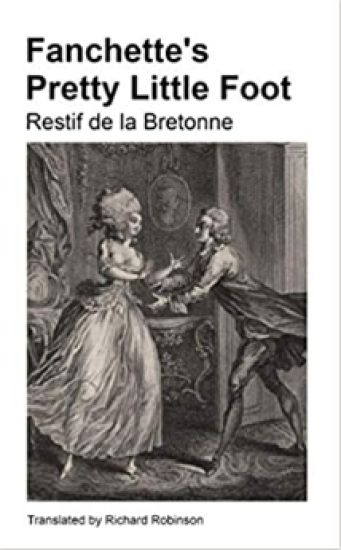
Fanchette's Pretty Little Foot

Fanchette's Pretty Little Foot

Restif de la Bretonne

Sunny Lou Publishing
2020
pokkari
Fanchetteʼs Pretty Little Foot (originally Le Pied de Fanchette in French), a novel by Restif de la Bretonne, was first published in 1769. The story is a cross between the fairytale Cinderella, from 1697, and Samuel Richardsonʼs moral story (actually libertine novel) Pamela, or Virtue Rewarded, from 1740. Now, Cinderella, or The Little Glass Slipper was originally a folktale dating back at least 2000 years ago to a similar tale from Greece or Egypt, but it was made famous in the modern era (at least for Western audiences) with the 17th-century publication of French writer Charles Perraultʼs version of the tale, and more recently still by the 20th-century release of Walt Disneyʼs animated movie. But one does not have to be a scholar of French fairytales, Hollywood movies, or 18th-century English libertine novels to appreciate this simple, but delightful tale about a young and virtuous bourgeois girl, the daughter of a wealthy fabric merchant, whose parents die while sheʼs still a teenager, leaving her to fateʼs fortune in then-naughty Paris. She is pretty as a belle sic] and even more virtuous, but it is her prettier little foot in especial that gets her into all kinds of trouble. Who would have thought that a girlʼs foot, embellished by a rich slipper, could be so attractive and seductive? Leave it to the French to capitalize on that. Or leave it to Restif de la Bretonne in this charming story, which is really a comedy, to bring it front and center. Interestingly, this novel was the first to give a name to a sensual preference called shoe fetishism, or "retifism" in French (after the authorʼs name).
Monsieur Nicolas' Abenteuer im Lande der Liebe (Ein Erotik Klassiker)
Monsieur Nicolas' Abenteuer im Lande der Liebe ist ein autobiographisches Werk von Nicolas Edme Restif de la Bretonne, erstmal 1796-1797 ver ffentlicht. Der bersetzer blieb unbekannt. Nicolas Edme Restif de la Bretonne, auch bekannt als R tif de la Bretonne (1734 - 1806) war ein franz sischer Romancier und Wegbereiter des Verismus und Naturalismus. Im deutschen Sprachraum berwiegt die Schreibweise "Retif," in der brigen Welt "Restif." R tif de la Bretonne gilt oft als blo er Pornograf. Tats chlich hat er aber eine Erg nzung zu Sades Bild der Aristokratie in seinen freiz gigen Schilderungen der niederen St nde geliefert. De Sade war ein Kontrahent R tifs. Seine sexuelle Fixierung auf Schuhe, geschildert in dem Roman Le Pied de Fanchette, f hrte zu der Bezeichnung Retifismus f r diese Art von Fetischismus. Zu seinen skurrilsten Einf llen geh rt die Idee, per Gesetz die Verheiratung aller 16-j hrigen M nner mit 32-j hrigen Frauen zu gebieten. Nach 16 Jahren sollten diese Ehen automatisch geschieden werden, um dann wiederum eine j ngere zu heiraten. Vergleichbare Ideen hat auch Arthur Schopenhauer ge u ert. Als Schilderer der Sitten der franz sischen Revolutionszeit hat ihn Iwan Bloch gew rdigt. Retif konnte sich r hmen jenseits des Rheins der meistgelesene (franz sische) Autor zu sein. Warnung: dies ist ein erotischer Klassiker der Weltliteratur, keine Pornographie im heutigen Sinn.