Kirjojen hintavertailu – 12 867 092 kirjaa ja 27 kauppaa

Kirjailija

Rhonda Phillips

Kirjat ja teokset yhdessä paikassa: 9 kirjaa, julkaisuja vuosilta 2002–2022, suosituimpiin kuuluu Sustainable Communities. Vertaile teosten hintoja ja tarkista saatavuus suomalaisista kirjakaupoista.

9 kirjaa

Kirjojen julkaisuvuodet: 2002–2022.

Rebooting Local Economies

Rebooting Local Economies

Robert Pittman; Rhonda Phillips

BUSINESS EXPERT PRESS
2022
pokkari
A prosperous future for your community is in your hands! Make your community a better place to live, work and play! Why do some communities thrive and grow while others struggle and decline? Smart communities know how to attract and nurture the kinds of businesses and organizations they want to create a vibrant economy and higher quality of life. The more that elected officials and all residents know about community and economic development the more the community will prosper. How to Build Prosperous Communities is a practical guide to help communities reach their goals for prosperity. Numerous examples throughout the book show how communities and regions of all sizes have attained and maintained prosperity in a constantly changing environment. The book is based on the authors' years of experience helping communities and regions across the country and around the world create their roadmaps to prosperity with better jobs, improved public services, and enhanced amenities.

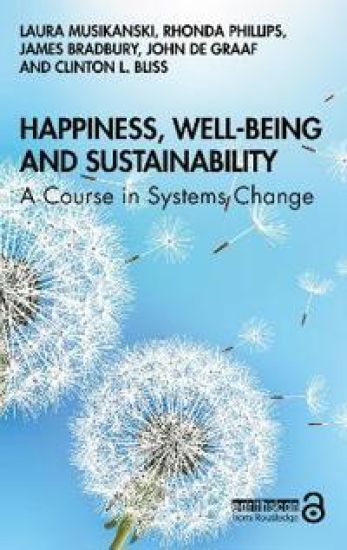
Happiness, Well-being and Sustainability

Happiness, Well-being and Sustainability

Laura Musikanski; Rhonda Phillips; James Bradbury; John de Graaf; Clinton Bliss

Routledge
2020
sidottu
Happiness, Well-being and Sustainability: A Course in Systems Change is the first textbook bridging the gap between personal happiness and sustainable social change. The book provides a guide for students to increase their skills, literacy and knowledge about connections between a sense of well-being and systems change. Further, it can help students live a life that brings them happiness and contributes to the well-being of others and the sustainability of our planet. The book is presented in seven chapters covering the subjects of systems thinking, personal and societal values, measuring happiness, human needs, ecological sustainability and public policy. In addition, each section includes engaging exercises to empower students to develop their own ideas, prompts for group discussion, suggestions for additional research and an extensive list of resources and references. The book is written in the context of systems thinking with a style that is approachable and accessible. Happiness, Well-being and Sustainability provides essential reading for students in courses on happiness, social change and sustainability studies, and provides a comprehensive framework for instructors looking to initiate courses in this field. A website to support the professors teaching the book is available at: https://www.happycounts.org/coursebook.htmlThe Open Access version of this book, available at http://www.taylorfrancis.com, has been made available under a Creative Commons Attribution-Non Commercial-No Derivatives (CC-BY-NC-ND) 4.0 license.”
Happiness, Well-being and Sustainability

Happiness, Well-being and Sustainability

Laura Musikanski; Rhonda Phillips; James Bradbury; John de Graaf; Clinton Bliss

Routledge
2020
nidottu
Happiness, Well-being and Sustainability: A Course in Systems Change is the first textbook bridging the gap between personal happiness and sustainable social change. The book provides a guide for students to increase their skills, literacy and knowledge about connections between a sense of well-being and systems change. Further, it can help students live a life that brings them happiness and contributes to the well-being of others and the sustainability of our planet. The book is presented in seven chapters covering the subjects of systems thinking, personal and societal values, measuring happiness, human needs, ecological sustainability and public policy. In addition, each section includes engaging exercises to empower students to develop their own ideas, prompts for group discussion, suggestions for additional research and an extensive list of resources and references. The book is written in the context of systems thinking with a style that is approachable and accessible. Happiness, Well-being and Sustainability provides essential reading for students in courses on happiness, social change and sustainability studies, and provides a comprehensive framework for instructors looking to initiate courses in this field. A website to support the professors teaching the book is available at: https://www.happycounts.org/coursebook.htmlThe Open Access version of this book, available at http://www.taylorfrancis.com, has been made available under a Creative Commons Attribution-Non Commercial-No Derivatives (CC-BY-NC-ND) 4.0 license.”
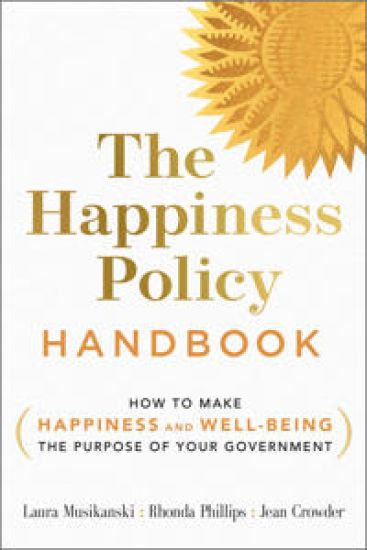
The Happiness Policy Handbook

The Happiness Policy Handbook

Laura Musikanski; Rhonda Phillips; Jean Crowder

New Society Publishers
2019
pokkari
Build a better society through happiness policyThomas Jefferson said that “the purpose of government is to enable the people of a nation to live in safety and happiness.” Yet only now, 270 years later, is the happiness of citizens starting to be taken seriously as the purpose of government. While happiness science is advancing rapidly, and governments and organizations are creating indices for measuring happiness, there is little practical information on how to create policy to advance happiness. Drawing from a deep well of expertise and experience, The Happiness Policy Handbook is the first step-by-step guide for integrating happiness into government policy at all levels. Coverage includes: A concise background on happiness science, indices and indicators, and happiness in public policy Tools for formulating happiness policy and integrating happiness into administrative functions A concept menu of happiness policies Communicating happiness policy objectives to media and engaging with the community A happiness policy screening tool for evaluating the happiness contribution of any policy Policy perspectives from seasoned experts across sectors. The Happiness Policy Handbook is the essential resource for policymakers and professionals working to integrate happiness and well-being into governmental processes and institutions.
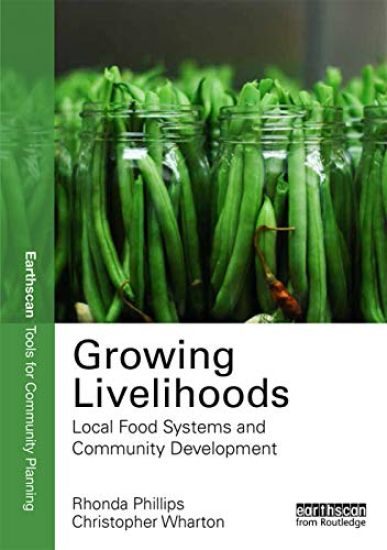
Growing Livelihoods

Growing Livelihoods

Rhonda Phillips; Chris Wharton

Routledge
2015
nidottu
Community planning is starting to include a broader food systems focus, spanning topics such as nutrition and health outcomes, sustainable farming practices, economic and social implications of local food production, distribution, and consumption. Together, these issues are a driving force for the passions of those seeking positive change in their communities through healthy food. The purpose of this book is to explore how and where local food and farms, as part of a local or regional food system, can positively impact both economic development and overall well-being of communities. Across North America, there are good examples of the ways in which innovative local food systems provide opportunities for: increasing job growth and entrepreneurship; retaining local farmers on their land while nourishing their community; and providing communities places to congregate, bond, and become closer-knit. Six such examples are highlighted, each illustrating a novel model offering unique contributions to community economic health and well-being. These important cases offer practitioners, advocates, academics, and students insight into how applications can be built or studied in their own communities.
Growing Livelihoods

Growing Livelihoods

Rhonda Phillips; Chris Wharton

Routledge
2015
sidottu
Community planning is starting to include a broader food systems focus, spanning topics such as nutrition and health outcomes, sustainable farming practices, economic and social implications of local food production, distribution, and consumption. Together, these issues are a driving force for the passions of those seeking positive change in their communities through healthy food. The purpose of this book is to explore how and where local food and farms, as part of a local or regional food system, can positively impact both economic development and overall well-being of communities. Across North America, there are good examples of the ways in which innovative local food systems provide opportunities for: increasing job growth and entrepreneurship; retaining local farmers on their land while nourishing their community; and providing communities places to congregate, bond, and become closer-knit. Six such examples are highlighted, each illustrating a novel model offering unique contributions to community economic health and well-being. These important cases offer practitioners, advocates, academics, and students insight into how applications can be built or studied in their own communities.
Sustainable Communities

Sustainable Communities

Rhonda Phillips; Bruce Seifer; Ed Antczak

Routledge
2013
sidottu
With a foreword written by Senator Bernie SandersWhat is a durable economy? It is one that not only survives but thrives. How is it created, and what does it take to sustain over time? Sustainable Communities provides insight and answers to these questions. Citing Burlington, Vermont's remarkable rise to award-winning status, this book explores the balance of community planning, social enterprise development, energy and environment, food systems and cultural well-being. Aimed at policymakers, development practitioners, students, and citizens, this book describes which and how multiple influences facilitate the creation of a local, durable and truly sustainable economy. The authors hope to inspire others by sharing this story of what can be done in the name of community economic development.
Sustainable Communities

Sustainable Communities

Rhonda Phillips; Bruce Seifer; Ed Antczak

Routledge
2013
nidottu
With a foreword written by Senator Bernie SandersWhat is a durable economy? It is one that not only survives but thrives. How is it created, and what does it take to sustain over time? Sustainable Communities provides insight and answers to these questions. Citing Burlington, Vermont's remarkable rise to award-winning status, this book explores the balance of community planning, social enterprise development, energy and environment, food systems and cultural well-being. Aimed at policymakers, development practitioners, students, and citizens, this book describes which and how multiple influences facilitate the creation of a local, durable and truly sustainable economy. The authors hope to inspire others by sharing this story of what can be done in the name of community economic development.
Concept Marketing for Communities

Concept Marketing for Communities

Rhonda Phillips

Praeger Publishers Inc
2002
sidottu
Exceptional communities possessing a definitive sense of place, the cities and towns presented in this book have created or re-created a style, ambience, or character that transcends the ordinary and is used as the basis for community economic development. Adapting the idea of concept marketing, these communities have found a niche or specialty to create community recognition and serve as a basis for garnering external investment, tourism, and other revenue-generating events. This book examines the use of popular and corporate culture, retail establishments, historical tradition, and surrealism in community concept marketing and profiles examples of communities from a diverse array of contexts and geographical settings. Bellows Falls, VT, for instance, a once-depressed former milltown has transformed itself to a vibrant community through an arts integrated development strategy, while Austin, MN, the home of Hormel Foods, has drawn on the town's corporate culture with the opening of a new SPAM Museum. Manchester, VT, taking a retail approach, has become a designer outlet mecca, and Walnut, IA, the state's Antique City. Cape May, NJ, has restored its historic properties and successfully marketed itself as a seaside resort, while Holland, MI, exemplifies the surreal approach, marketing itself as a Dutch town. Considering these and other uniquely marketed communities, this book examines the elements necessary for a successful concept marketing strategy to community economic development.