Kirjojen hintavertailu – 12 903 725 kirjaa ja 27 kauppaa

Kirjailija

Rich Ling

Kirjat ja teokset yhdessä paikassa: 5 kirjaa, julkaisuja vuosilta 2004–2018, suosituimpiin kuuluu The Reconstruction of Space and Time. Vertaile teosten hintoja ja tarkista saatavuus suomalaisista kirjakaupoista.

5 kirjaa

Kirjojen julkaisuvuodet: 2004–2018.

Mobile Communication and Low-Skilled Migrants’ Acculturation to Cosmopolitan Singapore
Mobile Communication and Low-Skilled Migrants’ Acculturation to Cosmopolitan Singapore examines the role of mobile communication in the acculturation of South Asian labor migrants to Singapore, adopting a mobile phone appropriation model and following a pluralistic-typological approach. While presenting data from a questionnaire survey and interviews with low-skilled migrants from Bangladesh and India in Singapore, it explores how their specific social conditions, including their transient status and low entitlements in their host country, influenced their mobile phone appropriation. It considers the links these migrants established and retained with their countries of origin and residence to identify several types of appropriation and acculturation types among the various populations.
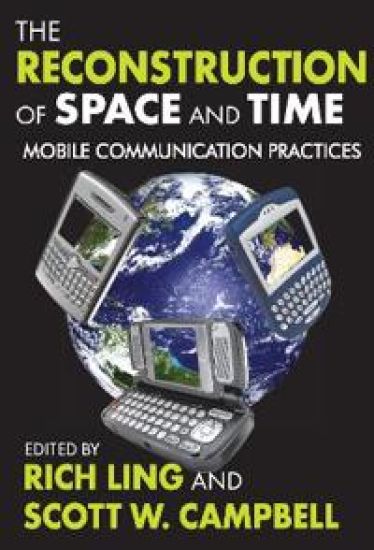
The Reconstruction of Space and Time

The Reconstruction of Space and Time

Rich Ling

AldineTransaction
2010
nidottu
One of the most significant and obvious examples of how mobile communication influences our understanding of time and space is how we coordinate with one another. Mobile communication enables us to call specific individuals, not general places. Regardless of location, we are able to make contact with almost anyone, almost anywhere. This advancement has changed, and continues to change, human interaction. Now, instead of agreeing on a particular time well beforehand, we can iteratively work out the most convenient time and place to meet at the last possible moment--on the way to the meeting or once we arrive at the destination. In their early days, mobile devices were primarily used for various types of emergency situations and for work. In some cases, the device was an essential element in various business operations or used so that overseas workers could communicate with their families. The distance between a remote posting and the people back home was suddenly and dramatically reduced. People began to share these devices not necessarily out of economic issues, but also questions of family and interpersonal dynamics. The process of sharing decisions as to who is a legitimate partner makes the nature of relationships more explicit. By examining the economy of sharing, we not only see how sharing mobile phones restructures social space, but are also given insight into an individual's web of interactions. This cutting-edge book deals with modern ways of thinking about communication and human interaction; it will illuminate the ways in which mobile communication alters our experience with space and time.
Mobile Communication

Mobile Communication

Rich Ling; Jonathan Donner

Polity Press
2009
nidottu
With staggering swiftness, the mobile phone has become a fixture of daily life in almost every society on earth. In 2007, the world had over 3 billion mobile subscriptions. Prosperous nations boast of having more subscriptions than people. In the developing world, hundreds of millions of people who could never afford a landline telephone now have a mobile number of their own. With a mobile in our hand many of us feel safer, more productive, and more connected to loved ones, but perhaps also more distracted and less involved with things happening immediately around us. Written by two leading researchers in the field, this volume presents an overview of the mobile telephone as a social and cultural phenomenon. Research is summarized and made accessible though detailed descriptions of ten mobile users from around the world. These illustrate popular debates, as well as deeper social forces at work. The book concludes by considering three themes: 1) the tighter interlacing of daily activities 2) a revolution of control in the social sphere, and 3) the arrival of a world where the majority of its inhabitants are reachable, anytime, anywhere.
Mobile Communication

Mobile Communication

Rich Ling; Jonathan Donner

Polity Press
2009
sidottu
With staggering swiftness, the mobile phone has become a fixture of daily life in almost every society on earth. In 2007, the world had over 3 billion mobile subscriptions. Prosperous nations boast of having more subscriptions than people. In the developing world, hundreds of millions of people who could never afford a landline telephone now have a mobile number of their own. With a mobile in our hand many of us feel safer, more productive, and more connected to loved ones, but perhaps also more distracted and less involved with things happening immediately around us. Written by two leading researchers in the field, this volume presents an overview of the mobile telephone as a social and cultural phenomenon. Research is summarized and made accessible though detailed descriptions of ten mobile users from around the world. These illustrate popular debates, as well as deeper social forces at work. The book concludes by considering three themes: 1) the tighter interlacing of daily activities 2) a revolution of control in the social sphere, and 3) the arrival of a world where the majority of its inhabitants are reachable, anytime, anywhere.
The Mobile Connection

The Mobile Connection

Rich Ling

Morgan Kaufmann Publishers In
2004
nidottu
Has the cell phone forever changed the way people communicate? The mobile phone is used for “real time? coordination while on the run, adolescents use it to manage their freedom, and teens “text? to each other day and night. The mobile phone is more than a simple technical innovation or social fad, more than just an intrusion on polite society. This book, based on world-wide research involving tens of thousands of interviews and contextual observations, looks into the impact of the phone on our daily lives. The mobile phone has fundamentally affected our accessibility, safety and security, coordination of social and business activities, and use of public places. Based on research conducted in dozens of countries, this insightful and entertaining book examines the once unexpected interaction between humans and cell phones, and between humans, period. The compelling discussion and projections about the future of the telephone should give designers everywhere a more informed practice and process, and provide researchers with new ideas to last years.