Kirjojen hintavertailu – 12 903 725 kirjaa ja 27 kauppaa

Kirjailija

Richard A. Cohen

Kirjat ja teokset yhdessä paikassa: 8 kirjaa, julkaisuja vuosilta 1994–2019, suosituimpiin kuuluu Out of Control. Vertaile teosten hintoja ja tarkista saatavuus suomalaisista kirjakaupoista.

8 kirjaa

Kirjojen julkaisuvuodet: 1994–2019.

On Obliteration – An Interview with Françoise Armengaud Concerning the Work of Sacha Sosno

On Obliteration – An Interview with Françoise Armengaud Concerning the Work of Sacha Sosno

Emmanuel Levinas; Richard A. Cohen; Dieter Mersch; Johannes Bennke

Diaphanes AG
2019
nidottu
Emmanuel Levinas’s interview with Françoise Armengaud in 1988 is one of the only statements we have from the philosopher, who became influential in various disciplines through his ethics that focuses on the fine arts specifically. Presented in English for the first time here, this interview brings us Levinas’s understanding of “obliteration” as an uncanny, disruptive, and even “unavailable” concept. Discussing the work of the French sculptor Sacha Sosno, Levinas parses the complex relationship between ethics and aesthetics, examining how they play out in artistic operations and practices. In doing so, he turns away from the “ease and lighthearted casualness of the beautiful” to shed light instead on the processes of material wear and tear and the traces of repair that go into the creation and maintenance of works of art, and which ultimately give them a profound uniqueness of presence. This evocative interview uncovers a hidden thread of aesthetic thinking in Levinas’s work and introduces a new way of looking at artistic practices in general.

Out of Control

Out of Control

Richard A. Cohen

State University of New York Press
2017
pokkari
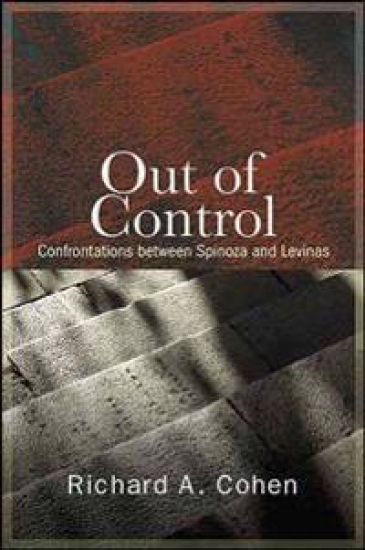
Explores the fundamental confrontations between Spinoza and Levinas in ethics, politics, science, and religion. After the end of superstitious religion, what is the meaning of the world? Baruch Spinoza's answer is truth, Emmanuel Levinas's is goodness: science versus ethics. In Out of Control, Richard A. Cohen brings this debate to life, providing a nuanced exposition of Spinoza and Levinas and the confrontations between them in ethics, politics, science, and religion. Spinoza is the control, the inexorable defensive logic of administrative rationality, where freedom is equated to necessity-a seventeenth-century glimpse of Orwellian doublespeak and Big Brother. Levinas is the way out: transcendence not of God, being, and logic but of the other person experienced as moral obligation. To alleviate the suffering of others-nothing is more important! Spinoza wagers everything on mathematical truth, discarding the rest as ignorance and illusion; for Levinas, nothing surpasses the priorities of morality and justice, to create a world in which humans can be human and not numbers or consumers, drudges or robots. Situating these two thinkers in today's context, Out of Control responds to the fear of dehumanization in a world flattened by the alliance of positivism and plutocracy. It offers a nonideological ethical alternative, a way out and up, in the nobility of one human being helping another, and the solidarity that moves from morality to justice.
Out of Control

Out of Control

Richard A. Cohen

State University of New York Press
2016
sidottu
Explores the fundamental confrontations between Spinoza and Levinas in ethics, politics, science, and religion. After the end of superstitious religion, what is the meaning of the world? Baruch Spinoza's answer is truth, Emmanuel Levinas's is goodness: science versus ethics. In Out of Control, Richard A. Cohen brings this debate to life, providing a nuanced exposition of Spinoza and Levinas and the confrontations between them in ethics, politics, science, and religion. Spinoza is the control, the inexorable defensive logic of administrative rationality, where freedom is equated to necessity-a seventeenth-century glimpse of Orwellian doublespeak and Big Brother. Levinas is the way out: transcendence not of God, being, and logic but of the other person experienced as moral obligation. To alleviate the suffering of others-nothing is more important! Spinoza wagers everything on mathematical truth, discarding the rest as ignorance and illusion; for Levinas, nothing surpasses the priorities of morality and justice, to create a world in which humans can be human and not numbers or consumers, drudges or robots. Situating these two thinkers in today's context, Out of Control responds to the fear of dehumanization in a world flattened by the alliance of positivism and plutocracy. It offers a nonideological ethical alternative, a way out and up, in the nobility of one human being helping another, and the solidarity that moves from morality to justice.
Ethics, Exegesis and Philosophy

Ethics, Exegesis and Philosophy

Richard A. Cohen

Cambridge University Press
2007
pokkari
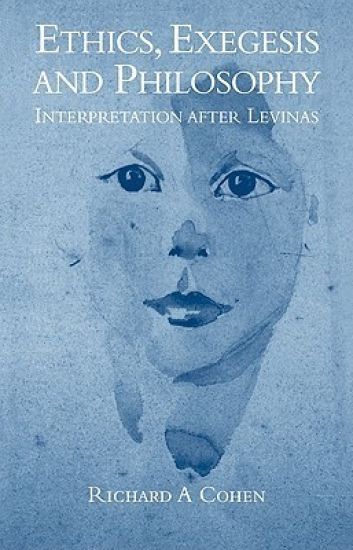
The reputation and influence of Emmanuel Levinas (1906–96) has grown powerfully. Well known in France in his lifetime, he has since his death become widely regarded as a major European moral philosopher profoundly shaped by his Jewish background. A pupil of Husserl and Heidegger, Levinas pioneered new forms of exegesis with his post-modern readings of the Talmud, and as an ethicist brought together religious and non-religious, Jewish and non-Jewish traditions of contemporary thought. Richard A. Cohen has written a book which uses Levinas' work as its base but goes on to explore broader questions of interpretation in the context of text-based ethical thinking. Levinas' reorientation of philosophy is considered in critical contrast to alternative contemporary approaches such as those found in modern science, psychology, Nietzsche, Freud, Husserl, Heidegger, Sartre, Merleau-Ponty, Derrida and Ricoeur. Cohen explores a manner of philosophizing which he terms 'ethical exegesis'.
Ethics, Exegesis and Philosophy

Ethics, Exegesis and Philosophy

Richard A. Cohen

Cambridge University Press
2001
sidottu
The reputation and influence of Emmanuel Levinas (1906–96) has grown powerfully. Well known in France in his lifetime, he has since his death become widely regarded as a major European moral philosopher profoundly shaped by his Jewish background. A pupil of Husserl and Heidegger, Levinas pioneered new forms of exegesis with his post-modern readings of the Talmud, and as an ethicist brought together religious and non-religious, Jewish and non-Jewish traditions of contemporary thought. Richard A. Cohen has written a book which uses Levinas' work as its base but goes on to explore broader questions of interpretation in the context of text-based ethical thinking. Levinas' reorientation of philosophy is considered in critical contrast to alternative contemporary approaches such as those found in modern science, psychology, Nietzsche, Freud, Husserl, Heidegger, Sartre, Merleau-Ponty, Derrida and Ricoeur. Cohen explores a manner of philosophizing which he terms 'ethical exegesis'.
The Theory of Intuition in Husserl's Phenomenology

The Theory of Intuition in Husserl's Phenomenology

Emmanuel Levinas; Richard A. Cohen

Northwestern University Press
1995
nidottu
This is a study that discusses the aspects and function of intuition in Husserl's thought and its meaning for philosophical self-reflection. It focuses on the role of intuition in Husserl, demonstrating how his theory of intuition follows directly from his new conception of being. He then identifies intuition as the original phenomenon that leads to the concept of truth itself. The introduction has updated the critical apparatus, and places this work in the context of contemporary phenomenology.
Elevations

Elevations

Richard A. Cohen

University of Chicago Press
1994
nidottu
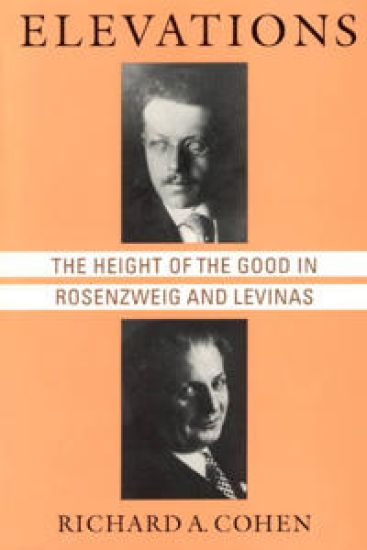
This text provides a series of closely related essays on the philosophical and theological work of Franz Rosenzweig and Emmanuel Levinas, two of the 20th century's most important Jewish philosophers. Focusing on the concept of transcendence, Richard Cohen shows that Rosenzweig and Levinas join the wisdom of revealed religions to the work of traditional philosophers to create a philosophy charged with the tasks of ethics and justice. He describes how they articulated a responsible humanism and a new enlightenment which would place moral obligation to the other above all other human concerns. This elevating pull of an ethics that can account for the relation of self and other without reducing either term is the central theme of these essays. Cohen also explores the ethical philosophy of these two thinkers in relation to Nietzsche, Husserl, Heidegger, Buber, Sartre and Derrida.
Elevations

Elevations

Richard A. Cohen

University of Chicago Press
1994
sidottu
This text provides a series of closely related essays on the philosophical and theological work of Franz Rosenzweig and Emmanuael Levinas, two of the 20th century's most important Jewish philosophers. Focusing on the concept of transcendence, Richard Cohen shows that Rosenzweig and Levinas join the wisdom of revealed religions to the work of traditional philosophers to create a philosophy charged with the tasks of ethics and justice. He describes how they articulated a responsible humanism and a new enlightenment which would place moral obligation to the other above all other human concerns. This elevating pull of an ethics that can account for the relation of self and other without reducing either term is the central theme of these essays. Cohen also explores the ethical philosophy of these two thinkers in relation to Nietzsche, Husserl, Heidegger, Buber, Sartre and Derrida.