Kirjailija
Richard A. Young
Kirjat ja teokset yhdessä paikassa: 8 kirjaa, julkaisuja vuosilta 1990–2025, suosituimpiin kuuluu The Teacher Credibility Codebook. Vertaile teosten hintoja ja tarkista saatavuus suomalaisista kirjakaupoista.
8 kirjaa
Kirjojen julkaisuvuodet: 1990–2025.
How can you build a classroom environment that creates buy-in from students? Richard Young shows how teacher credibility goes beyond building relationships. He offers a practical framework centered on student perception, engagement, motivation, trust, and communication, resulting in improved learning outcomes. With compelling visuals throughout, Young offers insights into how student motivation and social dynamics shape their perceptions. He also explains the nuances behind student inferences, social contagion, and cognitive alignment, so that you can learn how to proactively address misinterpretations, reinforce credibility, promote positive student perceptions, and create a more connected, cooperative learning environment. Each chapter offers actionable strategies and research-based tools to help you implement the ideas. Teachers at the middle and high school levels, where social dynamics and student misperceptions frequently impact learning environments, will particularly benefit from the unique and effective ideas in this book.
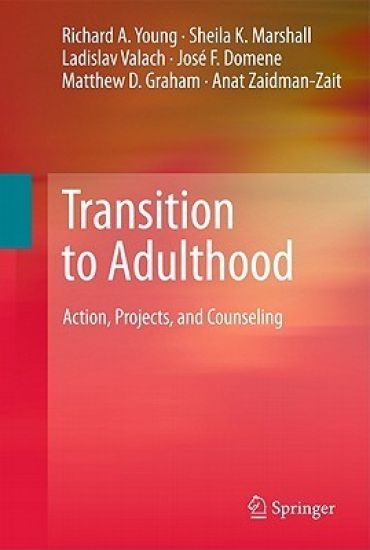
Transition to Adulthood
Richard A. Young; Sheila K. Marshall; Ladislav Valach; José F. Domene; Matthew D. Graham; Anat Zaidman-Zait
Springer-Verlag New York Inc.
2014
nidottu
The transition to adulthood involves, for most individuals, moving from school to work, establishment of long-term relationships, possibly parenting, and a number of other psychosocial transformations. Now more than ever, there is a concern within popular and research literature about children growing up too soon or too late or failing to realize changes associated with being adult. With this in mind, the book intends to answer a series of timely questions in regard to transition to adulthood and propose a wholly new approach to counseling that enables youth to engage fully in their lives and achieve their best. Active Transition to Adulthood: A New Approach for Counseling will discuss the authors’ work on the transition to adulthood (including early and late adolescence) from an entirely innovative perspective – action theory. Over a period of 10-15 years the authors have collected substantial data on adolescents and youth in transition, and will present an approach to counseling based on these data and cases. The action theory perspective in which the authors have grounded their work addresses the intentional, goal-directed behavior of persons and groups that is expressed through particular actions, longer-term projects, and life-encompassing careers. In this book, both transition to adulthood and counseling will be covered in the language of goal-directed action. In this way both transition and counseling reflect and capture the action, projects, and careers in which families, youth, and clients are engaged and use to construct on-going identity and other narratives.
Transition to Adulthood
Richard A. Young; Sheila K. Marshall; Ladislav Valach; José F. Domene; Matthew D. Graham; Anat Zaidman-Zait
Springer-Verlag New York Inc.
2010
sidottu
The transition to adulthood involves, for most individuals, moving from school to work, establishment of long-term relationships, possibly parenting, and a number of other psychosocial transformations. Now more than ever, there is a concern within popular and research literature about children growing up too soon or too late or failing to realize changes associated with being adult. With this in mind, the book intends to answer a series of timely questions in regard to transition to adulthood and propose a wholly new approach to counseling that enables youth to engage fully in their lives and achieve their best. Active Transition to Adulthood: A New Approach for Counseling will discuss the authors’ work on the transition to adulthood (including early and late adolescence) from an entirely innovative perspective – action theory. Over a period of 10-15 years the authors have collected substantial data on adolescents and youth in transition, and will present an approach to counseling based on these data and cases. The action theory perspective in which the authors have grounded their work addresses the intentional, goal-directed behavior of persons and groups that is expressed through particular actions, longer-term projects, and life-encompassing careers. In this book, both transition to adulthood and counseling will be covered in the language of goal-directed action. In this way both transition and counseling reflect and capture the action, projects, and careers in which families, youth, and clients are engaged and use to construct on-going identity and other narratives.
Action Theory
Ladislav Valach; Richard A. Young; M. Judith Lynam
Praeger Publishers Inc
2002
sidottu
The authors describe a view that our short-, medium-, and long- term behavior, interactions, and relationships—whether planned or spontaneous, purposeful or playful—can be understood in terms of goal-directed systems. An understanding of action theory and research methods used in applied settings is provided. It leads to the conclusion that individual processes are joint processes and the joint construction of lives should be monitored to understand ongoing personal and social involvements. The unique contribution of this book lies in its bringing together and extending of basic features of the theory of goal-directed action systems previously published in a range of scattered research and conceptual articles in the literature. Professionals including clinicians, counselors, social workers, researchers, doctors, nurses, and physical or occupational therapists will find in this book an accessible means to understand, act on, research, and intervene in the behavioral processes they encounter in everyday work.
The Church, Society, and Hegemony
Carlos Alberto Torres; Richard A. Young
Praeger Publishers Inc
1992
sidottu
This book provides a critical sociology of religion in Latin America. Its purpose is to discuss the notion of religion as part of social, cultural, and political processes in capitalist societies, drawing on the classics of sociological thought (Marx, Durkheim, Weber, and Gramsci). Thus, churches are analyzed as organized institutions of religious mediation intimately linked to the production of social, cultural, and political hegemony in Latin America. The Catholic Church, the dominant church in the region, is analyzed in terms of its different faces, changes, and transformations from conquest and colonization through the changing winds of Vatican II to the revolutionary experiences of the popular church in the 1970s and 1980s. This work will be of interest to scholars of Latin American studies, politics, religion, culture, and sociology. It also speaks to theologians and philosophers working in Latin America.
This work reports on a range of research studies in the career field that use biographical, narrative, and ecological approaches within an interpretive framework. It responds to the recognized dissonance between career theory and research, on the one part, and practice, on the other. It also responds to the view that in recent years practice has outstripped career theory and research. The qualitative approaches used in the research reported have gained popularity in the social sciences in recent years, but have been largely untried in the career field. This work offers specific interpretive studies that range over the life span and involve a number of perspectives including contexts such as parental influence, socio-political milieu, early career studies of apprentices, medical students, and nurses, studies of the established careers of secretaries, women entrepreneurs, teachers, and studies of the careers of older workers. In addition, the book contains interpretive studies pertaining to career theory, counseling and other interventions, and the research process. It also recognizes issues highlighted by a postmodernist perspective. A number of audiences will find this book useful: industrial/organizational psychologists, counseling psychologists, career counselors, counselor educators, and researchers in the career area from psychology and sociology.
Methodological Approaches to the Study of Career
William A. Borgen; Richard A. Young
Praeger Publishers Inc
1990
sidottu
This volume addresses a wide range of methodological approaches to the study of career with particular emphasis on alternative approaches. The contributors challenge those who see the traditional positivist empirical methodology as the only appropriate methodology with which to address important career questions and issues, arguing instead that the subject of career can best be studied within a number of disciplines, and using a variety of methodologies. Among the alternative methodologies explored by the contributors and employed in studies reported in this volume are those based on contextual/systems research, human action inquiry, and phenomenological/hermeneutical research. These alternatives, the contributors assert, are more responsive to human experience and social issues and are, therefore, often more viable for the study of career and career-related issues than is the positivist approach. Researchers in educational psychology, counseling psychology, and human resources will find this book an important contribution to the professional literature. Divided into three parts, the volume begins by identifying a number of specific questions--involving terminology, assessment, samples, culture, and outcomes--that contribute to the complexity of career research. Part two contains seven chapters, each of which addresses a generic research approach relevant to research in the career area. Both epistemological issues and the specifics of methods and techniques are addressed in these chapters. Among the approaches covered are Vondracek's developmental-contextual approach to career development research, narrative approaches, and the use of ethnography in career education studies. In the third section, the contributors use a range of methodologies to address appropriate topics in the career field, including the impact of parental influence on career choice, the problem of unemployment, midlife career change, and women's career development.