Kirjojen hintavertailu – 12 903 725 kirjaa ja 27 kauppaa

Kirjailija

Richard Bauman

Kirjat ja teokset yhdessä paikassa: 14 kirjaa, julkaisuja vuosilta 1986–2023, suosituimpiin kuuluu Let Your Words Be Few. Vertaile teosten hintoja ja tarkista saatavuus suomalaisista kirjakaupoista.

14 kirjaa

Kirjojen julkaisuvuodet: 1986–2023.

A Most Valuable Medium

A Most Valuable Medium

Richard Bauman

INDIANA UNIVERSITY PRESS
2023
pokkari
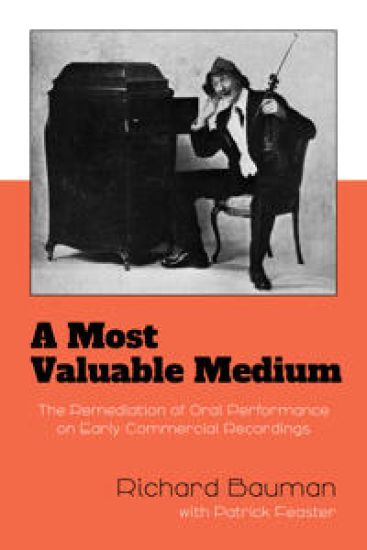
Between 1895 and 1920, the United States saw a sharp increase in commercial sound recording, the first mass medium of home entertainment. As companies sought to discover what kinds of records would appeal to consumers, they turned to performance forms already familiar to contemporary audiences—sales pitches, oratory, sermons, and stories. In A Most Valuable Medium, Richard Bauman explores the practical problems that producers and performers confronted when adapting familiar oral genres to this innovative medium of sound recording. He also examines how audiences responded to these modified and commoditized presentations. Featuring audio examples throughout and offering a novel look at the early history of sound recording, A Most Valuable Medium reveals how this new technology effected monumental change in the ways we receive information.
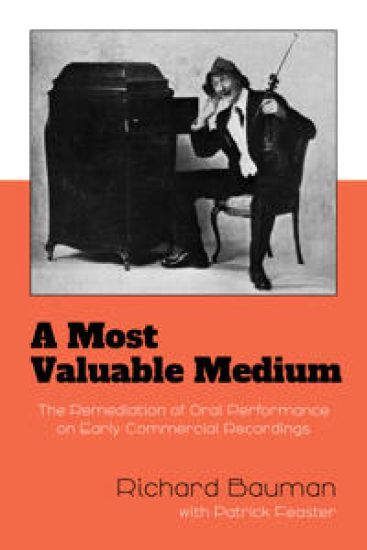
A Most Valuable Medium

A Most Valuable Medium

Richard Bauman

INDIANA UNIVERSITY PRESS
2023
sidottu
Between 1895 and 1920, the United States saw a sharp increase in commercial sound recording, the first mass medium of home entertainment. As companies sought to discover what kinds of records would appeal to consumers, they turned to performance forms already familiar to contemporary audiences—sales pitches, oratory, sermons, and stories. In A Most Valuable Medium, Richard Bauman explores the practical problems that producers and performers confronted when adapting familiar oral genres to this innovative medium of sound recording. He also examines how audiences responded to these modified and commoditized presentations. Featuring audio examples throughout and offering a novel look at the early history of sound recording, A Most Valuable Medium reveals how this new technology effected monumental change in the ways we receive information.
Political Trials in Ancient Greece (Routledge Revivals)
During the inspired years of the Athenian empire, through the tragedy of its collapse, to the more prosaic era that followed, most of the great names in Athenian history were involved in the procedures of criminal law. Political Trials in Ancient Greece, first published in 1990, explores the relationships between historical process, constitution, law, political machinations and foreign policy, concentrating on fifth and fourth century Athens and on Macedonia. These trials contribute significant details to our knowledge of such towering figures as Aeschylus, Pericles, Thucydides, Alcibiades, Socrates, Demosthenes and Aristotle, as well as a diverse collection of Macedonian defendants. The jurisdiction of the Areopagus, trials of communities, and the personal jurisdiction of the Macedonian king are also examined. Richard Bauman’s original account broadens our understanding of Greek legal institutions and of the ancient Greek approach to the law, as well as the general ethos of Athenian and Macedonian society.
Political Trials in Ancient Greece (Routledge Revivals)
During the inspired years of the Athenian empire, through the tragedy of its collapse, to the more prosaic era that followed, most of the great names in Athenian history were involved in the procedures of criminal law. Political Trials in Ancient Greece, first published in 1990, explores the relationships between historical process, constitution, law, political machinations and foreign policy, concentrating on fifth and fourth century Athens and on Macedonia. These trials contribute significant details to our knowledge of such towering figures as Aeschylus, Pericles, Thucydides, Alcibiades, Socrates, Demosthenes and Aristotle, as well as a diverse collection of Macedonian defendants. The jurisdiction of the Areopagus, trials of communities, and the personal jurisdiction of the Macedonian king are also examined. Richard Bauman’s original account broadens our understanding of Greek legal institutions and of the ancient Greek approach to the law, as well as the general ethos of Athenian and Macedonian society.
Human Rights in Ancient Rome

Human Rights in Ancient Rome

Richard Bauman

Routledge
2012
nidottu
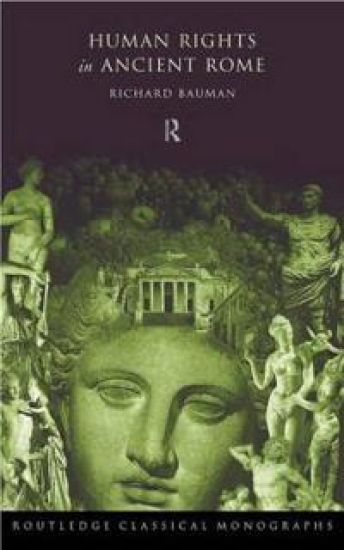
The concept of human rights has a long history. Its practical origins, as distinct from its theoretical antecedents, are said to be comparatively recent, going back no further than the American and French Bills of Rights of the eighteenth century. Even those landmarks are seen as little more than the precursors of the twentieth century starting-point - the Universal Declaration of Human Rights which was adopted by the General Assembly of the United Nations in 1948. In this unique and stimulating book, Richard Bauman investigates the concept of human rights in the Roman world. He argues that on the theoretical side, ideas were developed by thinkers such as Cicero and Seneca and on the pragmatic side, practical applications were rewarded mainly through the law. He presents a comprehensive analysis of human rights in ancient Rome and offers enlightening comparisons between the Roman and twentieth century understanding of human rights.
A World of Others' Words

A World of Others' Words

Richard Bauman

Wiley-Blackwell (an imprint of John Wiley Sons Ltd)
2004
nidottu
Drawing on his work in Iceland, Ireland, Scotland, North America, Ghana, and Fiji, linguistic anthropologist and folklorist Richard Bauman presents a series of ethnographic case studies that offer a sparkling look at intertextuality as communicative practice. A fascinating perspective on intertextuality: the idea that written and spoken texts speak to one another, e.g. through genre or allusions. Presents a series of ethnographic case studies to illustrate the topic. Draws on a broad range of oral performances and literary records from across the world. The author's introduction sets a framework for the analysis of genre, perform and intertextuality. Shows how performers blend genres, e.g., telling stories about riddles or legends about magical verses, or constructing sales pitches.
Voices of Modernity

Voices of Modernity

Richard Bauman; Charles L. Briggs

Cambridge University Press
2003
pokkari

Halvin toimitettuna 53,20 €

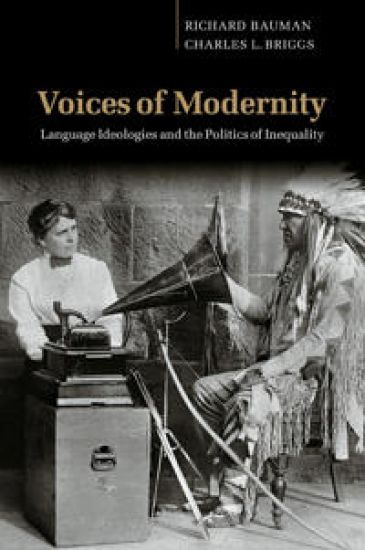
Language and tradition have long been relegated to the sidelines as scholars have considered the role of politics, science, technology and economics in the making of the modern world. This novel reading of over two centuries of philosophy, political theory, anthropology, folklore and history argues that new ways of imagining language and representing supposedly premodern people - the poor, labourers, country folk, non-europeans and women - made political and scientific revolutions possible. The connections between language ideologies, privileged linguistic codes, and political concepts and practices shape the diverse ways we perceive ourselves and others. Bauman and Briggs demonstrate that contemporary efforts to make schemes of social inequality based on race, gender, class and nationality seem compelling and legitimate, rely on deeply-rooted ideas about language and tradition. Showing how critics of modernity unwittingly reproduce these foundational fictions, they suggest new strategies for challenging the undemocratic influence of these voices of modernity.
Voices of Modernity

Voices of Modernity

Richard Bauman; Charles L. Briggs

Cambridge University Press
2003
sidottu
Language and tradition have long been relegated to the sidelines as scholars have considered the role of politics, science, technology and economics in the making of the modern world. This reading of over two centuries of philosophy, political theory, anthropology, folklore and history argues that new ways of imagining language and representing supposedly premodern people - the poor, labourers, country folk, non-europeans and women - made political and scientific revolutions possible. The connections between language ideologies, privileged linguistic codes, and political concepts and practices shape the diverse ways we perceive ourselves and others. This 2003 book demonstrates that contemporary efforts to make schemes of social inequality based on race, gender, class and nationality seem compelling and legitimate, rely on deeply-rooted ideas about language and tradition. Showing how critics of modernity unwittingly reproduce these foundational fictions, it suggests strategies for challenging the undemocratic influence of these voices of modernity.
Ideology and Community in the First Wave of Critical Legal Studies
In Ideology and Community in the First Wave of Critical Legal Studies Richard W. Bauman presents a fresh, rigorous assessment of some of the key ideas developed by writers aligned with the early Critical Legal Studies movement. This book examines several major themes and arguments in the first decade of critical legal scholarship, predominantly in the U. S. in the period dating roughly from the mid-1970s to the mid-1980s. Heterogeneous and progressive, the Critical Legal Studies movement inspired a variety of leftist reexaminations and critiques of dominant liberal assumptions underlying the law and legal institutions. Bauman offers an exposition and assessment of the radical challenge to several central tenets of legal and political liberalism, including the values associated with individualism, moral skepticism, and state neutrality. He maintains that radical critics associated with early critical legal studies misapprehended many of the important assumptions and commitments of contemporary political liberalism and tended to misconstrue liberalism as relying on specific, deficient metaphysical underpinnings. Although the quest therefore, might have failed, the early Critical Legal Studies movement did succeed in sharpening discussions about the politics of law and legal interpretation and in providing a stimulus to other types of radical, contemporary critique.
Ideology and Community in the First Wave of Critical Legal Studies
In Ideology and Community in the First Wave of Critical Legal Studies Richard W. Bauman presents a fresh, rigorous assessment of some of the key ideas developed by writers aligned with the early Critical Legal Studies movement. This book examines several major themes and arguments in the first decade of critical legal scholarship, predominantly in the U. S. in the period dating roughly from the mid-1970s to the mid-1980s. Heterogeneous and progressive, the Critical Legal Studies movement inspired a variety of leftist reexaminations and critiques of dominant liberal assumptions underlying the law and legal institutions. Bauman offers an exposition and assessment of the radical challenge to several central tenets of legal and political liberalism, including the values associated with individualism, moral skepticism, and state neutrality. He maintains that radical critics associated with early critical legal studies misapprehended many of the important assumptions and commitments of contemporary political liberalism and tended to misconstrue liberalism as relying on specific, deficient metaphysical underpinnings. Although the quest therefore, might have failed, the early Critical Legal Studies movement did succeed in sharpening discussions about the politics of law and legal interpretation and in providing a stimulus to other types of radical, contemporary critique.
Human Rights in Ancient Rome

Human Rights in Ancient Rome

Richard Bauman

Routledge
1999
sidottu
The concept of human rights has a long history. Its practical origins, as distinct from its theoretical antecedents, are said to be comparatively recent, going back no further than the American and French Bills of Rights of the eighteenth century. Even those landmarks are seen as little more than the precursors of the twentieth century starting-point - the Universal Declaration of Human Rights which was adopted by the General Assembly of the United Nations in 1948. In this unique and stimulating book, Richard Bauman investigates the concept of human rights in the Roman world. He argues that on the theoretical side, ideas were developed by thinkers such as Cicero and Seneca and on the pragmatic side, practical applications were rewarded mainly through the law. He presents a comprehensive analysis of human rights in ancient Rome and offers enlightening comparisons between the Roman and twentieth century understanding of human rights.
Reflections on the Folklife Festival

Reflections on the Folklife Festival

Richard Bauman; Patricia Sawin; Inta Gale Carpenter; Richard Anderson

Indiana University, Folklore Institute
1992
pokkari
This first ethnographic study of a folklife festival focuses on festival participants—the dancers, musicians, storytellers, and artisans at a public display of folk culture. These essays investigate the contention by supporters of these events that this form of folkloric representation is as intellectually legitimate as scholarly research.
Story, Performance, and Event

Story, Performance, and Event

Richard Bauman

Cambridge University Press
1986
pokkari
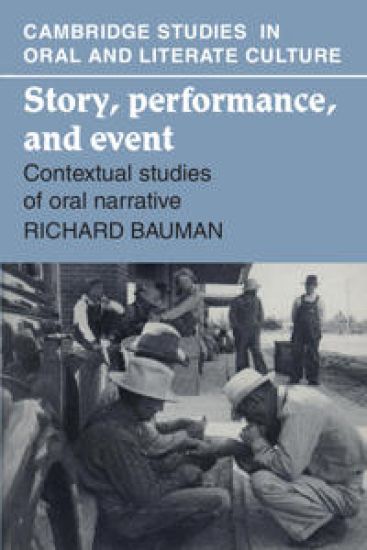
Based on a corpus of Texan oral narratives collected by the author over the past fifteen years, this study presents an analysis of the literary qualities or orally performed verbal art, focusing on the significance of its social context. Although the tales included are all from Texas, they are representative of oral storytelling traditions in other parts of the United States, including tall tales, hunting stories, local character anecdotes, accounts of practical jokes, and so on. They are also highly entertaining in their own right. Professor Bauman’s main emphasis is on the act of storytelling, not just the text. His central analytical concern is to demonstrate the interrelationships that exist between the events recounted in the narratives (narrated events), the narrative texts, and the situations in which the narratives are told (narrative events). He identifies these interrelationships by combining a close formal analysis of the texts with an ethnographic examination of the way in which their telling is accomplished, paying particular attention to the links between form and function. He also illuminates other more general concerns in the study of oral narrative, such as stability and variation in the oral text, the problem of genre, and the rhetorical efficacy of literary forms. As an important contribution to the theoretical and practical literary analysis of orally performed narratives, the book will appeal to students and teachers of folklore, sociolinguistics and linguistic anthropology, and literary theory.