Kirjojen hintavertailu – 12 903 735 kirjaa ja 27 kauppaa
Kirjailija
Richard Benson
Kirjat ja teokset yhdessä paikassa: 11 kirjaa, julkaisuja vuosilta 2006–2024, suosituimpiin kuuluu Myths and Misconceptions. Vertaile teosten hintoja ja tarkista saatavuus suomalaisista kirjakaupoista.
Med skrattgaranti! Det här är en humoristisk samling av några av de galnaste, knäppaste och dråpligaste provsvaren som lärare har träffat på. I bästa goddag yxskafts-anda radas här akademiska fadäser från prov i matte, religion, psykologi, företagsekonomi, historia m.m. En och annan lärare kommer att känna igen sig och alla som någon gång missuppfattat en provfråga eller frestats att skriva ett alternativt svar på ett prov kommer att skratta högt. Njut av lapsusar och svar som gjort lärare mållösa! Boken är snyggt formgiven så att den påminner om äldre skolhäften och anteckningsblock.
Have you always thought that a goldfish has a 3-second memory span? Do you think your morning coffee comes from a bean? Do you believe that those accused at the Salem Witch Trials were burned at the stake? If the answer to any of these questions is yes, then you’ve been lied to. But don’t worry, this book will set the record straight on all the common myths that most people take for fact, making you the most well-informed smart-alec in town. So next time someone proclaims that Napoleon Bonaparte was short, or that shaving causes hair to grow back thicker, you can correct them, and tell them smugly that everything they think they know is wrong.
'Wonderfully evocative ... Not for a heartbeat is there a false or faltering note as various life stories unfurl and conflate, invariably amid hardship and leading to heartbreak' The TimesThe close-knit villages of the Dearne Valley in Yorkshire were home to four generations of the Hollingworth family. Spanning Richard Benson’s great-grandmother Winnie’s ninety-two years in the valley, and drawing on years of historical research, interviews and anecdotes, The Valley lets us into generations of carousing and banter as the family’s attempts to build a better and fairer world for themselves meet sometimes with triumph, sometimes with bitter defeat. Against a backdrop of underground explosions, strikes and pit closures, these are unflinching, deeply personal stories of battles between the sexes in a man’s world sustained by strong women; of growing up, and the power of love and imagination to transform lives.
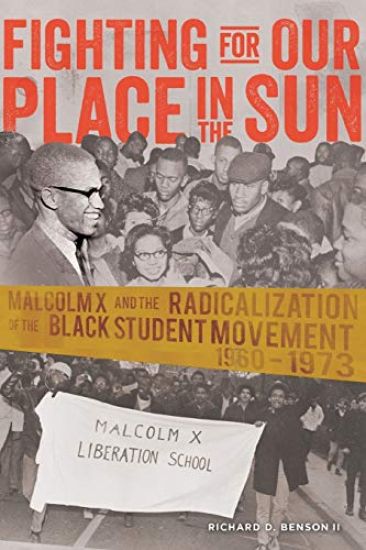
In Fighting for Our Place in the Sun, Richard D. Benson II examines the life of Malcolm X as not only a radical political figure, but also as a teacher and mentor. The book illuminates the untold tenets of Malcolm X’s educational philosophy, and also traces a historical trajectory of Black activists that sought to create spaces of liberation and learning that are free from cultural and racial oppression. It explains a side of the Black student movement and shift in black power that develops as a result of the student protests in North Carolina and Duke University. From these acts of radicalism, Malcolm X Liberation University (MXLU), the Student Organization for Black Unity (SOBU/YOBU), and African Liberation Day (ALD) were produced to serve as catalysts to extend the tradition of Black activism in the late 1960s and early 1970s. Scholars, researchers, community organizers, and students of African-American studies, American studies, history of education, political science, Pan-African studies, and more will benefit from this provocative and enlightening text.
In Fighting for Our Place in the Sun, Richard D. Benson II examines the life of Malcolm X as not only a radical political figure, but also as a teacher and mentor. The book illuminates the untold tenets of Malcolm X’s educational philosophy, and also traces a historical trajectory of Black activists that sought to create spaces of liberation and learning that are free from cultural and racial oppression. It explains a side of the Black student movement and shift in black power that develops as a result of the student protests in North Carolina and Duke University. From these acts of radicalism, Malcolm X Liberation University (MXLU), the Student Organization for Black Unity (SOBU/YOBU), and African Liberation Day (ALD) were produced to serve as catalysts to extend the tradition of Black activism in the late 1960s and early 1970s. Scholars, researchers, community organizers, and students of African-American studies, American studies, history of education, political science, Pan-African studies, and more will benefit from this provocative and enlightening text.
Richard Benson, former dean of the Yale School of Art and a MacArthur Foundation Fellow, has been a photographer for more than four decades, but until now his art often took a back seat to his prodigious achievements as a printer and a teacher. This volume presents one hundred photographs by Benson, highlighting the unique properties of his prints and exemplifying his fresh techniques for reproducing them for publication. From direct digital capture through inkjet output, his renowned technical wizardry has yielded unusually vibrant and beguiling colour prints that are at once ultra vivid and utterly natural, like our everyday visual experience. Their uncanny lushness and clarity give voice to Benson's generous, inquisitive eye. An essay by Peter Galassi, Chief Curator of Photography at MoMA, surveys the work, and a text by Benson explains how it was made.
“Ducks in a stream, the bridge at St. Anthony Falls, streets of cities and towns, a fish in a net, the glittering lakes seen under low skies. The Face of Minnesota is a fresh, simple, unpretentious statement of a place and time by people who know what Minnesota is because they live there.” -Minor White, Aperture, 1958 “John Szarkowski is the single most important curator that photography has ever had. Looking at his photographs created over the last fifty years makes me want to weep. They are truly American pictures; one feels his desire to show not just what America was but what it still can be.” -Ingrid Sischy, Vanity Fair, 2005 Originally commissioned to commemorate Minnesota’s centennial in 1958 and out of print for nearly forty years, The Face of Minnesota is a lost masterpiece of photography and an eloquent tribute to the people and places of the North Star state. Republished in celebration of the state’s sesquicentennial, this beautifully produced edition includes contemporary essays about John Szarkowski’s impact on American photography and introduces his work to new generations of Minnesotans. Featuring more than 175 arresting photographs as well as essays filled with wit and affection, The Face of Minnesota opens with this statement: “This book is about Minnesota now. But as a mature man carries on his face and in his bearing the history of his past, so does the look of a place today show its past-what it has been and what it has believed in.” Though Minnesota has changed dramatically during the past fifty years, The Face of Minnesota reveals the simple beauty of the imprint of the past and its deep resonance today. John Szarkowski (1925–2007) was director of the photography program at the Museum of Modern Art in New York, where he transformed our understanding of the art of photography through influential exhibitions and books, including Looking at Photographs (1973). In 2005 his work was surveyed in a traveling exhibition, accompanied by the book John Szarkowski: Photographs. Verlyn Klinkenborg joined the editorial board of the New York Times in 1997. He is the author of several works, including The Rural Life. Richard Benson has worked as a photographer and printer since 1966. He teaches at Yale University and is the coauthor, with John Szarkowski, of A Maritime Album: 100 Photographs and Their Stories.
When Richard Benson was growing up he felt like 'the village idiot with O'levels' - glowing school reports aren't much help when you're trying to help a sow give birth, or drive a power harrow in a straight line without getting half the hedgerow stuck in the tines. He left Yorkshire to work as a journalist in London, but returned when his dad called with the news that they were going to have to sell the family farm, and, in so doing, leave the home and livelihood that the Bensons had worked for generations. This is not only a moving personal account, but also one that reflects a profound change in rural life.