Kirjojen hintavertailu – 12 903 725 kirjaa ja 27 kauppaa

Kirjailija

Richard Billow

Kirjat ja teokset yhdessä paikassa: 3 kirjaa, julkaisuja vuosilta 2003–2017, suosituimpiin kuuluu Relational Group Psychotherapy. Vertaile teosten hintoja ja tarkista saatavuus suomalaisista kirjakaupoista.

3 kirjaa

Kirjojen julkaisuvuodet: 2003–2017.

A Three-Factor Model of Couples Therapy

A Three-Factor Model of Couples Therapy

Robert Mendelsohn; Richard Billow

Lexington Books
2017
sidottu
Couple psychotherapy extends the work of the psychotherapist to the patient’s most significant committed adult relationship, yet the therapy is difficult both conceptually and technically. One major reason for this difficulty is that in every couple’s treatment there is a confusing array of psychological defenses as well as regressive and nonregressive couple object relations-as distinct from the object relations that each individual member brings to the couple. Further, many of these processes are occurring outside consciousness and at the very same time. This book is an attempt to clarify all the confusing issues by presenting a three-factor model of couple psychotherapy within a psychodynamic framework. This model has been found to be very effective with many different kinds of couples. The book suggests that there are three powerful couple dynamics that shape every couple’s treatment: (A) the quality and quantity of the couple’s projective identifications; (B) the level of their “couple object relations”; and (C) the presence or absence of the defense of omnipotent control. These three variables are the most important factors in the therapy; they determine the success or failure of every therapy with every couple. These dynamics also determine quite a bit about how to conduct a couple therapy with regard to the therapist’s level of activity, tone, the way of sorting the material in his or her head, and even the kinds of interventions he/she chooses (whether or not, for example, the therapist will use certain resistance techniques). Understanding these three variables and how they interact is key to the success of the therapy.
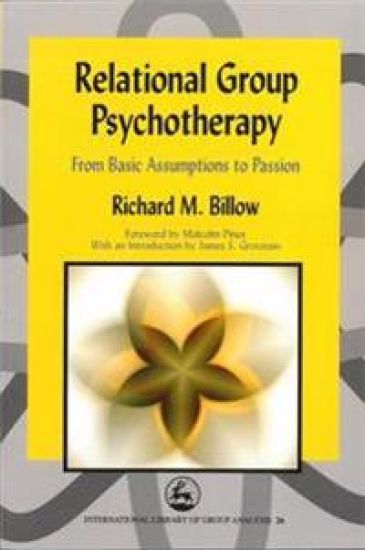
Relational Group Psychotherapy

Relational Group Psychotherapy

Richard Billow; Malcolm Pines

Jessica Kingsley Publishers
2003
pokkari
Integrating cutting-edge relational theory with technique, this volume reveals the deeply personal nature of the intersubjective process of group therapy as it affects the group therapist and other group members. By locating the group therapist's experience in the centre of the action, Richard M. Billow moves away from traditional approaches in group psychotherapy. Instead, he places emphasis on the effect of the therapist's own evolving psychology on what occurs and what does not occur in group psychotherapy. Building on Bion's early theory of group and his later formulations regarding the structure of thought and the role of affect, this work expands on the present understanding of relational theory and technique. Through the use of clinical anecdotes the author is able to ground theory in the realities of clinical experience making this essential reading for group psychoanalysts and psychotherapists, psychiatrists and other mental health professionals, academics and students of psychoanalytic theory.
Relational Group Psychotherapy

Relational Group Psychotherapy

Richard Billow; Malcolm Pines

Jessica Kingsley Publishers
2003
sidottu
Integrating cutting-edge relational theory with technique, this volume reveals the deeply personal nature of the intersubjective process of group therapy as it affects the group therapist and other group members. By locating the group therapist's experience in the centre of the action, Richard M. Billow moves away from traditional approaches in group psychotherapy. Instead, he places emphasis on the effect of the therapist's own evolving psychology on what occurs and what does not occur in group psychotherapy. Building on Bion's early theory of group and his later formulations regarding the structure of thought and the role of affect, this work expands on the present understanding of relational theory and technique. Through the use of clinical anecdotes the author is able to ground theory in the realities of clinical experience making this essential reading for group psychoanalysts and psychotherapists, psychiatrists and other mental health professionals, academics and students of psychoanalytic theory.