Kirjojen hintavertailu – 12 859 824 kirjaa ja 27 kauppaa
Kirjailija
Richard Brown
Kirjat ja teokset yhdessä paikassa: 120 kirjaa, julkaisuja vuosilta 1981–2026, suosituimpiin kuuluu A Slice of Rural Essex. Vertaile teosten hintoja ja tarkista saatavuus suomalaisista kirjakaupoista.
In this, the second part of his history of the Industrial Revolution, Richard Brown examines the political and religious developments which took place in Britain between the 1780s and 1840s in terms of the aristocratic elite and through the expression of alternative radical ideologies. Opening with a discussion of the nature of history, and of Britain in 1700, it goes on to consider Britain's foreign policy, the emergence of the modern state and the mid-century 'crisis' of the 1840s. Unlike many previous works, it emphasises British not just English history. It is this diversity of experience and the focus on continuity as well as change, women as well as men, that makes this a distinctive text. Students will also find the theoretical foundations of historical narrative and analysis clearly explained.
Understanding Industrial Organizations critically reviews the approaches developed by industrial sociologists to analyze industrial organizations. It outlines four general perspectives on organizations - systems thinking, contingency approach, the action approach and labour process for a more adequate sociology of organizations. The book provides a clear, relevant and important contribution to the sociology of organizations.
For both contemporaries and later historians the Industrial Revolution is viewed as a turning point' in modern British history. There is no doubt that change occurred, but what was the nature of that change and how did affect rural and urban society? Beginning with an examination of the nature of history and Britain in 1700, this volume focuses on the economic and social aspects of the Industrial Revolution. Unlike many previous textbooks on the same period, it emphasizes British history, and deals with developments in Wales, Scotland, and Ireland in their own right. It is the emphasis on the diversity, not the uniformity of experience, on continuities as well as change in this crucial period of development, which makes this volume distinctive. In his companion title Richard Brown completes his examination of the period and looks at the changes that took place in Britain's political system and in its religious affiliations.
The kingdom of France when Louis VI came to the throne in 1108 was a patchwork of feudal principalities over which the authority of the French Capetian monarchy was weak. Beyond the heartlands of Capetian power around Paris, kings of France had little power and the rulers of the great principalities such as Aquitaine paid little heed to the authority of the French state. Under Louis VI, this gradually began to change and, although it took a further two centuries to complete the process, the feudal supremacy of the French monarchy began to be asserted and the lands over which it had feudal hegemony began to expand. Much of what we know about Louis' reign comes from his life written by his friend and advisor Suger Abbot of St-Denis. Suger was a talented individual who straddled the often perilous divide between Church and State with considerable skill. He was a diplomat, administrator in both ecclesiastical and political spheres and staunch defender of his monastery. He witnessed many of the important events of Louis' reign and knew many of the people he wrote about. His Life of Louis VI is a partial biography, like most medieval biographies, that aims through recounting Louis' life to demonstrate what the nature of 'good' kingship should be--to defend the weak, to dispense justice, to defend both Church and State from those who sought control over them and to defend France against attack from within and without. His is an epic tale of good versus evil, justice versus injustice and right against wrong. This volume provides a revised translation of Suger's work, original published as a Kindle in 2014, with detailed annotation that identify the key participants and explain the significance of the key events. The introduction provides a brief biography of Suger and examines what his intentions were in writing his book. Two appendices look at the French defeat at he Battle of the Two Kings at Br mule in 1119 and the murder of Charles of Flanders in 1127 through the eyes of other medieval writers. There is also a detailed bibliography.
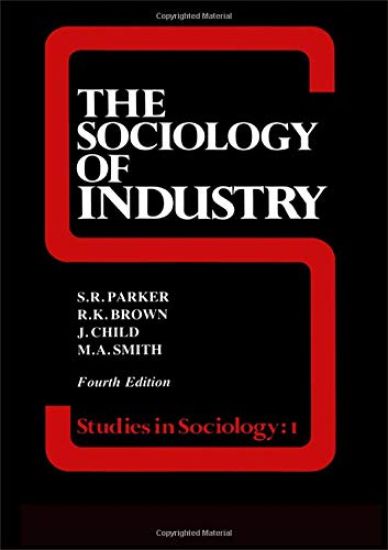
This book provides an excellent introduction to the sociology of industry. It comprises of three sections, which in turn address: the relation between industry and other sub-systems or institutions in society; the internal structure of industry and the roles people play within that structure; the social actions of individuals and groups within an organisational structure. It is an excellent resource for students of sociology who have an interest in its application to the ‘world of work’.