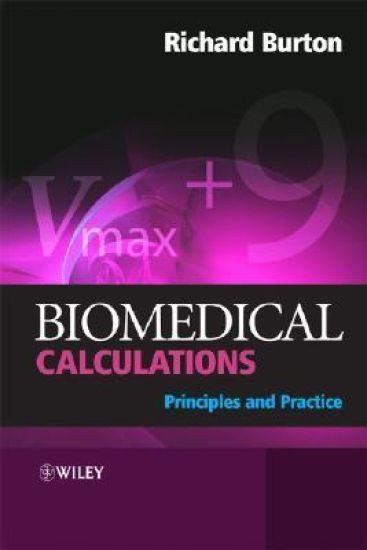
"It is said if you take care of the pennies, the pounds will take care of themselves. Richard Burton's excellent book takes this approach to calculations applied to the biomedical sciences…This is certainly interesting and engaging but it avoids being complicated." –Journal of Biological Education, April 2009 Biomedical Calculations: Principles and Practice is an accessible, student-friendly introduction to calculating, applying formulae and solving quantitative problems within these subjects. This book targets a problem area for many students and aims to give them the confidence which they are so often lacking when undertaking scientific calculations. It takes a unique approach to the subject and uses unit analysis as a central theme throughout the book to enhance student understanding. Clearly structured throughout, little basic knowledge of mathematics is assumed, but even the most numerate readers will be interested in the sometimes-novel biological detail. Numerous worked examples, supplementary questions and practice problems are provided and although the book is written to be read in sequence, it will also be a useful reference. The central theme of the book focuses on the value of unit analysis in solving quantitative problems, with explanations on how to avoid errors in calculations and in checking, understanding and deriving formulae and equations. As a background to this, there is extensive treatment of physical units, both individually (e.g. kg, m, mmol) and in combination (e.g. m s¯², mmol L¯¹), and also of other aspects of quantitative thinking. A variety of topics (mostly from physiology, pharmacology and biochemistry) are used to demonstrate these calculations in practice. Key features: An accessible, student-friendly introduction for all those hesitant in calculating, applying formulae and solving quantitative problems An innovative approach to scientific calculations and how to work with unfamiliar formulae for the biomedical and life sciencesIncludes modern, up to date definition of pH eliminating the need for logarithms and a discussion of the importance of pHClear introduction on how to use the book, guidance on units and unit conversion, and an appendix on basic mathematics and notation Use of unit analysis as a central theme Includes numerous worked examples and supplementary questions throughout the text to enhance student understanding





![Sindh, and the Races that inhabit the Valley of the Indus; with notices of the topography and history of the Province. [With a map.]](/covers/9781241214203.jpg)