Kirjojen hintavertailu – 12 903 735 kirjaa ja 27 kauppaa

Kirjailija

Richard Freeborn

Kirjat ja teokset yhdessä paikassa: 15 kirjaa, julkaisuja vuosilta 1973–2026, suosituimpiin kuuluu Christmas at the Puzzle Store. Vertaile teosten hintoja ja tarkista saatavuus suomalaisista kirjakaupoista.

15 kirjaa

Kirjojen julkaisuvuodet: 1973–2026.

Christmas at the Puzzle Store

Christmas at the Puzzle Store

Richard Freeborn

Richard Freeborn
2021
pokkari
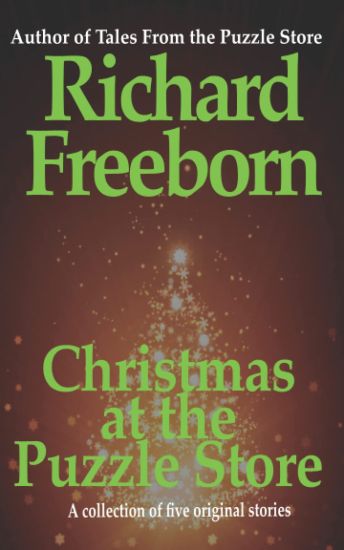
It's Holiday Season. In the spirit of classic Science Fiction, Christmas at the Puzzle Store takes you to places strange, but recognizable. Mostly. Whether it's chasing a fugitive or fleeing the ghosts of the past, everyone ends up at the Puzzle Store as you'll see in these five original stories, first published here: The Ghost of Christmas MaybeOn the Feast of StephenChristmas on the Village GreenHow Santa Saved ChristmasIn Royal David's CityMac's having a sale. Be careful which puzzles you look at, because you may never see a jigsaw puzzle the same way again.
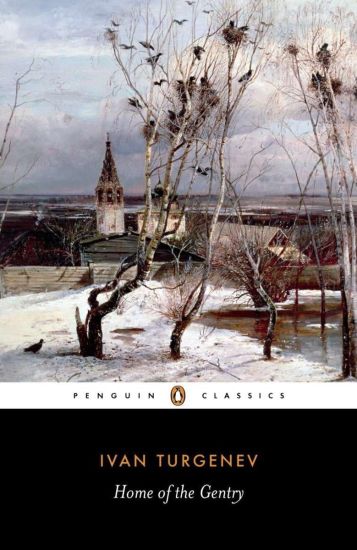
Home of the Gentry

Home of the Gentry

Turgenev Ivan; Richard Freeborn

Penguin Classics
2007
pokkari
On one level the novel is about the homecoming of Lavretsky, who, broken and disillusioned by a failed marriage, returns to his estate and finds love again - only to lose it. The sense of loss and of unfulfilled promise, beautifully captured by Turgenev, reflects his underlying theme that humanity is not destined to experience happiness except as something ephemeral and inevitably doomed. On another level Turgenev is presenting the homecoming of a whole generation of young Russians who have fallen under the spell of European ideas that have uprooted them from Russia, their 'home', but have proved ultimately superfluous. In tragic bewilderment, they attempt to find reconciliation with their land.
The Russian Revolutionary Novel

The Russian Revolutionary Novel

Richard Freeborn

Cambridge University Press
1985
pokkari
Professor Freeborn’s book is an attempt to identify and define the evolution of a particular kind of novel in Russian and Soviet literature: the revolutionary novel. This genre is a uniquely Russian phenomenon and one that is of central importance in Russian literature. The study begins with a consideration of Turgenev’s masterpiece Fathers and Children and traces the evolution of the revolutionary novel through to its most important development a century later in Pasternak’s Doctor Zhivago and the emergence of a dissident literature in the Soviet Union. Professor Freeborn examines the particular phases of the genre’s development, and in particular the development after 1917: the early fiction which explored the relationship between revolution and instinct, such as Pil’nyak’s The Naked Year; the first attempts at mythmaking in Leonov’s The Badgers and Furmanov’s Chapayev; the next phase, in which novelists turned to the investigation of ideas, exemplified most notably by Zamyatin’s We; the resumption of the classical approach in such works as Olesha’s Envy, which explore the interaction between the individual and society. and finally the appearance of the revolutionary epic in Gorky’s The Life of Klim Samgin, Sholokhov’s Quiet Flows the Don, and Alexey Tolstoy’s The Road to Calvary. Professor Freeborn also examines the way this kind of novel has undergone change in response to revolutionary change; and he shows how an important feature of this process has been the implicit assumption that the revolutionary novel is distinguished by its right to pass an objective, independent judgement on revolution and the revolutionary image of man. This is a comprehensive and challenging study of a uniquely Russian tradition of writing, which draws on a great range of novels, many of them little-known in the West. As with other titles in this series all quotations have been translated.
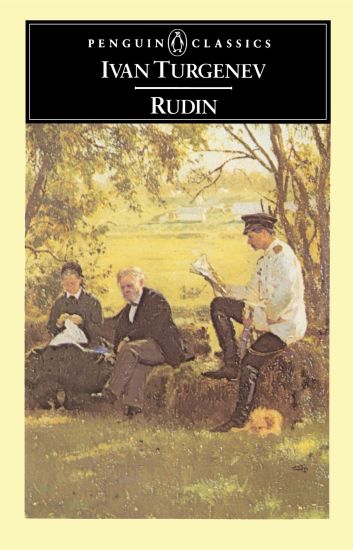
Rudin

Rudin

Ivan Turgenev; Richard Freeborn

Penguin Classics
1975
pokkari
Turgenev is an author who no longer belongs to Russia only. During the last fifteen years of his life he won for himself the reading public, first in France, then in Germany and America, and finally in England. In his funeral oration the spokesman of the most artistic and critical of European nations, Ernest Renan, hailed him as one of the greatest writers of our times: 'The Master, whose exquisite works have charmed our century, stand more than any other man as the incarnation of the whole race,' because 'a whole world lived in him and spoke through his mouth.' Rudin is the first of Turgenev's social novels, and is a sort of artistic introduction to those that follow, because it refers to the epoch anterior to that when the present social and political movements began. This epoch is being fast forgotten, and without his novel it would be difficult for us to fully realise it, but it is well worth studying, because we find in it the germ of future growths.
The Rise of the Russian Novel

The Rise of the Russian Novel

Richard Freeborn

Cambridge University Press
1973
sidottu
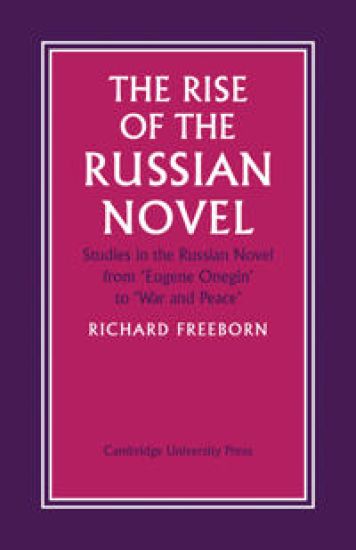
This introduction to the study of the Russian novel demonstrates how the form evolved from imitative beginnings to the point in the 1860s when it reached maturity and established itself as part of the European tradition. Professor Freeborn considers selected novels by Pushkin, Lermontov, Gogol, Dostoyevsky and Tolstoy. Extended introductory sections to the studies of Dostoyevsk and Tolstoy deal with their earlier works. A final chapter summarises the principal points of contrast between Crime and Punishment and War and Peace, and argues that in certain specific ways, they represent the peaks in the evolution of the form of the Russian novel. Quotations are translated, but key passages are also given in the original. Professor Freeborn treats the novel as a literary form and avoids the overworked formulae on which much historical writing on Russian literature has been based. He is concerned with the literary development of a great form.
The Rise of the Russian Novel

The Rise of the Russian Novel

Richard Freeborn

Cambridge University Press
1973
pokkari
This introduction to the study of the Russian novel demonstrates how the form evolved from imitative beginnings to the point in the 1860s when it reached maturity and established itself as part of the European tradition. Professor Freeborn considers selected novels by Pushkin, Lermontov, Gogol, Dostoyevsky and Tolstoy. Extended introductory sections to the studies of Dostoyevsk and Tolstoy deal with their earlier works. A final chapter summarises the principal points of contrast between Crime and Punishment and War and Peace, and argues that in certain specific ways, they represent the peaks in the evolution of the form of the Russian novel. Quotations are translated, but key passages are also given in the original. Professor Freeborn treats the novel as a literary form and avoids the overworked formulae on which much historical writing on Russian literature has been based. He is concerned with the literary development of a great form.