Kirjojen hintavertailu – 12 859 824 kirjaa ja 27 kauppaa
Kirjailija
Richard G. Niemi
Kirjat ja teokset yhdessä paikassa: 13 kirjaa, julkaisuja vuosilta 1992–2016, suosituimpiin kuuluu Comparing Democracies. Vertaile teosten hintoja ja tarkista saatavuus suomalaisista kirjakaupoista.
This book shows how specific agents shape the political character of adolescents, how response to these agents varies according to sex, race, and other factors, and how political learning changes through the life-cycle and across generations. Originally published in 1974. The Princeton Legacy Library uses the latest print-on-demand technology to again make available previously out-of-print books from the distinguished backlist of Princeton University Press. These editions preserve the original texts of these important books while presenting them in durable paperback and hardcover editions. The goal of the Princeton Legacy Library is to vastly increase access to the rich scholarly heritage found in the thousands of books published by Princeton University Press since its founding in 1905.
Kent Jennings and Richard Nieini arc recognized widely for their 1965 study of the development of political attitudes and behavior among a large, nationally representative sample of high school seniors and their parents (The Political Character of Adolescence, Princeton). Now they present the results of a follow-up study of these same individuals in 1973 along with a fresh study of 1973 high school seniors. Spanning a dramatic eight-year historical period and an important transitional phase in the life cycle of the younger generation, this material provides a unique opportunity to assess the development of political attitudes and participation. Originally published in 1981. The Princeton Legacy Library uses the latest print-on-demand technology to again make available previously out-of-print books from the distinguished backlist of Princeton University Press. These editions preserve the original texts of these important books while presenting them in durable paperback and hardcover editions. The goal of the Princeton Legacy Library is to vastly increase access to the rich scholarly heritage found in the thousands of books published by Princeton University Press since its founding in 1905.
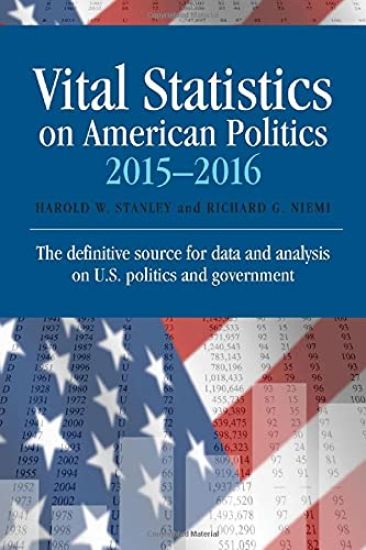
There is no other print source, online source, or Web search engine that provides the wide range and depth of insight found in Vital Statistics on American Politics. This new 2015-2016 edition is updated with the most recent information available. The editors consult hundreds of sources to calculate and locate the data, facts, and figures that offer a vivid and multifaceted portrait of the broad spectrum of United States politics and policies. Students, professional researchers, and interested citizens will find chapters devoted to key subject areas such as elections and political parties, public opinion and voting, the media, the three branches of U. S. government, foreign, military, social and economic policy, and much more. For depth of information and ease of use, this updated edition is the best resource of its kind available and should be a key component of all academic and large public library collections.
This book shows how specific agents shape the political character of adolescents, how response to these agents varies according to sex, race, and other factors, and how political learning changes through the life-cycle and across generations. Originally published in 1974. The Princeton Legacy Library uses the latest print-on-demand technology to again make available previously out-of-print books from the distinguished backlist of Princeton University Press. These editions preserve the original texts of these important books while presenting them in durable paperback and hardcover editions. The goal of the Princeton Legacy Library is to vastly increase access to the rich scholarly heritage found in the thousands of books published by Princeton University Press since its founding in 1905.
Kent Jennings and Richard Nieini arc recognized widely for their 1965 study of the development of political attitudes and behavior among a large, nationally representative sample of high school seniors and their parents (The Political Character of Adolescence, Princeton). Now they present the results of a follow-up study of these same individuals in 1973 along with a fresh study of 1973 high school seniors. Spanning a dramatic eight-year historical period and an important transitional phase in the life cycle of the younger generation, this material provides a unique opportunity to assess the development of political attitudes and participation. Originally published in 1981. The Princeton Legacy Library uses the latest print-on-demand technology to again make available previously out-of-print books from the distinguished backlist of Princeton University Press. These editions preserve the original texts of these important books while presenting them in durable paperback and hardcover editions. The goal of the Princeton Legacy Library is to vastly increase access to the rich scholarly heritage found in the thousands of books published by Princeton University Press since its founding in 1905.
This book provides you with a theoretical and comparative understanding of the major topics related to elections and voting behaviour. It explores important work taking place on new areas, whilst at the same time covering the key themes that you’ll encounter throughout your studies. Edited by three leading figures in the field, the new edition brings together an impressive range of contributors and draws on a range of cases and examples from across the world. It now includes: New chapters on authoritarian elections and regime change, and electoral integrity A chapter dedicated to voting behaviour Increased emphasis on issues relating to the economy. Comparing Democracies, Fourth Edition will remain a must-read for students and lecturers of elections and voting behaviour, comparative politics, parties, and democracy.
There is no other print source, online source, or Web search engine that provides the wide range and depth of insight found in Vital Statistics on American Politics. This new edition is updated with the most recent information available. What sets this book apart is the experience of editors Harold Stanley and Richard Niemi. These scholars consult hundreds of sources to calculate and locate the data, facts, and figures that offer a vivid and multifaceted portrait of the broad spectrum of United States politics and policies. In over 230 tables and figures, students, professional researchers, and interested citizens will find chapters devoted to key subject areas such as elections and political parties, public opinion and voting, the media, the three branches of U. S. government, foreign, military, social and economic policy, and much more. For depth of information and ease of use, this volume is the best resource of its kind available and should be a key component of all academic and large public library collections.
"Voting difficulties hung over America's presidential election in 2000 like a dark cloud. Hanging chads, a butterfly ballot, and the Supreme Court remain the most vivid memories of that political donnybrook. Passage of 2002's Help America Vote Act sparked further interest in the physical process of casting a ballot, yet several recent contests still produced confusion at the polls. A solution to at least some of those problems may be found in new technology, but such innovations carry their own concerns and questions. V oting Technology is the first book to investigate in a scientific and authoritative manner how voters respond to the new equipment. The authors—an interdisciplinary group of experts in American elections, political behavior, human-computer interaction, and human factors psychology—assess five commercially available voting systems, each one representing a specific class based on shared design principles, as well as a prototype system not currently available. They evaluate the systems against different criteria (including ease of use, speed, and accuracy) using field experiments, laboratory experiments, and expert reviews. The results reveal the good and bad about the new systems, including specific features that contribute to clarity, confusion, or error. Going beyond the concern with spoiled ballots, they determine whether voters actually cast their ballots for the candidates they intended to support. They address fundamental questions of whether voters like and trust the equipment and whether the various systems are equally usable by all voters. Their research also opens up an entirely new line of inquiry by asking about the interaction between ballot format and voter behavior. The concluding chapter pulls together best practices that will guide manufacturers of voting systems, ballot designers, election officials, political observers, and of course, voters. In a political system based on free exercise of personal choice, the least we can do is make sure our choices are being accurately recorded and counted."
Sound democratic decisions rely on a citizenry with at least a partial mastery of the rules and workings of democratic government. American high schools, where students learn the basics of citizenship, thus ought to play a critical role in the success of democracy. Yet studies examining the impact of high school government and civics courses on political knowledge over the past quarter-century have generally shown that these courses have little or no effect. In this important book, Richard G. Niemi and Jane Junn take a fresh look at what America’s high school seniors know about government and politics and how they learn it. The authors argue convincingly that secondary school civics courses do indeed enhance students’ civic knowledge. This book is based on the most extensive assessment to date of civic knowledge among American youth—the 1988 National Assessment of Education Progress (NAEP) Civics Assessment. The authors develop and test a theoretical model to explain the cognitive process by which students learn about politics and they conclude by suggesting specific changes in the style and emphasis of civics teaching.
It has been predicted that term limits in state legislatures--soon to be in effect in eighteen states--will first affect the composition of the legislatures, next the behavior of legislators, and finally legislatures as institutions. The studies in Term Limits in State Legislatures demonstrate that term limits have had considerably less effect on state legislatures than proponents predicted. The term-limit movement--designed to limit the maximum time a legislator can serve in office--swept through the states like wildfire in the first half of the 1990s. By November 2000, state legislators will have been "term limited out" in eleven states. This book is based on a survey of nearly 3,000 legislators from all fifty states along with intensive interviews with twenty-two legislative leaders in four term-limited states. The data were collected as term limits were just beginning to take effect in order to capture anticipatory effects of the reform, which set in as soon as term limit laws were passed. In order to understand the effects of term limits on the broader electoral arena, the authors also examine data on advancement of legislators between houses of state legislatures and from the state legislatures to Congress. The results show that there are no systematic differences between term limit and non-term limit states in the composition of the legislature (e.g., professional backgrounds, demographics, ideology). Yet with respect to legislative behavior, term limits decrease the time legislators devote to securing pork and heighten the priority they place on the needs of the state and on the demands of conscience relative to district interests. At the same time, with respect to the legislature as an institution, term limits appear to be redistributing power away from majority party leaders and toward governors and possibly legislative staffers. This book will be of interest both to political scientists, policymakers, and activists involved in state politics. John M. Carey is Assistant Professor of Political Science, Washington University in St. Louis. Richard G. Niemi is Professor of Political Science, University of Rochester. Lynda W. Powell is Professor of Political Science, University of Rochester.
This book provides an up-to-date analysis of American voting rights law and the numerous controversies surrounding minority representation. Written by authors with first-hand experience in the case law, the book details the evolution of the law and precedent from 1965 onwards. The authors explain the logic underlying the major decisions, introduce the reader to the procedures for establishing standards of representation and measuring discrimination, and discuss the major points of recent contention. In conclusion, they address the implications of recent developments in voting rights law for the future of representation in America.