Kirjojen hintavertailu – 12 859 828 kirjaa ja 27 kauppaa

Kirjailija

Richard Hodges

Kirjat ja teokset yhdessä paikassa: 23 kirjaa, julkaisuja vuosilta 1983–2026, suosituimpiin kuuluu Villa to Village. Vertaile teosten hintoja ja tarkista saatavuus suomalaisista kirjakaupoista.

23 kirjaa

Kirjojen julkaisuvuodet: 1983–2026.

Villa to Village

Villa to Village

Riccardo Francovich; Richard Hodges

Bristol Classical Press
2003
pokkari
"Villa to Village" challenges the historical view that hilltop villages in Italy were first founded in the tenth century. Drawing upon recent excavations, the authors show that the makings of the medieval village lie in the demise of the Roman villa in late antiquity. The book describes the lively debate between archaeologists and historians on this issue. It also examines the evidence for the first manorial villages of the Carolingian era and describes how these were transformed into the familiar feudal villages that are characteristic of much of Italy.
Becoming Europe: Archaeology and the Making of the Middle Ages
This book uses 50 years of modern archaeology to re-examine Henri Pirenne’s canonical thesis, Mohammed, Charlemagne (1937/39). It advances a new paradigm using material evidence to reinterpret the established narrative of the post-Roman creation of Europe based upon written sources mostly written by ecclesiastical authors. The book begins by setting out the historiographical argument and the archaeological and anthropological methods used to make sense of the material evidence. It then shows how a so-called temple society emerged in Late Antiquity and, through overweening concerns with the afterlife, set in motion not just the collapse of the Roman world but also led to the creation of new political forces in, first Ireland, then emergent Anglo-Saxon England. Pivoting on events in the later 7th century in England and Frisia, it traces the subsequent evolution of the temple society in Francia, and its fundamental importance to Charlemagne’s cultural and economic revolution that, through many innovations, shaped Medieval Europe. Finally, the narrative examines the immediate aftermath of the end of the temple society in the 10th and 11th centuries. Emphasis is then placed on the role of external forces, the Vikings in north-west Europe and the Arabs in the Mediterranean, as instigators of economic changes that became baked into European town and country life after the turn of the millennium. Ending with a compelling call for a revision of our contemporary European concerns in an increasingly nationalist era, this book is an essential read for students and scholars of medieval European history and medieval archaeology.
The Origins of Anglo-Saxon Towns

The Origins of Anglo-Saxon Towns

Richard Hodges

BLOOMSBURY PUBLISHING PLC
2025
sidottu
Through a reconsideration of the debate about the archaeology of Anglo-Saxon towns, Richard Hodges focuses on the origins and history of the four Middle-Saxon emporia – London, Ipswich, Southampton and York – and then the impact of the Viking Conquest in AD 866 on England's subsequent history. To mark the occasion of the centennial of Henri Pirenne’s celebrated book, Medieval Cities (1925), Hodges reviews the influence of the Scandinavian urban model on Anglo-Saxon England in line with new archaeological and numismatic evidence, tracing the importance of the Viking conquerors to the formation of towns in England. The crux of this study is to explore the question of when and how English early Medieval settlements gained a distinctive urban identity. And so, the emphasis is not just on markets and role of craftsmen, but also on civil defence. Looking beyond England, this book proposes that the Danish urban model influenced the rise of towns in Flanders, setting an economic strategy that played a major part in the creation of what Pirenne described as ‘Medieval Civilization’. By asking questions about the political and economic situation of the 7th to 10th centuries, archaeology challenges key chapters in the canonical history of not just English urbanism but also the making of the European economy.
The Origins of Anglo-Saxon Towns

The Origins of Anglo-Saxon Towns

Richard Hodges

BLOOMSBURY PUBLISHING PLC
2025
nidottu

Halvin toimitettuna 34,40 €

Through a reconsideration of the debate about the archaeology of Anglo-Saxon towns, Richard Hodges focuses on the origins and history of the four Middle-Saxon emporia – London, Ipswich, Southampton and York – and then the impact of the Viking Conquest in AD 866 on England's subsequent history. To mark the occasion of the centennial of Henri Pirenne’s celebrated book, Medieval Cities (1925), Hodges reviews the influence of the Scandinavian urban model on Anglo-Saxon England in line with new archaeological and numismatic evidence, tracing the importance of the Viking conquerors to the formation of towns in England. The crux of this study is to explore the question of when and how English early Medieval settlements gained a distinctive urban identity. And so, the emphasis is not just on markets and role of craftsmen, but also on civil defence. Looking beyond England, this book proposes that the Danish urban model influenced the rise of towns in Flanders, setting an economic strategy that played a major part in the creation of what Pirenne described as ‘Medieval Civilization’. By asking questions about the political and economic situation of the 7th to 10th centuries, archaeology challenges key chapters in the canonical history of not just English urbanism but also the making of the European economy.
Butrint

Butrint

Richard Hodges

BLOOMSBURY PUBLISHING PLC
2025
sidottu
Focusing on the archaeology and history of Butrint in southern Albania, this book begins by looking at its foundation in the Bronze Age period through to the contemporary era, where it is now a popular tourist destination. Richard Hodges, who has excavated at the site for over thirty years and is a trustee of the Butrint Management Foundation, looks at the Mediterranean seaport and its changing landscape over the course of five thousand years. Organized chronologically, Hodges presents the latest archaeological data and surveys on specific individual sites ranging from the ancient Greek sanctuary and the Roman colony to the early Medieval Byzantine kastron and the arrival of the Venetians in 1386. He concludes with the arrival of the Italian Archaeological Mission in 1928, whereupon Butrint’s long and glorious history was discovered, cementing its mark as the premier archaeological site in Albania. Designed for students and general readers, this book offers an accessible and lively account of Butrint’s fascinating cultural history.
Butrint

Butrint

Richard Hodges

BLOOMSBURY PUBLISHING PLC
2025
nidottu
Focusing on the archaeology and history of Butrint in southern Albania, this book begins by looking at its foundation in the Bronze Age period through to the contemporary era, where it is now a popular tourist destination. Richard Hodges, who has excavated at the site for over thirty years and is a trustee of the Butrint Management Foundation, looks at the Mediterranean seaport and its changing landscape over the course of five thousand years. Organized chronologically, Hodges presents the latest archaeological data and surveys on specific individual sites ranging from the ancient Greek sanctuary and the Roman colony to the early Medieval Byzantine kastron and the arrival of the Venetians in 1386. He concludes with the arrival of the Italian Archaeological Mission in 1928, whereupon Butrint’s long and glorious history was discovered, cementing its mark as the premier archaeological site in Albania. Designed for students and general readers, this book offers an accessible and lively account of Butrint’s fascinating cultural history.
Roman Butrint

Roman Butrint

Inge Lyse Hansen; Richard Hodges

Oxbow Books
2021
nidottu
Butrint, ancient Buthrotum , has taken many forms in different ages, shaped by the near-constant interaction between the place, its lagoonal landscape and the Mediterranean. Though Butrint does not appear on any of the records of early Greek colonisation to identify it as a Corcyrean settlement, strong links must have existed between it and the metropolitan Corinthian colony of Corfu. Blessed with springs that possessed healing qualities, a small polis was created - extended to incorporate a healing sanctuary dedicated to Asclepius. Julius Caesar, harbouring at Butrint in urgent need of supplies to sustain his struggle against Pompey, must have viewed the sanctuary, ringed by largely dried-out marshland, as the perfect site to settle veterans as a colony. It was an obvious cornerstone in controlling the passage from the Adriatic to the Aegean. The early settlers seem to have been limited in number and possibly mainly of civilian status. However, the political changes to the city's magistrature were immediate, and within a relatively short time-span fundamental changes to the physical make-up of the city were set in motion. Its new Roman status also located Butrint as a directly before the highest authorities in Rome, and within fifteen years or so, under Augustus's guidance following his victory at Actium, the city was refounded as a colony and awarded a pivotal role in Virgil's court-sponsored foundation epic, The Aeneid. Now linked to the Victory City of Nicopolis rather than in the shadow of Corfu, Butrint prospered. The urban fabric evolved, sometimes faltered, but was essentially sustained until the later 6th century A. D. This present volume is an assessment of the Roman archaeology, a compilation of studies and field reports that focuses upon the foundation and early history of the colony.

Knidos

Knidos

Richard Hodges

Brick Tower Press
2021
pokkari
This memoir describes the authors experiences as a young archaeologist participating in the American archaeological excavations at ancient Knidos at south-west Turkey in 1971. Knidos, once a great classical metropolis and now entirely abandoned, is situated at Cape Crio, an isolated but glorious location at the end of a mountainous finger jutting out towards the Dodecanese islands. The ancient metropolis is famous for its marble statue of the goddess, Aphrodite, the scandalous first naked image of the deity made by the renowned sculptor, Praxiteles in the 4th century BC and imitated throughout antiquity. The book describes ('the mad consul') Charles Newton's epic excavations at Knidos during the Crimean War when, with Parliamentary support and a frigate, he excavated tons of sculpture which was dispatched the British Museum. Newton's excavations set the scene for Iris Cornelia Love's excavations (1967-77)--the Guggenheim heiress from Manhattan, who believed she discovered Aphrodite on the day American astronauts landed on the moon. This is a story about adolescence, place, archaeologists, the lost world of Turkish peasants and...... love. It portrays a major Mediterranean dig and a restless search for trophies. It also tells a tale about an extraordinarily magical place. Knidos is about classical archaeology in Victorian and modern times, the spirit of this magical place in Aegean Turkey. It also describes the mix of many personalities on this excavation, from the USA in the Vietnam War era (featuring a New York heiress, Iris Cornelia Love) and of course the local, Turkish hired peasants. Based on youthful participation on the excavations, it aims to recall some of the excitement of archaeology. Central to the story is the quest for Praxiteles's celebrated naked statue of Aphrodite, the goddess of love.
The Archaeology of Mediterranean Placemaking

The Archaeology of Mediterranean Placemaking

Richard Hodges

Bloomsbury Academic
2018
nidottu
Butrint has been one of the largest archaeological projects in the Mediterranean over the last two decades. Major excavations and a multi-volume series of accompanying scientific publications have made this a key site for our developing understanding of the Roman and Medieval Mediterranean. Through this set of interwoven reflections about the archaeology and cultural heritage history of his twenty-year odyssey in south-west Albania, Richard Hodges considers how the Butrint Foundation protected and enhanced Butrint’s spirit of place for future generations. Hodges reviews Virgil’s long influence on Butrint and how its topographic archaeology has now helped to invent a new narrative and identity. He then describes the struggle of placemaking in Albania during the early post-communist era, and finally asks, in the light of the Butrint Foundation’s experience, who matters in the shaping of a place – international regulations, the nation, the archaeologist, the visitor, the local community or some combination of all of these stakeholders? With appropriate maps and photographs, this book aims to offer an unusual but important new direction for archaeology in the Mediterranean. It should be essential reading for archaeologists, classical historians, medievalists, cultural heritage specialists, tourism specialists as well as those interested in the Mediterranean's past and future.
The Archaeology of Mediterranean Placemaking

The Archaeology of Mediterranean Placemaking

Richard Hodges

Bloomsbury Academic
2016
sidottu
Butrint has been one of the largest archaeological projects in the Mediterranean over the last two decades. Major excavations and a multi-volume series of accompanying scientific publications have made this a key site for our developing understanding of the Roman and Medieval Mediterranean. Through this set of interwoven reflections about the archaeology and cultural heritage history of his twenty-year odyssey in south-west Albania, Richard Hodges considers how the Butrint Foundation protected and enhanced Butrint’s spirit of place for future generations. Hodges reviews Virgil’s long influence on Butrint and how its topographic archaeology has now helped to invent a new narrative and identity. He then describes the struggle of placemaking in Albania during the early post-communist era, and finally asks, in the light of the Butrint Foundation’s experience, who matters in the shaping of a place – international regulations, the nation, the archaeologist, the visitor, the local community or some combination of all of these stakeholders? With appropriate maps and photographs, this book aims to offer an unusual but important new direction for archaeology in the Mediterranean. It should be essential reading for archaeologists, classical historians, medievalists, cultural heritage specialists, tourism specialists as well as those interested in the Mediterranean's past and future.
Dark Age Economics

Dark Age Economics

Richard Hodges

Bristol Classical Press
2012
nidottu
This new volume enlarges on the debate that still continues almost thirty years after Richard Hodges' ground-breaking "Dark Age Economics" was first published. Richard Hodges focuses on the archaeological, anthropological and historical models of gift and commodity exchange, pertinent to Europe during the seventh to ninth centuries, and shows how these debates shed new light on the evolution of the Early Medieval political economies. Special attention is also given to new evidence for managing agrarian economies and how this shaped the evolution of towns. Ranging across western Europe, a new thesis is advanced about the shift from the consumption economies of antiquity to the emphasis upon production in the Middle Ages.
Goodbye to the Vikings?

Goodbye to the Vikings?

Richard Hodges

Bristol Classical Press
2006
nidottu
"In Goodbye to the Vikings?", Richard Hodges uses new archaeological evidence to re-read the familiar history of the early Middle Ages. Taking his examples from the fifth to the tenth centuries, he re-examines many familiar themes, including the identity of King Arthur, the Pirenne thesis, Marc Bloch on feudalism, the significance of nationalism in early medieval archaeology and the place of the Vikings in European history. Some of the studies are wide-ranging, while others re-examine the archaeology of the monastery of San Vincenzo al Volturno (Italy) in detail. This book shows how archaeology is making us appreciate the changing rhythms of early medieval Europe, especially in terms of the contacts made by traders, pilgrims and travellers.
Roystone Grange

Roystone Grange

Richard Hodges

The History Press Ltd
2006
nidottu
Describes the archaeology and history of a picturesque White Peak farm at Roystone Grange. Based upon fieldwork, this book dissects the sequence of prehistoric, Roman, medieval and modern farms, and also the fossilised fields and field walls. Illustrated with maps, plans, and photographs, it presents an example of English landscape archaeology.
Towns and Trade in the Age of Charlemagne

Towns and Trade in the Age of Charlemagne

Richard Hodges

Bristol Classical Press
2000
pokkari
This text examines the important continuing discussion of the rebirth of urbanism in Carolingian Europe. Drawing upon a good deal of new archaeological evidence from southern and northern Europe, Richard Hodges looks at the end of towns in Roman antiquity, the phenomenon of the Dark Age emporium, and the hotly disputed mechanisms which led to the inception of market towns during the age of Charlemagne. Much use is made, in particular, of recently excavated evidence from the Mediterranean, as well as from England.
Muhammad, Charlemagne and the Origins of Europe

Muhammad, Charlemagne and the Origins of Europe

Richard Hodges; David Whitehouse

Bristol Classical Press
1998
pokkari
Henri Pirennewas a Belgian historian whose career was devoted to promoting the thesis since named after him. His claim (in Mohammed and Charlemagne, 1939) was that the classical world survived the Germanic invasions of the fourth and fifth centuries, that the Islamic conquests destroyed the classical world by putting an end to Mediterranean trade upon which the classical world relied, and that the Carolingian Renaissance was due entirely to domestic resources. This thesis was disputed from the start, but mainly on the terms of literary evidence. In this concise, well argued book, Richard Hodges and David Whitehouse use data from archaeology to challenge all of these claims.
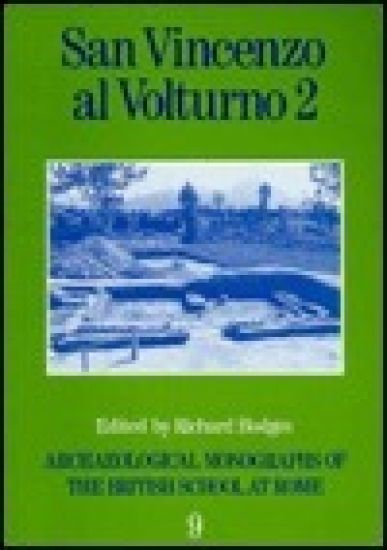
San Vincenzo al Volturno 2

San Vincenzo al Volturno 2

Richard Hodges

British School at Rome
1995
nidottu
This volume presents the second part of the detailed report on the British School at Rome's excavations between 1980 and 1986 at the early medieval Benedictine abbey of San Vincenzo in Molise, central Italy. It contains discussion of the Vestibule, the Assembly Room containing the reconstructed wall of painted prophets, the Refectory, the terraces, the hilltop cemetery, and the late Roman settlement. It also includes essays on the historical context of the site: `Christians and countrymen' (Samuel Barnish) , `Monastic lands and monastic patrons' (Chris Wickham) , and `San Vincenzo and the Plan of Saint Gall' (Richard Hodges) .