Kirjojen hintavertailu – 12 859 829 kirjaa ja 27 kauppaa

Kirjailija

Richard J. Bernstein

Kirjat ja teokset yhdessä paikassa: 30 kirjaa, julkaisuja vuosilta 1971–2022, suosituimpiin kuuluu Ironic Life. Vertaile teosten hintoja ja tarkista saatavuus suomalaisista kirjakaupoista.

Nimi esiintyy myös muodoissa: Richard J Bernstein

30 kirjaa

Kirjojen julkaisuvuodet: 1971–2022.

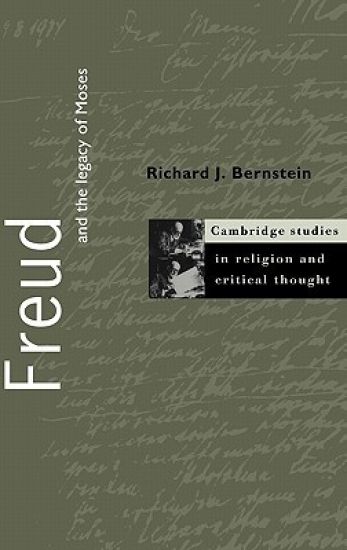
Freud and the Legacy of Moses

Freud and the Legacy of Moses

Richard J. Bernstein

Cambridge University Press
1998
sidottu
Freud's last book, Moses and Monotheism, was published in 1939 during one of the darkest periods in Jewish history. This difficult book has frequently been vilified and dismissed because Freud claims that Moses was not a Hebrew but an Egyptian, and that the Jews murdered Moses in the wilderness. Richard Bernstein argues that a close reading of Moses and Monotheism reveals an underlying powerful coherence in which Freud seeks to specify the distinctive character and contribution of the Jewish people. It is this character that has enabled the Jewish people to survive despite persecution and virulent anti-Semitism, and Freud proudly identifies himself with it. In his analysis of Freud's often misunderstood last work, Bernstein goes on to shows how Freud expands and deepens our understanding of a religious tradition by revealing its unconscious dynamics.

Hannah Arendt and the Jewish Question

Hannah Arendt and the Jewish Question

Richard J. Bernstein

Polity Press
1996
nidottu
Hannah Arendt is increasingly recognised as one of the most original social and political thinkers of the twentieth century. In this important book, Richard Bernstein sets out to show that many of the most significant themes in Arendt's thinking have their origins in their confrontation with the Jewish Question. By approaching her mature work from this perspective, we can gain a richer and more subtle grasp of her main ideas. Bernstein discusses some of the key experiences and events in Arendt's life story in order to show how they shaped her thinking. He examines her distinction between the Jewish parvenu and the pariah, and shows how the conscious pariah becomes a basis for understanding the independent thinker. Arendt's deepest insights about politics emerged from her reflections on statelessness, which were based on her own experiences as a stateless person. By confronting the horrors of totalitarianism and the concentration camps, Arendt developed her own distinctive understanding of authentic politics - the politics required to express our humanity and which totalitarianism sought to destroy. Finally, Bernstein takes up Arendt's concern with the phenomenon of the banality of evil. He follows her use of Eichmann in order to explore how the failure to think and to judge is the key for grasping this new phenomenon. Hannah Arendt and the Jewish Question offers a new interpretation of Arendt and her work - one which situates her in her historical context as an engaged Jewish intellectual.
The New Constellation

The New Constellation

Richard J. Bernstein

MIT Press
1992
pokkari
During the last two decades Richard Bernstein has established a worldwide reputation as one of the few philosophers able to bridge different traditions of thought and to clarify, through sympathetic criticism, the key intellectual issues of our time. In these 10 essays he explores the ethical and political dimensions of the modernity/postmodernity debates. Bernstein argues that modernity/postmodernity should be understood as a pervasive mood - what Heidegger calls a Stimmung - one that is amorphous, shifting, and protean but that nevetheless exerts a powerful influence on our current ways of thinking and acting. Focusing on such thinkers as Heidegger, Derrida, Foucault, Rorty, and Habermas, Bernstein seeks to demonstrate the strengths and weaknesses of their work and to highlight the ways in which they have contributed to the formation of a new and distinctive constellation of ideas and themes. Richard J. Bernstein is Vera List Professor of Philosophy at the New School for Social Research. The Essays: Philosophy, History, and Critique. The Rage Against Reason. Incommensurability and Otherness Revisited. Heidegger's Silence? Ethos and Technology. Foucault: Critique as a Philosophic Ethos. Serious Play: The Ethical-Political Horizon of Derrida. An Allegory of Modernity/Postmodernity: Habermas and Derrida. One Step Forward, Two Steps Backward: Rorty on Liberal Democracy. Rorty's Liberal Utopia, Reconciliation/Rupture.
The New Constellation

The New Constellation

Richard J. Bernstein

Polity Press
1991
nidottu
In this major new work, Bernstein explores the ethical and political dimensions of the modernity/post-modernity debate. Bernstein argues that modernity / post-modernity should be understood as a kind of mood - one which is amorphous, shifting and protean but which exerts a powerful influence on our current thinking. Focusing on thinkers such as Heidegger, Derrida, Foucault, Habermas and Rorty, Bernstein probes the strengths and weaknesses of their work, and shows how they have contributed to the formation of a new mood, a new and distinctive constellation of ideas. This new constellation has put ethical and political issues back on the philosophical agenda, forcing us to confront anew, the Socratic question 'How should I live?'
Philosophical Profiles

Philosophical Profiles

Richard J. Bernstein

University of Pennsylvania Press
1986
pokkari
Philosophical Profiles brings together ten important essays by Richard Berstein. Each focuses on the work of a thinker or group of thinkers at the center of contemporary developments in philosophy, including Hannah Arendt, John Dewey, Hans-Georg Gadamer, Jurgen Habermas, G. W. F. Hegel, Alasdair MacIntyre, Herbert Marcuse, and Richard Rorty.
Habermas and Modernity

Habermas and Modernity

Richard J. Bernstein

JOHN WILEY AND SONS LTD
1985
nidottu
Jurgen Habermas is one of the leading and one of the most challenging social theorists of our time. During the past several decades he has been developing a systematic critical analysis of modernity - its historical origins, pathologies and future prospects. He is a thinker who has been uncannily attuned to the basic moods and vital concerns of contemporary culture. He stubbornly resists those who claim that Western rationality is exhausted, that the Enlightenment legacy is dead and that the project of modernity is a failure. He has elaborated a comprehensive theory of rationality and the rationalisation processes of modernisation - one which highlights the intersubjective character of communicative action. His ambitious and carefully argues intellectual project invites - indeed commands - rigorous critical scrutiny. This collection of critical essays draws together leading thinkers from a variety of fields in order to assess some of Habermas's major theses concerning the philosophical, cultural and social conditions of modernity. In his substantial reply to these critics Habermas clarifies and defends his view, specifying a range of new problems which demand further analysis. This book is an invaluable resource for understanding Habermas's work and an essential text for anyone who is interested in current debates about the nature of, ad prospects for, contemporary societies and modern culture.
Beyond Objectivism and Relativism

Beyond Objectivism and Relativism

Richard J. Bernstein

University of Pennsylvania Press
1983
pokkari

Halvin toimitettuna 38,20 €

Drawing freely and expertly from Continental and analytic traditions, Richard Bernstein examines a number of debates and controversies exemplified in the works of Gadamer, Habermas, Rorty, and Arendt. He argues that a "new conversation" is emerging about human rationality-a new understanding that emphasizes its practical character and has important ramifications both for thought and action.
A Pluralistic Universe

A Pluralistic Universe

William James; Richard J. Bernstein

Harvard University Press
1977
sidottu
In May 1908 William James, a gifted and popular lecturer, delivered a series of eight Hibbert Lectures at Manchester College, Oxford, on “The Present Situation in Philosophy.” These were published a year later as A Pluralistic Universe. During the preceding decade James, as he struggled with deep conflicts within his own philosophic development, had become increasingly preoccupied with epistemological and metaphysical issues. He saw serious inadequacies in the forms of absolute and monistic idealism dominant in England and the United States, and he used the lectures to attack the specific form that “vicious intellectualism” had taken. In A Pluralistic Universe James captures a new philosophic vision, at once intimate and realistic. He shares with his readers a view of the universe that is fresh, active, and novel. The message conveyed is as relevant today as it was in his time. This is the fourth volume of The Works of William James in an authoritative edition sponsored by the American Council of Learned Societies. Prepared according to modern standards of textual scholarship, this series utilizes all available published and unpublished materials; its texts have been awarded the seal of approval of the Center for Editions of American Authors. Frederick Burkhardt is General Editor; Fredson Bowers, Textual Editor; Ignas K. Skrupskelis, Associate Editor.
Praxis and Action

Praxis and Action

Richard J. Bernstein

University of Pennsylvania Press
1971
pokkari
From the Introduction: This inquiry is concerned with the themes of praxis and action in four philosophic movements: Marxism, existentialism, pragmatism, and analytic philosophy. It is rare that these four movements are considered in a single inquiry, for there are profound differences of emphasis, focus, terminology, and approach represented by these styles of thought. Many philosophers believe that similarities among these movements are superficial and that a close examination of them will reveal only hopelessly unbridgeable cleavages. While respecting the genuine fundamental differences of these movements, this inquiry is undertaken in the spirit of showing that there are important common themes and motifs in what first appears to be a chaotic babble of voices. I intend to show that the concern with man as an agent has been a primary focal point of each of these movements and further that each contributes something permanent and important to our understanding of the nature and context of human activity.