Kirjojen hintavertailu – 12 903 724 kirjaa ja 27 kauppaa

Kirjailija

Richard M. Clifford

Kirjat ja teokset yhdessä paikassa: 8 kirjaa, julkaisuja vuosilta 2004–2025, suosituimpiin kuuluu Escala De Calificacion Ambiente Para Bebes Y Ninos Pequenos. Vertaile teosten hintoja ja tarkista saatavuus suomalaisista kirjakaupoista.

8 kirjaa

Kirjojen julkaisuvuodet: 2004–2025.

Play Environment Rating Scale (PERS) & Creative Environment Rating Scale (CERS)

Play Environment Rating Scale (PERS) & Creative Environment Rating Scale (CERS)

Igor Shiyan; Anna Iakshina; Tatiana Le-van; Olga Shiyan; Irina Vorobeva; Anastasia Belolutskaya; Olga Kholodova; Larisa Loginova; Richard M. Clifford; Debby Cryer

TEACHERS' COLLEGE PRESS
2025
kierre
This title is in the Environment Rating Scale® Family of Products—the leading research-based tools to optimize the quality of children's early learning. This book includes two distinct environment rating scales designed to be used as extensions to the Early Childhood Environment Rating Scale® (ECERS-3)—one for supporting young children's play (PERS) and one for supporting their creative abilities (CERS). Both scales are based on Vygotsky's cultural-historical approach. Additionally, they are each structured and scored in the same manner as the Environment Rating Scale®. PERS and CERS can be used in both preschool and kindergarten classrooms to take a deeper look at specific aspects of quality and to provide guidance for improving conditions to support children's development. PERS is a research-based scale designed to analyze and evaluate conditions to support mature (or developed) play that nurtures young children's imagination and contributes to the development of self-regulation, emotions, communication, social skills, cooperation among peers, speech, storytelling, and literacy. Mature play is also very important for school readiness, children's self-esteem, learning motivation, and successful transition to school. Each item of the scale is focused on a specific and meaningful aspect of complex play support: space for play program structure and free time for play play materials adult's support of children's play and peer interaction. CERS is a research-based scale designed to analyze and evaluate conditions to support the development of creative thinking and imagination in young children so that they can come up with new ideas, make discoveries, and solve nonstandard tasks. While most early childhood professionals know that encouraging creativity is important, many do not have the tools to do so on a day-to-day basis. CERS can be used as a formal assessment, and it can also serve as a tool for practitioner reflection on how to better support the development of creative abilities in preschool and kindergarten students. It measures both environmental provisions and teacher–child interactions that affect several areas: understanding the development processes asking and supporting questions being inventive and transforming contradictions and using imagination. Environment Rating Scale® and Early Childhood Environment Rating Scale® are registered trademarks of Teachers College, Columbia University
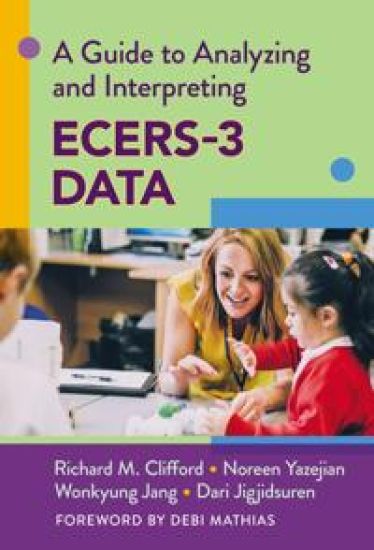
A Guide to Analyzing and Interpreting ECERS-3 Data

A Guide to Analyzing and Interpreting ECERS-3 Data

Richard M. Clifford; Noreen Yazejian; Wonkyung Jang; Dari Jigjidsuren

Teachers' College Press
2021
sidottu
Early childhood is a crucial stage in a child's life, and aspects of the environment in the physical, social-emotional, cognitive, and health and safety domains all play important roles in shaping children's development during these early years. Having a valid and reliable measure of the quality of these aspects of children's care settings is critical. The Early Childhood Environment Rating Scale (ECERS-3) is the leading research-based instrument for examining these influential global factors that directly impact children in early childhood environments. In this new guide, readers will find an in-depth description of both the conceptual model underlying the ECERS-3 and innovative ways of analyzing data for a fuller understanding of what can be done with the scale and why it is integral to the evaluation of early care and education. The authors analyze a large database of classroom observations to help ECERS-3 users better understand, interpret, and utilize their own findings. Readers will also see how components of their ECERS-3 data relate to one another, within and across subscales, and within the scale as a whole. A Guide to Analyzing and Interpreting ECERS-3 Data will assist program directors, agency administrators, preK–K teaching coaches/mentors, school principals, researchers, and others who use the ECERS-3 to more successfully document, interpret, and analyze the quality of essential influential factors in an early learning setting. This resource will help guide program improvement initiatives with insight into what is needed for children's development and learning. Book Features: Provides a framework for thinking about how early childhood care and education learning environments fit into the larger picture of influences on children's development. Presents a theory of change that combines understanding how children learn and develop with how early education and care affect long-term outcomes. Analyzes what ECERS-3 data looks like for a large sample of classrooms and by different child and teacher characteristics. Includes full color tables and figures illuminating the data analysis of the classroom observations.
A Guide to Analyzing and Interpreting ECERS-3 Data

A Guide to Analyzing and Interpreting ECERS-3 Data

Richard M. Clifford; Noreen Yazejian; Wonkyung Jang; Dari Jigjidsuren

Teachers' College Press
2021
nidottu
Early childhood is a crucial stage in a child's life, and aspects of the environment in the physical, social-emotional, cognitive, and health and safety domains all play important roles in shaping children's development during these early years. Having a valid and reliable measure of the quality of these aspects of children's care settings is critical. The Early Childhood Environment Rating Scale (ECERS-3) is the leading research-based instrument for examining these influential global factors that directly impact children in early childhood environments. In this new guide, readers will find an in-depth description of both the conceptual model underlying the ECERS-3 and innovative ways of analyzing data for a fuller understanding of what can be done with the scale and why it is integral to the evaluation of early care and education. The authors analyze a large database of classroom observations to help ECERS-3 users better understand, interpret, and utilize their own findings. Readers will also see how components of their ECERS-3 data relate to one another, within and across subscales, and within the scale as a whole. A Guide to Analyzing and Interpreting ECERS-3 Data will assist program directors, agency administrators, preK–K teaching coaches/mentors, school principals, researchers, and others who use the ECERS-3 to more successfully document, interpret, and analyze the quality of essential influential factors in an early learning setting. This resource will help guide program improvement initiatives with insight into what is needed for children's development and learning. Book Features: Provides a framework for thinking about how early childhood care and education learning environments fit into the larger picture of influences on children's development. Presents a theory of change that combines understanding how children learn and develop with how early education and care affect long-term outcomes. Analyzes what ECERS-3 data looks like for a large sample of classrooms and by different child and teacher characteristics. Includes full color tables and figures illuminating the data analysis of the classroom observations.
Escala De Calificación Del Ambiente De La Infancia Temprana

Escala De Calificación Del Ambiente De La Infancia Temprana

Thelma Harms; Richard M. Clifford; Debby Cryer

Teachers' College Press
2020
kierre
This is the Spanish edition of the new version of the internationally recognized Early Childhood Environment Rating Scale. ECERS-3 focuses on the full range of needs of preschool- and kindergarten aged children. This widely used, comprehensive assessment tool measures both environmental provisions and teacher–child interactions that affect the broad developmental needs of young children. Esta nueva versión de la internacionalmente reconocida Escala de Calificación del Ambiente de la Infancia Temprana, ECERS-3, se centra en la gama completa de necesidades de los niños en edad preescolar y de kindergarten. Esta herramienta de evaluación, integral y ampliamente utilizada, mide las disposiciones del ambiente y las interacciones maestro-niño que afectan las necesidades generales para el desarrollo de los niños de corta edad, incluyendo las necesidades:cognitivas · socio-emocionales · físicas · de salud y seguridadLa ECERS-3 incluye ítems adicionales que evalúan las actividades de lectoescritura y matemáticas adecuadas para cada etapa del desarrollo. Diseñada para salones de clases de preescolar, kindergarten y cuidado infantil, que atienden a niños de 3 a 5 años de edad, la ECERS-3:Proporciona una transición sin problemas para quienes ya usan ECERS-R. Enfatiza el papel del maestro en la creación de un ambiente favorable para los avances en el desarrollo. Está diseñada para predecir los resultados del niño con mayor exactitud y precisión. Provee un método más sólido para distinguir entre los programas buenos y los verdaderamente sobresalientes. Ofrece un programa de capacitación completo con soporte continuo disponible en el sitio web del Environment Rating Scales Institute (ERSI) (www.ersi.info). La ECERS-3 es adecuada para los QRIS estatales y distritales y el mejoramiento continuo, para los programas de evaluación a cargo de directores y supervisores, la autoevaluación de los maestros, la supervisión del personal de la agencia y los programas de capacitación de los maestros. La establecida confiabilidad y la evidencia de validez a largo plazo de la familia de instrumentos de ERS hacen que esta nueva versión de la ECERS sea particularmente útil para la rendición de cuentas del programa RTTT-ELC y la investigación. Aptas para uso en programas inclusivos y culturalmente diversos, las subescalas de la ECERS-3 evalúan:Espacio y muebles · Rutinas de cuidado personal · Lenguaje y lectoescritura · Actividades de aprendizaje · interacción · Estructura del programa
Infant/Toddler Environment Rating Scale (ITERS-3)

Infant/Toddler Environment Rating Scale (ITERS-3)

Thelma Harms; Debby Cryer; Richard M. Clifford; Noreen Yazejian

Teachers' College Press
2017
kierre

Halvin toimitettuna 37,70 €

This revised and updated assessment tool focuses on the full range of needs of infants and toddlers up to 36 months of age and provides a framework for improving program quality. ITERS-3 assesses both environmental provisions and teacher-child interactions that affect the broad developmental milestones of infants and toddlers, including: language, cognitive, social-emotional and physical development as well as concern for health and safety.
Early Childhood Environment Rating Scale (ECERS-3)

Early Childhood Environment Rating Scale (ECERS-3)

Thelma Harms; Richard M. Clifford; Debby Cryer

Teachers' College Press
2014
kierre

Halvin toimitettuna 34,60 €

The long-anticipated new version of the internationally recognized Early Childhood Environment Rating Scale, ECERS-3, focuses on the full range of needs of preschool- and kindergarten-aged children. This widely used, comprehensive assessment tool measures both environmental provisions and teacher-child interactions that affect the broad developmental needs of young children, including:CognitiveSocial-EmotionalPhysicalHealth and safetyECERS-3 also includes additional Items assessing developmentally appropriate literacy and math activities. Designed for preschool, kindergarten, and child care classrooms serving children 3 through 5 years of age, ECERS-3:Provides a smooth transition for those already using ECERS-R. Emphasizes the role of the teacher in creating an environment conducive to developmental gains. Is designed to predict child outcomes more accurately and with greater precision. Provides a stronger method of distinguishing between good and truly excellent programs. Offers a complete training program with ongoing support available at the Environment Rating Scales Institute (ERSI) website (www.ersi.info). ECERS-3 is appropriate for state and district-wide QRIS and continuous improvement; program evaluation by directors and supervisors; teacher self-evaluation; monitoring by agency staff; and teacher education. The established reliability and long term evidence of validity of the ERS family of instruments make this new version of ECERS particularly useful for RTTT-ELC accountability and research. Suitable for use in inclusive and culturally diverse programs, ECERS-3 subscales evaluate:Space and FurnishingsPersonal Care RoutinesLanguage and LiteracyLearning ActivitiesInteractionProgram Structure
Kvalitetsvurdering av barnehagen

Kvalitetsvurdering av barnehagen

Debby Cryer; Richard M. Clifford; Thelma Harms

Sebu forl.
2011
nidottu
ECERS- metoden er et instrument for å vurdere kvaliteten på barnehagen, og er beregnet for barnehager hvor det går barn i alderen to til fem år. ECERS består av totalt 45 ulike skalaer, og til hver skala er det gitt et visst antall kvalitetsindikatorer. Skalaen kan brukes til mange formål, for eksempel interne og eksterne vurderinger, og av studenter i praksis under utdanning. ECERS er oversatt til mange språk, og denne norske oversettelsen er standardisert for norske barnehager.