Kirjojen hintavertailu – 12 903 725 kirjaa ja 27 kauppaa

Kirjailija

Richard Marsden

Kirjat ja teokset yhdessä paikassa: 29 kirjaa, julkaisuja vuosilta 1995–2021, suosituimpiin kuuluu Broadband in Europe. Vertaile teosten hintoja ja tarkista saatavuus suomalaisista kirjakaupoista.

29 kirjaa

Kirjojen julkaisuvuodet: 1995–2021.

The Nature of Capital

The Nature of Capital

Richard Marsden

Routledge
2014
nidottu
The synthesis of Marx and Foucault has traditionally been seen within the social sciences as deeply problematic. The author overturns this received wisdom by subjecting both thinkers to an original re-reading through the lens of the philosophy of critical realism. The result is an illuminating synthesis between Marx's social relations of production and Foucault's disciplinary power from which the author constructs a model of the material causes of our capacity to act. The laws of motion of a society and its microphysics are shown to be complementary parts of a theory of capital, society's genetic code. The Nature of Capital overturns traditional interpretations of Marx, presents an accessible and comprehensive account of the development of his model of capital and demonstrates its ability to explain modern societies.
The New Cambridge History of the Bible: Volume 2, From 600 to 1450

The New Cambridge History of the Bible: Volume 2, From 600 to 1450

Richard Marsden; E. Ann Matter

Cambridge University Press
2012
sidottu
This volume examines the development and use of the Bible from late Antiquity to the Reformation, tracing both its geographical and its intellectual journeys from its homelands throughout the Middle East and Mediterranean and into northern Europe. Richard Marsden and E. Ann Matter's volume provides a balanced treatment of eastern and western biblical traditions, highlighting processes of transmission and modes of exegesis among Roman and Orthodox Christians, Jews and Muslims and illuminating the role of the Bible in medieval inter-religious dialogue. Translations into Ethiopic, Slavic, Armenian and Georgian vernaculars, as well as Romance and Germanic, are treated in detail, along with the theme of allegorized spirituality and established forms of glossing. The chapters take the study of Bible history beyond the cloisters of medieval monasteries and ecclesiastical schools to consider the influence of biblical texts on vernacular poetry, prose, drama, law and the visual arts of East and West.
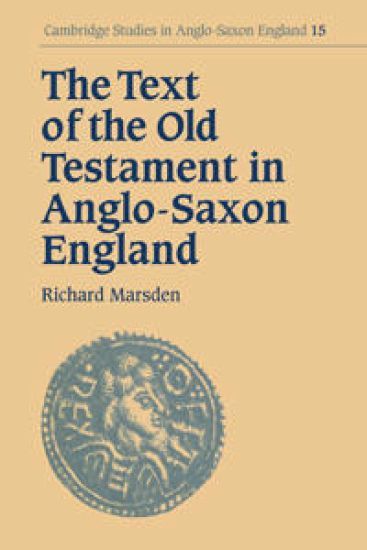
The Text of the Old Testament in Anglo-Saxon England

The Text of the Old Testament in Anglo-Saxon England

Richard Marsden

Cambridge University Press
2006
pokkari
The early medieval Vulgate Bible had no fixed textual form - multiple copying resulted in a multitude of forms. This 1995 book tackles questions about the transmission of the Vulgate Old Testament in Anglo-Saxon England. By tracing the history of the text in the surviving Latin manuscripts we can illuminate monastic and intellectual history. Following an introduction which explains the wider continental history in which the dissemination of the Latin scriptures occurred, Richard Marsden goes on to analyse twenty surviving manuscripts including the Codex Amiatinus, one of the greatest English books and the earliest surviving complete Vulgate Bible. The book provides a comprehensive listing and collation of surviving Anglo-Saxon manuscripts of the Old Testament, and it also establishes textual history as a dimension of wider Anglo-Saxon history.
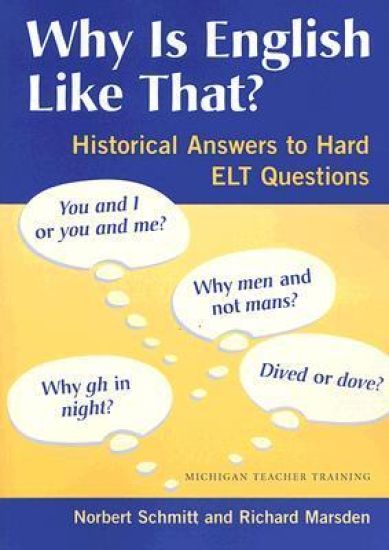
Why Is English Like That?

Why Is English Like That?

Norbert Schmitt; Richard Marsden

The University of Michigan Press
2006
nidottu
Why is "night" spelled with "gh"? Why can't sentences end with prepositions? Why does English have so many words that express the same ideas? Questions like these can be difficult for teachers to answer when they do not know the historical background of the English language. Why Is English Like That? gives teachers a brief and accessible history of the English without assuming any prior knowledge of the subject. The book outlines the historical events that shaped English; describes how its grammar, vocabulary, spelling, and pronunciation developed over time; and highlights the "quirks" and "exceptions" in English that can be explained on a historical basis. By understanding how the English of today evolved from the English of past times, both teachers and students will be more comfortable with the many conventions of the English language. Why Is English Like That? also contains reproducible grammar and vocabulary exercises that will help teachers incorporate some of this historical knowledge into classroom activities. This book was written with English language teachers in mind, and the exercises are designed for ESL/EFL students, but it may also be used by teachers in training (L1 and L2).
The Nature of Capital

The Nature of Capital

Richard Marsden

Routledge
1999
sidottu
The synthesis of Marx and Foucault has traditionally been seen within the social sciences as deeply problematic. The author overturns this received wisdom by subjecting both thinkers to an original re-reading through the lens of the philosophy of critical realism. The result is an illuminating synthesis between Marx's social relations of production and Foucault's disciplinary power from which the author constructs a model of the material causes of our capacity to act. The laws of motion of a society and its microphysics are shown to be complementary parts of a theory of capital, society's genetic code. The Nature of Capital overturns traditional interpretations of Marx, presents an accessible and comprehensive account of the development of his model of capital and demonstrates its ability to explain modern societies.

The Text of the Old Testament in Anglo-Saxon England

The Text of the Old Testament in Anglo-Saxon England

Richard Marsden

Cambridge University Press
1995
sidottu
The early medieval Vulgate Bible had no fixed textual form - multiple copying resulted in a multitude of forms. This book is the first to tackle questions about the transmission of the Vulgate Old Testament in Anglo-Saxon England. By tracing the history of the text in the surviving Latin manuscripts we can illuminate monastic and intellectual history. Following an introduction which explains the wider continental history in which the dissemination of the Latin scriptures occurred, Richard Marsden goes on to analyse twenty surviving manuscripts including the Codex Amiatinus, one of the greatest English books and the earliest surviving complete Vulgate Bible. The book provides the first comprehensive listing and collation of surviving Anglo-Saxon manuscripts of the Old Testament; it also establishes textual history as a dimension of wider Anglo-Saxon history.