
Kirjailija
Richard Mason
Kirjat ja teokset yhdessä paikassa: 48 kirjaa, julkaisuja vuosilta 1999–2026, suosituimpiin kuuluu Analyzing a More Resilient National Positioning, Navigation, and Timing Capability. Vertaile teosten hintoja ja tarkista saatavuus suomalaisista kirjakaupoista.
48 kirjaa
Kirjojen julkaisuvuodet: 1999–2026.

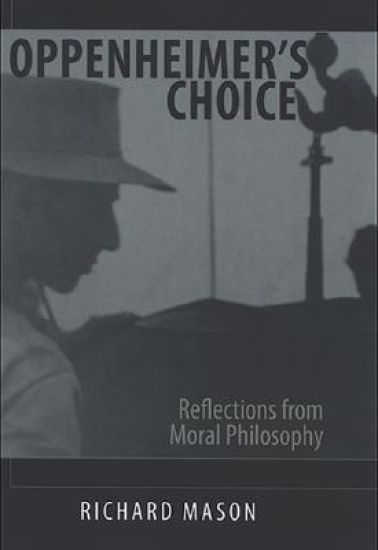
Studies J. Robert Oppenheimer's choice to accept leadership of the Manhattan Project. In 1942, J. Robert Oppenheimer accepted the leadership of the Manhattan Project at the Los Alamos Laboratory, which produced the first atomic bomb three years later. This book examines the ethics of Oppenheimer's choice to take that job and our judgment of his acceptance, leading to the larger question of the meaning of moral judgment itself. Through an analysis of Oppenheimer's choice, Richard Mason explores questions of responsibility, the justification for the pursuit of scientific curiosity, the purity of research, and many other topics of interest in scientific ethics. This unique look at one man's choice brings out the necessary step from personal detail to abstract reflection-it may be easy to praise or condemn Oppenheimer's choice, but less easy to justify our praise or condemnation. Oppenheimer's Choice establishes the possibility of this kind of moral philosophy-neither "applied" nor "practical" ethics, but instead a sustained concentration on a single choice, and what it means.
Approaching the central themes of Spinoza's thought from both a historical and analytical perspective, this book examines the logical-metaphysical core of Spinoza's philosophy, its epistemology and its ramifications for his much disputed attitude towards religion. Opening with a discussion of Spinoza's historical and philosophical location as the appropriate context for the interpretation of his work the book goes on to present a non-'logical' reading of Spinoza's metaphysics, a consideration of Spinoza's radical repudiation of Cartesian subjectivism and an examination of how Spinoza wanted religion to be understood in the context of his wider thinking and the influence of his non-Christian background. Mason also assesses Spinoza's significance and importance for philosophy now.
Studies J. Robert Oppenheimer's choice to accept leadership of the Manhattan Project. In 1942, J. Robert Oppenheimer accepted the leadership of the Manhattan Project at the Los Alamos Laboratory, which produced the first atomic bomb three years later. This book examines the ethics of Oppenheimer's choice to take that job and our judgment of his acceptance, leading to the larger question of the meaning of moral judgment itself. Through an analysis of Oppenheimer's choice, Richard Mason explores questions of responsibility, the justification for the pursuit of scientific curiosity, the purity of research, and many other topics of interest in scientific ethics. This unique look at one man's choice brings out the necessary step from personal detail to abstract reflection-it may be easy to praise or condemn Oppenheimer's choice, but less easy to justify our praise or condemnation. Oppenheimer's Choice establishes the possibility of this kind of moral philosophy-neither "applied" nor "practical" ethics, but instead a sustained concentration on a single choice, and what it means.
A study of the scope and limits of understanding. How is understanding to be understood? Are there limits to understanding? What of importance, if anything, could lie beyond understanding? And do we need to understand knowledge before we can know about understanding? Richard Mason's argument is that a critical theory of understanding, modeled on past theories of knowledge, cannot be workable. Understanding may bring wisdom: an uncomfortable thought for many philosophers in the twentieth century. Yet philosophy aims at expanding understanding at least as much as knowledge. How we understand understanding affects how we understand philosophy. If we put aside a narrow view of understanding based upon a Cartesian model of knowledge, we may gain a more liberal, open understanding of philosophy. Mason's treatment of these fascinating problems offers a clear and lucid dialogue with a number of contemporary philosophical schools and with philosophy's past. His discussions include the thought of Hume, Henry James, Heidegger, Frege, Charles Taylor, Michael Oakeshott, Wittgenstein, Gadamer, James Joyce, and the Guyaki Indians. This fascinating book contributes to the work of many of these traditions as well as to the nature of understanding in areas as diverse as physics, music, and linguistics.

Argues that there is an undeniable and essentially historical dimension to logic. 2000 CHOICE Outstanding Academic Title Must logic come first? Are philosophical problems really logical? Must we think logically to think at all? Richard Mason's case is that too much comes before logic-too many choices and too much history. Logic has been formed by choices made by philosophers, not just as a subject of study, but in terms of what has mattered: the problems, and the possible solutions. Before Logic contains case studies of crucial choices: on the formation of logical possibility, on truth, on the explanation of necessity, on essentialism, and on the location of logic. For readers with interests in analytical or continental philosophy or in logic, this book shows why and how history matters to logic. Logic then, cannot be the basis for metaphysics-or an important grounding for philosophical investigations-because too many important assumptions precede it. The difficulty this position presents is that it avoids the obvious objections of relativism. This controversial topic strikes at the heart of much post-Wittgensteinian and post-Heideggerian thought.
The God of Spinoza
Richard Mason
Cambridge University Press
1999
pokkari
Halvin toimitettuna 55,60 €
This book is the fullest study in English for many years on the role of God in Spinoza’s philosophy. Spinoza has been called both a ‘God-intoxicated man’ and an atheist, both a pioneer of secular Judaism and a bitter critic of religion. He was born a Jew but chose to live outside any religious community. He was deeply engaged both in traditional Hebrew learning and in contemporary physical science. He identified God with nature or substance: a theme which runs through his work, enabling him to naturalise religion but - equally important - to divinise nature. He emerges not as a rationalist precursor of the Enlightenment but as a thinker of the highest importance in his own right, both in philosophy and in religion.