Kirjojen hintavertailu – 12 859 829 kirjaa ja 27 kauppaa

Kirjailija

Richard N. Haass

Kirjat ja teokset yhdessä paikassa: 6 kirjaa, julkaisuja vuosilta 1988–2010, suosituimpiin kuuluu Beyond the INF Treaty. Vertaile teosten hintoja ja tarkista saatavuus suomalaisista kirjakaupoista.

6 kirjaa

Kirjojen julkaisuvuodet: 1988–2010.

War of Necessity, War of Choice: A Memoir of Two Iraq Wars
Richard Haass, a member of the National Security Council staff in the George H. W. Bush administration and the State Department director of policy planning for George W. Bush, reviews the causes and strategies of the first and second Iraq wars while providing a thoughtful examination of the means and ends of U. S. foreign policy. War of Necessity, War of Choice--part history, part memoir--provides invaluable insight into some of the most important recent events in the world. Additionally, this book provides a much-needed compass for how the United States can apply the lessons learned from the two Iraq wars so that it is better positioned to put into practice what worked and avoid repeating what so clearly did not. In this compelling, honest, and challenging book by one of the country's most respected voices on foreign policy, Haass's assessments are critical yet fair and carry tremendous weight.
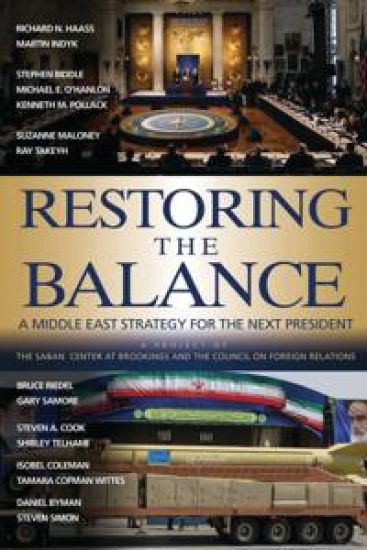
Restoring the Balance

Restoring the Balance

Richard N. Haass; Martin S. Indyk

Brookings Institution
2008
nidottu
"The next U. S. president will need to pursue a new strategic framework for advancing American interests in the Middle East. The mounting challenges include sectarian conflict in Iraq, Iran's pursuit of nuclear capabilities, failing Palestinian and Lebanese governments, a dormant peace process, and the ongoing war against terror. Compounding these challenges is a growing hostility toward U. S. involvement in the Middle East. The old policy paradigms, whether President George W. Bush's model of regime change and democratization or President Bill Clinton's model of peacemaking and containment, will no longer suit the likely circumstances confronting the next administration in the Middle East. In R estoring the Balance, experts from the Saban Center at the Brookings Institution and from the Council on Foreign Relations propose a new, nonpartisan strategy drawing on the lessons of past failures to address both the short-term and long-term challenges to U. S. interests. Following an overview chapter by Richard N. Haass, president of the Council on Foreign Relations, and Martin Indyk, director of the Saban Center, individual chapters address the Arab-Israeli conflict, counterterrorism, Iran, Iraq, political and economic development, and nuclear proliferation. Specific policy recommendations stem from in-depth research and extensive dialogue with individuals in government, media, academia, and the private sector throughout the region. The experts include Stephen Biddle, Isobel Coleman, Steven A. Cook, Steven Simon, and Ray Takeyh from the Council on Foreign Relations and Daniel L. Byman, Suzanne Maloney, Kenneth M. Pollack, Bruce Riedel, ShibleyTelhami, and Tamara Cofman Wittes from Brookings' Saban Center."
The Bureaucratic Entrepreneur

The Bureaucratic Entrepreneur

Richard N. Haass

Brookings Institution
1999
nidottu
"How do you figure out what to do in a job? How do you get it done? How should you deal with demanding bosses? How can you get the most out of subordinates? What should you do to get along with difficult colleagues and handle powerful interest groups and the media? Just how can you succeed in a world where persuasion rather than direct command is the rule? Using a compass as his operating metaphor--your boss is north of you, your staff is south, colleagues are east and so on--Richard Haass provides clear, practical guidelines for setting goals and translating goals into results. The result is a lively, useful book for the tens of millions of Americans working in complex and unruly organizations of every sort and for students of both public administration and business. The Bureaucratic Entrepreneur is a new and updated edition of Haass's 1994 book, The Power to Persuade."
Economic Sanctions and American Diplomacy

Economic Sanctions and American Diplomacy

Richard N. Haass

Council on Foreign Relations
1998
pokkari
"Sanctions don't work" is an often-heard refrain. The reality, though, is more complex. Sanctions - mostly economic but also political and military penalties aimed at states or other entities to alter political and/or military behavior - almost always have consequences, sometimes desirable, at other times unwanted and unexpected. What cannot be disputed is that economic sanctions are increasingly at the center of American foreign policy: to stem the proliferation of weapons of mass destruction, promote human rights, discourage aggression, protect the environment, and thwart drug trafficking. Drawing on eight case studies - China, Cuba, Haiti, Iran, Iraq, Libya, Pakistan, and the former Yugoslavia - this edited volume presents lessons to be learned from recent American use of economic sanctions. It also provides specific guidelines designed to shape future decisions by Congress and the executive branch.
Intervention

Intervention

Richard N. Haass

Brookings Institution
1997
nidottu
This new edition of the Carnegie Endowment bestseller?selected by Choice as ""an outstanding academic book of 1995""?now also discusses the interventions in Haiti and Bosnia, the 1998 crisis (and earlier skirmishes) with Iraq, and the decision to not intervene to halt apparent genocide in Central Africa. In the core original study, which draws upon twelve cases?including Somalia, Lebanon, Panama, Grenada, and the Gulf War? Richard Haass suggests political and military guidelines for potential U. S. military interventions ranging from peacekeeping and humanitarian operations to preventive strikes and all-out warfare.
Beyond the INF Treaty

Beyond the INF Treaty

Richard N. Haass

University Press of America
1988
sidottu
With the signing of the intermediate-range nuclear forces (INF) treaty in December 1987, a chapter in NATO history came to an end. This agreement eliminated an entire class of nuclear weapons from Europe. This volume analyzes the possible repercussions of the INF treaty in the context of NATO's overall doctrine of flexible response, and concludes that the U. S. and NATO must adopt arms and arms control policies consistent with one another and with NATO doctrine.