Kirjojen hintavertailu – 12 903 739 kirjaa ja 27 kauppaa

Kirjailija

Richard Newbold Adams

Kirjat ja teokset yhdessä paikassa: 7 kirjaa, julkaisuja vuosilta 1975–2013, suosituimpiin kuuluu United States University Cooperation in Latin America: A Study Based on Selected Programs in Bolivia, Chile, Peru, and Mexico. Vertaile teosten hintoja ja tarkista saatavuus suomalaisista kirjakaupoista.

7 kirjaa

Kirjojen julkaisuvuodet: 1975–2013.

Cultural Surveys of Panama-Nicaragua-Guatemala-El Salvador-Honduras

Cultural Surveys of Panama-Nicaragua-Guatemala-El Salvador-Honduras

Richard Newbold Adams

Literary Licensing, LLC
2013
sidottu
""Cultural Surveys of Panama-Nicaragua-Guatemala-El Salvador-Honduras"" is a book written by Richard Newbold Adams. The book is a comprehensive exploration of the cultural heritage and traditions of five Central American countries, namely Panama, Nicaragua, Guatemala, El Salvador, and Honduras. The author delves into the history, geography, and social structure of each country, providing readers with a detailed understanding of the unique cultural characteristics of the region. The book is divided into five sections, each focusing on a specific country. The author begins by discussing the indigenous cultures of each country, including the Maya, Aztec, and Inca civilizations. He then moves on to explore the impact of European colonization on the region, including the influence of Spanish and Portuguese culture on the local populations. Throughout the book, the author also examines the role of religion in shaping the cultural landscape of Central America. He discusses the influence of Catholicism, Protestantism, and other religious traditions on the region's art, music, and literature. In addition to exploring the historical and cultural context of each country, the author also provides readers with a glimpse into contemporary life in Central America. He discusses the challenges facing the region, including poverty, political instability, and environmental degradation. Overall, ""Cultural Surveys of Panama-Nicaragua-Guatemala-El Salvador-Honduras"" is a fascinating exploration of the rich cultural heritage of Central America. It is an essential read for anyone interested in the history, culture, and social dynamics of the region. Pan American Sanitary Bureau, Scientific Publications, No. 33, December, 1957. Additional Contributor Is Ofelia Hooper. This scarce antiquarian book is a facsimile reprint of the old original and may contain some imperfections such as library marks and notations. Because we believe this work is culturally important, we have made it available as part of our commitment for protecting, preserving, and promoting the world's literature in affordable, high quality, modern editions, that are true to their original work.

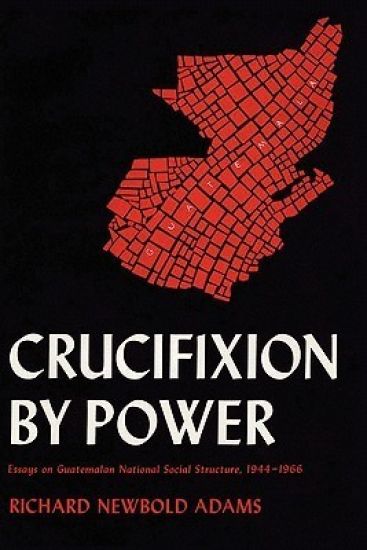
Crucifixion by Power

Crucifixion by Power

Richard Newbold Adams

University of Texas Press
2011
pokkari
"Quite the contrary of old generals, nations do not fade away; they have to be killed." Richard Adams' view of the nation as a basic social unit is central to this pioneering study in social anthropology. The result of many years of research in Guatemala, this volume utilizes the author's fieldwork as well as that of his colleagues and students to construct a set of concepts explaining how Guatemala reached the difficult circumstances in which it found itself in the 1960s-and still finds itself today. With the breakup of the great colonial empires after the Second World War, the curtain that had been drawn around Marx by Western social scientists fell away; countries once called "primitive" began to be seen as "underdeveloped," while those once thought to be stable and advanced began to appear predatory and conflict ridden. The theme of Mr. Adams' book is that, in the world as a whole, there is a structural escalation of power concentration. The author believes that Guatemala, as a small nation within the general domain of the United States, is caught in the developmental hinterland of that powerful neighbor and that the United States, within its own capitalistic development pattern and in competition with other leading world powers, cannot allow the smaller nation to resolve its own political and social problems. Thus Guatemala, he declares, finds itself crucified by unyielding and uncontrollable power plays beyond its national borders. As a background for the study of specific sectors in Guatemalan society, the author discusses the theoretical nature of complex societies. He shows the cohesive force of a nation to be its power structure and then examines mechanisms whereby this structure is kept intact in Guatemala. Special emphasis is given to the lack of access to power by the poor, the development of the military, the organization of power within the Catholic Church, and the expansion of upper-sector interest groups. While there was important growth in the power of upper-sector Guatemalan society over the two decades of the study, there was no comparable increase in distribution; the position of the lower sectors within the power structure has therefore changed very slightly. "Development," then, in Guatemala was principally in terms of what was advantageous to the major powers.
The Eighth Day

The Eighth Day

Richard Newbold Adams

University of Texas Press
1988
pokkari
Can human social evolution be described in terms common to other sciences, most specifically, as an energy process? The Eighth Day reflects a conviction that the human trajectory, for all its uniqueness and indeterminism, will never be satisfactorily understood until it is framed in dynamics that are common to all of nature. The problem in doing this, however, lies in ourselves. The major social theories have failed to treat human social evolution as a component of broader natural processes. The Eighth Day argues that the energy process provides a basis for explaining, comparing, and measuring complex social evolution. Using traditional ecological energy flow studies as background, society is conceived as a self-organization of energy. This perspective enables Adams to analyze society in term of the natural selection of self-organizing energy forms and the trigger processes basic to it. Domestication, civilization, socioeconomic development, and the regulation of contemporary industrial nation-states serve to illustrate the approach. A principal aim is to explore the limitation that energy process imposes on human social evolution as well as to clarify the alternatives that it allows. Richly informed by contemporary anthropological historicism, sociobiology, and Marxism, The Eighth Day avoids simple reductionism and denies facile ideological categorization. Adams builds on work in nonequilibrium thermodynamics and theoretical biology and brings three decades of his own work to an analysis of human society that demands an extreme materialism in which human thought and action find a central place.
Energy and Structure

Energy and Structure

Richard Newbold Adams

University of Texas Press
1975
pokkari
All social structures are essentially power structures dependent on energy. The concept of power and the role of energy in social organization are crucial and timely concerns, especially in light of the current apprehension about future energy resources. In Energy and Structure, Richard N. Adams argues that social power affects humanity's approach to ecological, economic, and political problems, directing people to seek solutions that are often deceptively shortsighted. Adams, an anthropologist, proposes that social power is directly derived from control over energy processes. He identifies how power and mentalistic structures constitute fundamental determinants that shape the lives of people at all stages of cultural development, forcing them to accept alternatives often far removed from their desires. His central thesis is that the amount of power in any system varies with the amount of control exercised over the environment and that increasing power and control lead to increasing centralization of decision-making, social marginalization, and environmental despoliation. Thus the more highly developed societies, by virtue of their greater controls, are responsible for the greater ultimate subordination and destruction of human potential, as humanity combines technological advances with a growing inability to exercise good judgment with respect to our own survival. Energy and Structure begins with an examination of the basic theory of social power-what it is and how it works. Adams defines and differentiates between the concepts of power and control, authority and legitimacy, power domains and levels. He then examines the underlying metatheory of energetic and mentalistic structures and provides an analytic model of the evolution of power, from the primitive band to modern nations. He predicts the emergence of supranational blocs and discusses other future possibilities. Throughout, his theoretical points are solidly supported by examples drawn from a wide range of cultures.