Kirjojen hintavertailu – 12 903 724 kirjaa ja 27 kauppaa

Kirjailija

Richard Pulteney

Kirjat ja teokset yhdessä paikassa: 10 kirjaa, julkaisuja vuosilta 2008–2025, suosituimpiin kuuluu A General View of the Writings of LinnÃ]us,. Vertaile teosten hintoja ja tarkista saatavuus suomalaisista kirjakaupoista.

10 kirjaa

Kirjojen julkaisuvuodet: 2008–2025.

Catalogues of the Birds, Shells, and Some of the More Rare Plants, of Dorsetshire. From the new and Enlarged Edition of Mr. Hutchins's History of That County. By Richard Pulteney,
The 18th century was a wealth of knowledge, exploration and rapidly growing technology and expanding record-keeping made possible by advances in the printing press. In its determination to preserve the century of revolution, Gale initiated a revolution of its own: digitization of epic proportions to preserve these invaluable works in the largest archive of its kind. Now for the first time these high-quality digital copies of original 18th century manuscripts are available in print, making them highly accessible to libraries, undergraduate students, and independent scholars. Medical theory and practice of the 1700s developed rapidly, as is evidenced by the extensive collection, which includes descriptions of diseases, their conditions, and treatments. Books on science and technology, agriculture, military technology, natural philosophy, even cookbooks, are all contained here.++++The below data was compiled from various identification fields in the bibliographic record of this title. This data is provided as an additional tool in helping to insure edition identification: ++++British LibraryT140194London: printed by J. Nichols, for the use of the compiler and his friends, 1799. 2],92p.; 2

Historical and Biographical Sketches of the Progress of Botany in England
Richard Pulteney (1730–1801) was a Leicestershire physician whose medical career suffered both from a lack of aristocratic patronage and from his dissenting religious background. However, his lifelong interest in botany and natural history, and particularly his work on the new Linnaean system of botanical classification, led to publications in the Gentleman's Magazine and the Philosophical Transactions of the Royal Society. He was elected a Fellow of the Royal Society in 1762. His book on Linnaeus (also reissued in this series), first published in 1782, was later considered to be of great significance for the acceptance in England of the Linnaean system, and this two-volume work, published in 1790, is still relevant to the study of the history of botany. Volume 1 begins in 'primaeval' and 'druidical' times and continues to the seventeenth century, including the first printed herbals and the work of the great botanist John Ray.
Historical and Biographical Sketches of the Progress of Botany in England
Richard Pulteney (1730–1801) was a Leicestershire physician whose medical career suffered both from a lack of aristocratic patronage and from his dissenting religious background. However, his lifelong interest in botany and natural history, and particularly his work on the new Linnaean system of botanical classification, led to publications in the Gentleman's Magazine and the Philosophical Transactions of the Royal Society. He was elected a Fellow of the Royal Society in 1762. His book on Linnaeus (also reissued in this series), first published in 1782, was later considered to be of great significance for the acceptance in England of the Linnaean system, and this two-volume work, published in 1790, is still relevant to the study of the history of botany. Volume 2 includes the development of botanical gardens, famous figures such as Dillenius and Sherard, and the study of botany in Scotland and Ireland.
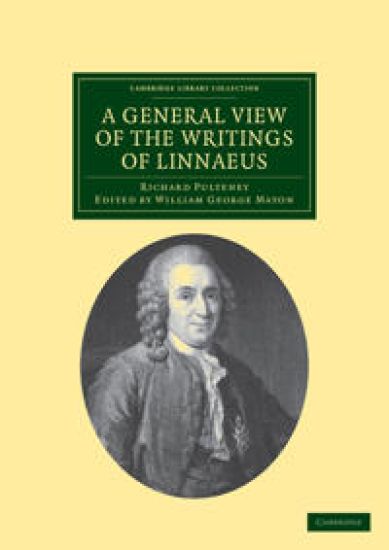
A General View of the Writings of Linnaeus

A General View of the Writings of Linnaeus

Richard Pulteney; Carl Linnaeus

Cambridge University Press
2011
pokkari
Carl Linnaeus (1707–88), father of modern taxonomy, was one of the most important scientists of the eighteenth century. This biography was written by Richard Pulteney (1730–1801), a physician and botanist who greatly admired Linnaeus' methods and aimed to promote them in England. The first edition was published in 1781 and contains a thorough account of the major works of Linnaeus and his unpublished papers. As well as details of his academic career, the work also gives insights into Linnaeus' character and personal life. The second edition, reissued here, was edited by William George Maton (1774–1835), a physician and member of the Linnean Society, and published in 1805. It contains in addition a memoir of Pulteney and a translation of a Swedish life of Linnaeus based on his own notes. The book is a rich source of information on a central figure in the history of botany.