Kirjojen hintavertailu – 12 903 725 kirjaa ja 27 kauppaa

Kirjailija

Richard Schacht

Kirjat ja teokset yhdessä paikassa: 13 kirjaa, julkaisuja vuosilta 1984–2024, suosituimpiin kuuluu Alienation. Vertaile teosten hintoja ja tarkista saatavuus suomalaisista kirjakaupoista.

13 kirjaa

Kirjojen julkaisuvuodet: 1984–2024.

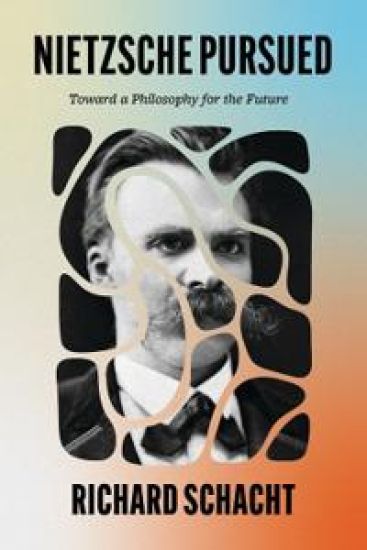
Nietzsche Pursued

Nietzsche Pursued

Richard Schacht

THE UNIVERSITY OF CHICAGO PRESS
2024
sidottu

Halvin toimitettuna 52,30 €

An ambitious venture into Nietzsche’s envisioned philosophy for the future. Nietzsche advocated for a post-theistic “philosophy of the future”—a new approach to human reality that would bend Western thought away from nihilism in a life-affirming, value-creative direction. His early demise left this endeavor only just begun. In Nietzsche Pursued, Richard Schacht examines Nietzsche’s revisionist approach to familiar philosophical topics, exploring how some may be further pursued in Nietzschean ways. Each chapter focuses on one topic that is central to Nietzsche's vision of what philosophy can and should be and do. Among them: his kind of naturalism, humanity, perspectivism, morality, and music. Building on his analysis in Nietzsche’s Kind of Philosophy, Schacht invites readers to see with new appreciation the ongoing significance of Nietzsche’s thought for philosophy’s future.
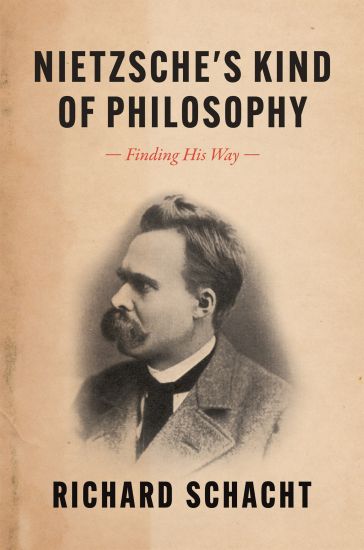
Nietzsche's Kind of Philosophy

Nietzsche's Kind of Philosophy

Richard Schacht

THE UNIVERSITY OF CHICAGO PRESS
2023
sidottu
A holistic reading of Nietzsche’s distinctive thought beyond the “death of God.” In Nietzsche’s Kind of Philosophy, Richard Schacht provides a holistic interpretation of Friedrich Nietzsche’s distinctive thinking, developed over decades of engagement with the philosopher’s work. For Schacht, Nietzsche’s overarching project is to envision a “philosophy of the future” attuned to new challenges facing Western humanity after the “death of God,” when monotheism no longer anchors our understanding of ourselves and our world. Schacht traces the developmental arc of Nietzsche’s philosophical efforts across Human, All Too Human, Daybreak, Joyful Knowing (The Gay Science), Thus Spoke Zarathustra, Beyond Good and Evil, and On the Genealogy of Morality. He then shows how familiar labels for Nietzsche—nihilist, existentialist, individualist, free spirit, and naturalist—prove insufficient individually but fruitful if refined and taken together. The result is an expansive account of Nietzsche’s kind of philosophy.
Alienation

Alienation

Richard Schacht

Psychology Press Ltd
2017
nidottu
First published in 1970, original blurb:‘Alienation’ is the catchword of our time. It has been applied to everything from the new politics to the anti-heroes of today’s films. But what does it mean to say that someone is alienated? Is alienation a state of mind, or a relationship? If modern man is indeed alienated, is it from his work, his government, his society, or himself – or from all of these? Richard Schacht, in this intelligent analysis, gets to the root of these questions. Examining the concept of alienation in the works of Hegel and Marx, he gives a clear account of the origins of the modern usage of the term. Among the many insights to be gained from this analysis is a clear understanding of Hegel’s influence on Marx in this most crucial area. Mr Schacht goes on to discuss the concept of alienation in recent philosophical and sociological literature, particularly in the writings of Erich Fromm. Here he finds a great deal of confusion, which has resulted in a series of almost universally unquestioned misconceptions. This, then, is a book for all of us who use – and mis-use – the term ‘alienation’, and who are interested in the concepts it brings to mind. The arguments of Professor Walter Kaufmann’s introductory essay provide a useful background for Mr Schacht’s analysis. In this essay, Professor Kaufmann states that ‘henceforth nobody should write about alienation without first reading Schacht’s book.’
Classical Modern Philosophers

Classical Modern Philosophers

Richard Schacht

Routledge
2016
sidottu
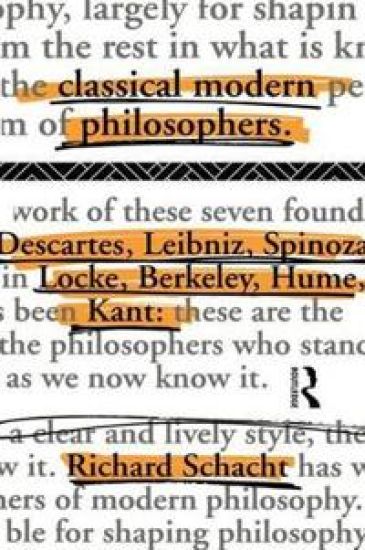
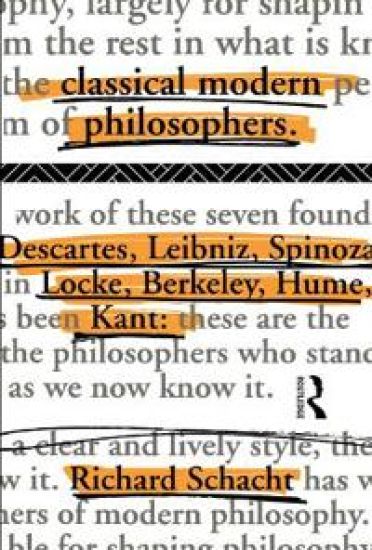
Descartes, Leibniz, Spinoza, Locke, Berkeley, Hume, and Kant: these are the seven philosophers who stand out from the rest in what is known as the `modern' period in philosophy. Their thought defines the mainstream of classical or early modern philosophy, largely responsible for shaping philosophy as we now know it. In a clear and lively style, Richard Schacht has written a thorough introduction to the work of these seven founding fathers of modern philosophy. The bibliography has been updated for this revised edition to take account of the recent explosion of writings on modern philosophy.
Nietzsche

Nietzsche

Richard Schacht

Routledge
2015
sidottu
Few philosophers have been as widely misunderstood as Nietzsche. His detractors and followers alike have often fundamentally misinterpreted him, distorting his views and intentions and criticizing or celebrating him for reasons removed from the views he actually held. Now Nietzsche assesses his place in European thought, concentrating upon his writings in the last decade of his productive life.
Alienation

Alienation

Richard Schacht

Psychology Press Ltd
2015
sidottu
First published in 1970, original blurb:‘Alienation’ is the catchword of our time. It has been applied to everything from the new politics to the anti-heroes of today’s films. But what does it mean to say that someone is alienated? Is alienation a state of mind, or a relationship? If modern man is indeed alienated, is it from his work, his government, his society, or himself – or from all of these? Richard Schacht, in this intelligent analysis, gets to the root of these questions. Examining the concept of alienation in the works of Hegel and Marx, he gives a clear account of the origins of the modern usage of the term. Among the many insights to be gained from this analysis is a clear understanding of Hegel’s influence on Marx in this most crucial area. Mr Schacht goes on to discuss the concept of alienation in recent philosophical and sociological literature, particularly in the writings of Erich Fromm. Here he finds a great deal of confusion, which has resulted in a series of almost universally unquestioned misconceptions. This, then, is a book for all of us who use – and mis-use – the term ‘alienation’, and who are interested in the concepts it brings to mind. The arguments of Professor Walter Kaufmann’s introductory essay provide a useful background for Mr Schacht’s analysis. In this essay, Professor Kaufmann states that ‘henceforth nobody should write about alienation without first reading Schacht’s book.’
Nietzsche

Nietzsche

Richard Schacht

Routledge
2011
nidottu
First published in 1999. This book, in compliance with the aims of the series, attempts to provide a comprehensive and critical account of Nietzsche's thought. The present study is an examination of his philosophical thinking; and while this already makes it selective (as well as interpretive), it is of necessity selective in other ways as well.
Finding an Ending

Finding an Ending

Philip Kitcher; Richard Schacht

Oxford University Press Inc
2005
nidottu
Few musical works loom as large in Western culture as Richard Wagner's four-part Ring of the Nibelung. In Finding an Ending, two eminent philosophers, Philip Kitcher and Richard Schacht, offer an illuminating look at this greatest of Wagner's achievements, focusing on its far-reaching and subtle exploration of problems of meanings and endings in this life and world. Kitcher and Schacht plunge the reader into the heart of Wagner's Ring, drawing out the philosophical and human significance of the text and the music. They show how different forms of love, freedom, heroism, authority, and judgment are explored and tested as it unfolds. As they journey across its sweeping musical-dramatic landscape, Kitcher and Schacht lead us to the central concern of the Ring—the problem of endowing life with genuine significance that can be enhanced rather than negated by its ending, if the right sort of ending can be found. The drama originates in Wotan's quest for a transformation of the primordial state of things into a world in which life can be lived more meaningfully. The authors trace the evolution of Wotan's efforts, the intricate problems he confronts, and his failures and defeats. But while the problem Wotan poses for himself proves to be insoluble as he conceives of it, they suggest that his very efforts and failures set the stage for the transformation of his problem, and for the only sort of resolution of it that may be humanly possible—to which it is not Siegfried but rather Brünnhilde who shows the way. The Ring's ending, with its passing of the gods above and destruction of the world below, might seem to be devastating; but Kitcher and Schacht see a kind of meaning in and through the ending revealed to us that is profoundly affirmative, and that has perhaps never been so powerfully and so beautifully expressed.
Nietzsche

Nietzsche

Richard Schacht

Routledge
1999
sidottu
First published in 1999. This book, in compliance with the aims of the series, attempts to provide a comprehensive and critical account of Nietzsche's thought. The present study is an examination of his philosophical thinking; and while this already makes it selective (as well as interpretive), it is of necessity selective in other ways as well.
The Future of Alienation

The Future of Alienation

Richard Schacht

University of Illinois Press
1994
nidottu
Richard Schacht has long argued that alienation theory can shed important light upon aspects of life in the modern world and upon our human predicament. The essays here call for a rethinking of a variety of forms of alienation in light of contemporary dynamics and a clearer understanding of the dialectic of human selfhood and social participation. They call for a renewed interest in alienation theory; they counter the myth that, with the collapse of the Soviet empire, Marx's thinking has been "refuted"; and they argue for an enhanced sensitivity to the problem of how we describe, interpret, and evaluate the world around us in light of the complexity and diversity that alienation theory reveals.
Nietzsche

Nietzsche

Richard Schacht

Routledge
1985
nidottu
Few philosophers have been as widely misunderstood as Nietzsche. His detractors and followers alike have often fundamentally misinterpreted him, distorting his views and intentions and criticizing or celebrating him for reasons removed from the views he actually held. Now Nietzsche assesses his place in European thought, concentrating upon his writings in the last decade of his productive life.
Classical Modern Philosophers

Classical Modern Philosophers

Richard Schacht

Routledge
1984
nidottu
Descartes, Leibniz, Spinoza, Locke, Berkeley, Hume, and Kant: these are the seven philosophers who stand out from the rest in what is known as the `modern' period in philosophy. Their thought defines the mainstream of classical or early modern philosophy, largely responsible for shaping philosophy as we now know it. In a clear and lively style, Richard Schacht has written a thorough introduction to the work of these seven founding fathers of modern philosophy. The bibliography has been updated for this revised edition to take account of the recent explosion of writings on modern philosophy.