Kirjojen hintavertailu – 12 903 725 kirjaa ja 27 kauppaa

Kirjailija

Richard Taruskin

Kirjat ja teokset yhdessä paikassa: 15 kirjaa, julkaisuja vuosilta 1997–2025, suosituimpiin kuuluu The Oxford History of Western Music. Vertaile teosten hintoja ja tarkista saatavuus suomalaisista kirjakaupoista.

15 kirjaa

Kirjojen julkaisuvuodet: 1997–2025.

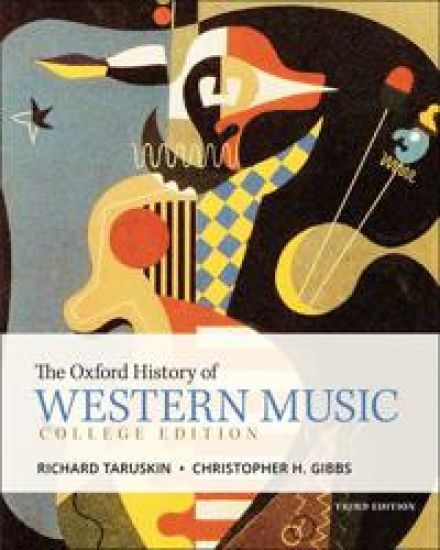
The Oxford History of Western Music

The Oxford History of Western Music

Richard Taruskin

OXFORD UNIVERSITY PRESS INC
2025
nidottu
The Oxford History of Western Music, Third Edition, guides students on an immersive journey through the evolution of Western music from ancient and medieval times to the present day. By emphasizing the connections between works within each cultural era and across time and place, the text goes beyond a simple retelling of musical history to develop students' listening skills for each period's key works. Accompanied by anthologies and streaming audio featuring recordings of previously undocumented ancient pieces and links to existing music, The Oxford History of Western Music is a comprehensive text ideal for building students' understanding and appreciation of the classical canon.
Musical Lives and Times Examined

Musical Lives and Times Examined

Richard Taruskin

University of California Press
2023
pokkari

Halvin toimitettuna 37,40 €

In this new and final collection, Richard Taruskin gathers a sweeping range of keynote speeches, reviews, and critical essays from the first twenty years of the twenty-first century. With twenty-three essays in total, this volume presents five lectures delivered in Budapest on Hungarian music and ten essays on Russian music. Reviews of contemporary work in musicology and reflections on the place of music in society showcase Taruskin’s trademark wit and breadth. Musical Lives and Times Examined is an essential collection, a comprehensive portrait of a distinguished figure in music studies, illuminating the ideas that have transformed the discipline and will continue to do so.
Musical Lives and Times Examined

Musical Lives and Times Examined

Richard Taruskin

University of California Press
2023
sidottu
In this new and final collection, Richard Taruskin gathers a sweeping range of keynote speeches, reviews, and critical essays from the first twenty years of the twenty-first century. With twenty-three essays in total, this volume presents five lectures delivered in Budapest on Hungarian music and ten essays on Russian music. Reviews of contemporary work in musicology and reflections on the place of music in society showcase Taruskin’s trademark wit and breadth. Musical Lives and Times Examined is an essential collection, a comprehensive portrait of a distinguished figure in music studies, illuminating the ideas that have transformed the discipline and will continue to do so.
Liberties Journal of Culture and Politics

Liberties Journal of Culture and Politics

Cass R. Sunstein; Carissa Veliz; Ekaterina Pravilova; Richard Taruskin; Claire Malroux; Richard Wolin; Mark Polizzotti; Jonathan Zimmerman; Marissa Grunes; Andrew Butterfield; Scott Spillman; Leora Batnitzky; Helen Vendler; Jared Marcel Pollen; Paula Bohince

Liberties Journal Foundation
2022
nidottu
“A Meteor of Intelligent Substance”“Something was Missing in our Culture, and Here It Is”"Invaluable""Liberties is THE place to be. Change starts in the mind.” Liberties, a journal of Culture and Politics, is essential reading for those engaged in the cultural and political issues and causes of our time. Liberties features serious, independent, stylish, and controversial essays by significant writers and leaders throughout the world; new poetry; and, introduces the next generation of writers and voices to inspire and impact the intellectual and creative lifeblood of today’s culture and politics. In this issue of Liberties: Cass R. Sunstein - The Supreme Court Gone Wrong; Carissa Veliz - Digitization is Surveillance; Ekaterina Pravilova - The Autocrat’s War; Richard Taruskin - What is Bad Taste; Jonathan Zimmerman - Memoirs of a White Savior; Richard Wolin - The Cult of Carl Schmitt; Mark Polizzotti - Surrealism and Cancellation; Andrew Butterfield - Dante During Covid; Scott Spillman - The Strange History of the Slave Songs; Leora Batnitzky - The Sacrifice of Edith Stein; Helen Vendler - Sylvia Plath on Motherhood; Jared Marcel Pollen - Was Havel Right?; Celeste Marcus - The Curse of the Radical Israeli Right; Leon Wieseltier - The Future of Nature; and new poems by Claire Malroux, Marissa Grunes, Paula Bohince.
Cursed Questions

Cursed Questions

Richard Taruskin

University of California Press
2020
sidottu
Richard Taruskin’s sweeping collection of essays distills a half century of professional experience, demonstrating an unparalleled insider awareness of relevant debates in all areas of music studies, including historiography and criticism, representation and aesthetics, musical and professional politics, and the sociology of taste. Cursed Questions, invoking a famous catchphrase from Russian intellectual history, grapples with questions that are never finally answered but never go away. The writings gathered here form an intellectual biography that showcases the characteristic wit, provocation, and erudition that readers have come to expect from Taruskin, making it an essential volume for anyone interested in music, politics, and the arts.
Cursed Questions

Cursed Questions

Richard Taruskin

University of California Press
2020
pokkari
Richard Taruskin’s sweeping collection of essays distills a half century of professional experience, demonstrating an unparalleled insider awareness of relevant debates in all areas of music studies, including historiography and criticism, representation and aesthetics, musical and professional politics, and the sociology of taste. Cursed Questions, invoking a famous catchphrase from Russian intellectual history, grapples with questions that are never finally answered but never go away. The writings gathered here form an intellectual biography that showcases the characteristic wit, provocation, and erudition that readers have come to expect from Taruskin, making it an essential volume for anyone interested in music, politics, and the arts.
Stravinsky in the Americas

Stravinsky in the Americas

H. Colin Slim; Richard Taruskin

University of California Press
2019
sidottu
Stravinsky in the Americas explores the “pre-Craft” period of Igor Stravinsky’s life, from when he first landed on American shores in 1925 to the end of World War II in 1945. Through a rich archival trove of ephemera, correspondence, photographs, and other documents, eminent musicologist H. Colin Slim examines the twenty-year period that began with Stravinsky as a radical European art-music composer and ended with him as a popular figure in American culture. This collection traces Stravinsky’s rise to fame—catapulted in large part by his collaborations with Hollywood and Disney and marked by his extra-marital affairs, his grappling with feelings of anti-Semitism, and his encounters with contemporary musicians as the music industry was emerging and taking shape in midcentury America. Slim’s lively narrative records the composer’s larger-than-life persona through a close look at his transatlantic tours and domestic excursions, where Stravinsky’s personal and professional life collided in often-dramatic ways.
Russian Music at Home and Abroad

Russian Music at Home and Abroad

Richard Taruskin

University of California Press
2016
sidottu
This new collection views Russian music through the Greek triad of "the Good, the True, and the Beautiful" to investigate how the idea of "nation" embeds itself in the public discourse about music and other arts with results at times invigorating, at times corrupting. In our divided, post-Cold War, and now post-9/11 world, Russian music, formerly a quiet corner on the margins of musicology, has become a site of noisy contention. Richard Taruskin assesses the political and cultural stakes that attach to it in the era of Pussy Riot and renewed international tensions, before turning to individual cases from the nineteenth century to the present. Much of the volume is devoted to the resolutely cosmopolitan but inveterately Russian Igor Stravinsky, one of the major forces in the music of the twentieth century and subject of particular interest to composers and music theorists all over the world. Taruskin here revisits him for the first time since the 1990s, when everything changed for Russia and its cultural products. Other essays are devoted to the cultural and social policies of the Soviet Union and their effect on the music produced there as those policies swung away from Communist internationalism to traditional Russian nationalism; to the musicians of the Russian postrevolutionary diaspora; and to the tension between the compelling artistic quality of works such as Stravinsky's Sacre du Printemps or Prokofieff's Zdravitsa and the antihumanistic or totalitarian messages they convey. Russian Music at Home and Abroad addresses these concerns in a personal and critical way, characteristically demonstrating Taruskin's authority and ability to bring living history out of the shadows.
Russian Music at Home and Abroad

Russian Music at Home and Abroad

Richard Taruskin

University of California Press
2016
pokkari
This new collection views Russian music through the Greek triad of "the Good, the True, and the Beautiful" to investigate how the idea of "nation" embeds itself in the public discourse about music and other arts with results at times invigorating, at times corrupting. In our divided, post-Cold War, and now post-9/11 world, Russian music, formerly a quiet corner on the margins of musicology, has become a site of noisy contention. Richard Taruskin assesses the political and cultural stakes that attach to it in the era of Pussy Riot and renewed international tensions, before turning to individual cases from the nineteenth century to the present. Much of the volume is devoted to the resolutely cosmopolitan but inveterately Russian Igor Stravinsky, one of the major forces in the music of the twentieth century and subject of particular interest to composers and music theorists all over the world. Taruskin here revisits him for the first time since the 1990s, when everything changed for Russia and its cultural products. Other essays are devoted to the cultural and social policies of the Soviet Union and their effect on the music produced there as those policies swung away from Communist internationalism to traditional Russian nationalism; to the musicians of the Russian postrevolutionary diaspora; and to the tension between the compelling artistic quality of works such as Stravinsky's Sacre du Printemps or Prokofieff's Zdravitsa and the antihumanistic or totalitarian messages they convey. Russian Music at Home and Abroad addresses these concerns in a personal and critical way, characteristically demonstrating Taruskin's authority and ability to bring living history out of the shadows.
Stravinsky and the Russian Traditions, Volume Two: A Biography of the Works Through Mavra Volume 2
This book undoes 50 years of mythmaking about Stravinsky's life in music. During his spectacular career, Igor Stravinsky underplayed his Russian past in favor of a European cosmopolitanism. Richard Taruskin has refused to take the composer at his word. In this long-awaited study, he defines Stravinsky's relationship to the musical and artistic traditions of his native land and gives us a dramatically new picture of one of the major figures in the history of music. Taruskin draws directly on newly accessible archives and on a wealth of Russian documents. In Volume One, he sets the historical scene: the St. Petersburg musical press, the arts journals, and the writings of anthropologists, folklorists, philosophers, and poets. Volume Two addresses the masterpieces of Stravinsky's early maturity--Petrushka, The Rite of Spring, and Les Noces. Taruskin investigates the composer's collaborations with Diaghilev to illuminate the relationship between folklore and modernity. He elucidates the Silver Age ideal of "neonationalism"--the professional appropriation of motifs and style characteristics from folk art--and how Stravinsky realized this ideal in his music. Taruskin demonstrates how Stravinsky achieved his modernist technique by combining what was most characteristically Russian in his musical training with stylistic elements abstracted from Russian folklore. The stylistic synthesis thus achieved formed Stravinsky as a composer for life, whatever the aesthetic allegiances he later professed. Written with Taruskin's characteristic mixture of in-depth research and stylistic verve, this book will be mandatory reading for all those seriously interested in the life and work of Stravinsky.
The Danger of Music and Other Anti-Utopian Essays

The Danger of Music and Other Anti-Utopian Essays

Richard Taruskin

University of California Press
2010
pokkari
"The Danger of Music" gathers some two decades of Richard Taruskin's writing on the arts and politics, ranging in approach from occasional pieces for major newspapers such as "The New York Times" to full-scale critical essays for leading intellectual journals. Hard-hitting, provocative, and incisive, these essays consider contemporary composition and performance, the role of critics and historians in the life of the arts, and the fraught terrain where ethics and aesthetics interact and at times conflict. Many of the works collected here have themselves excited wide debate, including the title essay, which considers the rights and obligations of artists in the aftermath of the 9/11 terrorist attacks. In a series of lively postscripts written especially for this volume, Taruskin, America's 'public' musicologist, addresses the debates he has stirred up by insisting that art is not a utopian escape and that artists inhabit the same world as the rest of society. Among the book's forty-two essays are two public addresses - one about the prospects for classical music at the end of the second millennium C. E., the other a revisiting of the performance issues previously discussed in the author's "Text and Act (1995)" - that appear in print for the first time.
On Russian Music

On Russian Music

Richard Taruskin

University of California Press
2010
pokkari
Over the past four decades, Richard Taruskin's publications have redefined the field of Russian-music study. This volume gathers thirty-six essays on composers ranging from Bortnyansky in the eighteenth century to Tarnopolsky in the twenty-first, as well as all of the famous names in between. Some of these pieces, like the ones on Chaikovsky's alleged suicide and on the interpretation of Shostakovich's legacy, have won fame in their own right as decisive contributions to some of the most significant debates in contemporary musicology. An extensive introduction lays out the main issues and a justification of Taruskin's approach, seen both in the light of his intellectual development and in that of the changing intellectual environment, which has been particularly marked by the end of the cold war in Europe.
Music in the Western World

Music in the Western World

Piero Weiss; Richard Taruskin

Schirmer Books,U.S.
2007
nidottu
This classic anthology assembles over 200 source readings, bringing to life the history of music through letters, reviews, biographical sketches, memoirs, and other documents. Writings by composers, critics, and educators touch on virtually every aspect of Western music from ancient Greece to the present day.
Defining Russia Musically

Defining Russia Musically

Richard Taruskin

Princeton University Press
2000
pokkari
The world-renowned musicologist Richard Taruskin has devoted much of his career to helping listeners appreciate Russian and Soviet music in new and sometimes controversial ways. Defining Russia Musically represents one of his landmark achievements: here Taruskin uses music, together with history and politics, to illustrate the many ways in which Russian national identity has been constructed, both from within Russia and from the Western perspective. He contends that it is through music that the powerful myth of Russia's "national character" can best be understood. Russian art music, like Russia itself, Taruskin writes, has "always [been] tinged or tainted ...with an air of alterity--sensed, exploited, bemoaned, reveled in, traded on, and defended against both from within and from without." The author's goal is to explore this assumption of otherness in an all-encompassing work that re-creates the cultural contexts of the folksong anthologies of the 1700s, the operas, symphonies, and ballets of the 1800s, the modernist masterpieces of the 1900s, and the hugely fraught but ambiguous products of the Soviet period. Taruskin begins by showing how enlightened aristocrats, reactionary romantics, and the theorists and victims of totalitarianism have variously fashioned their vision of Russian society in musical terms. He then examines how Russia as a whole shaped its identity in contrast to an "East" during the age of its imperialist expansion, and in contrast to two different musical "Wests," Germany and Italy, during the formative years of its national consciousness. The final section, expanded from a series of Christian Gauss seminars presented at Princeton in 1993, focuses on four individual composers, each characterized both as a self-consciously Russian creator and as a European, and each placed in perspective within a revealing hermeneutic scheme. In the culminating chapters--Chaikovsky and the Human, Scriabin and the Superhuman, Stravinsky and the Subhuman, and Shostakovich and the Inhuman--Taruskin offers especially thought-provoking insights, for example, on Chaikovsky's status as the "last great eighteenth-century composer" and on Stravinsky's espousal of formalism as a reactionary, literally counterrevolutionary move.

Musorgsky

Musorgsky

Richard Taruskin

Princeton University Press
1997
pokkari
"It is [a] fully illuminated story that Richard Taruskin, in the path-breaking essays collected here, unfolds around Modest Musorgsky, Russia's greatest national composer...[Taruskin's] tour de force comes with a frontal attack on all the Soviet-bred truisms that for a century have refashioned Musorgsky from what the evidence suggests he was--an aristocrat with an early clinical interest in true-to-life musical portraiture and a later penchant for drinking partners who were both folklore buffs and political reactionaries democrat."--From the foreword Incorporating both new and now-classic essays, this book for the first time sets the vocal works of Modest Musorgsky in a fully detailed cultural, political, and historical context. From this perspective Richard Taruskin revises fundamentally the composer's historical and artistic image, in particular debunking the century-old dogmas of Vladimir Stasov, Musorgsky's first biographer. Here the author offers the most complete explanation of the revision of the opera Boris Godunov, compares it to contemporaneous operas by Chaikovsky and Rimsky-Korsakov, advances a revisionary characterization of Khovanshchina as an aristocratic tragedy informed by a pessimistic view of history, discusses Musorgsky's use of folklore, and, focusing on Sorochintsi Fair, brings to a climax his refutation of Musorgsky as a protorevolutionary populist. The epilogue is a survey of revisionary productions of Musorgsky's works at home during the Gorbachev era.