Kirjojen hintavertailu – 12 903 735 kirjaa ja 27 kauppaa

Kirjailija

Richard Toye

Kirjat ja teokset yhdessä paikassa: 20 kirjaa, julkaisuja vuosilta 2003–2026, suosituimpiin kuuluu Churchill Cold War Warrior. Vertaile teosten hintoja ja tarkista saatavuus suomalaisista kirjakaupoista.

20 kirjaa

Kirjojen julkaisuvuodet: 2003–2026.

Churchill Cold War Warrior

Churchill Cold War Warrior

Anthony Tucker-Jones; Richard Toye

PEN SWORD BOOKS LTD
2026
nidottu
‘By focusing attention on a poorly understood but vitally important aspect of Churchill’s career, Tucker-Jones has performed an important service. Churchill Cold War Warrior should be read, not only as a commentary on the ironies of history, but also as an essay on the potential and the limits of power.’ - PROFESSOR RICHARD TOYE, AUTHOR OF WINSTON CHURCHILL: A LIFE IN THE NEWS ‘In Cold War Warrior, Anthony Tucker-Jones has excelled again. Building on his ChurchillMaster and Commander, he brings us Churchill the prophet, sage and tireless fighteragainst Communism. With Russia and China again threatening the world order, this timelyaccount of Winston's post-war life is essential reading for any student of the Iron Curtainera.’ - PETER CADDICK-ADAMS, AUTHOR OF 1945: VICTORY IN THE WEST ‘Anthony Tucker-Jones’s CHURCHILL COLD WAR WARRIORis a fascinating and highlyworthwhile addition to the well-worn sub-genre of Churchilliana. Intricately researched andpacked full of revelation and incident, it is an invaluable book for any aficionado oftwentieth century military and political history.’ - ALEXANDER LARMAN, AUTHOR OF THEWINDSORS AT WAR: THE NAZI THREAT TO THE CROWN In Churchill Cold War Warrior, renowned military historian Anthony Tucker-Jones reassesses Winston Churchill’s neglected postwar career. He explains how in an unguarded moment Winston inadvertently sowed the seeds for the Cold War by granting Stalin control of Eastern Europe. Famously Churchill, at Fulton, then warned of the growing danger created by this partition of the continent. Winston after the Second World War wanted to prove a point. Shunned by the electorate in 1945, instead of retiring he was determined to be Prime Minister for a second time. Biding his time he watched in dismay as Britain scuttled from India and Palestine and weathered the East-West confrontation over Berlin. He finally got his way in 1951 and took the reins of a country with drastically waning powers. Churchill was confronted by a world in turmoil, with an escalating Cold War that had gone hot in Korea and an unravelling British Empire. Communism and nationalism proved a heady cocktail that fanned the flames of widespread conflict. He had to contain rebellions in Kenya and Malaya while clinging on in Egypt. Desperately he also sought to avoid a Third World War and the use of nuclear weapons by reuniting the 'Big Three'.

Age of Hope

Age of Hope

Richard Toye

BLOOMSBURY PUBLISHING PLC
2025
nidottu
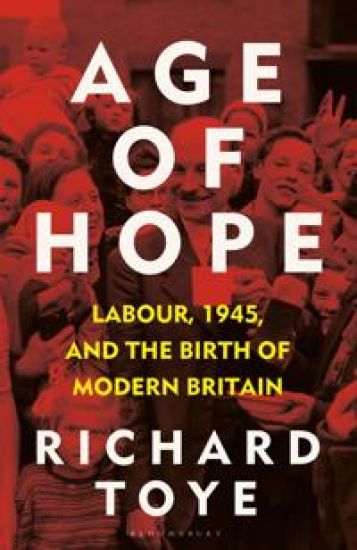
“The clue to our future lies in our past and Toye has winkled it out with elegant and devastating precision.” Chris Bryant, MP for Rhondda WAS THE ATTLEE GOVERNMENT OF 1945 REALLY THE GOLDEN PERIOD OF LABOUR POWER? 2024 marks the centenary of the first Labour government under Ramsay MacDonald. What legacy of the past have they left behind? How far has each Labour administration influenced succeeding administrations? Above all, was the Attlee government of 1945 really the golden period of Labour power? Professor Richard Toye explores Labour’s exercise of power as a continuum, setting Attlee’s administration in long-term historical context between the first Labour Government of 1924 and the current party under Keir Starmer. Within this context he shows why the Attlee administration matters so much and how successive Labour governments have fashioned it in their own image. Into this story are woven the foundation of the Labour Party in 1900, the First World War, the General Strike of 1926, the Spanish Civil War and the coalition war-time government under Churchill. Also discussed are the great names of Labour history: Ramsay MacDonald, Clement Attlee himself, Ernest Bevin, Aneurin Bevan, Hugh Gaitskell, Harold Wilson and Ellen Wilkinson. Covering Labour's history all the way up to the present - including Wilson and Blair's attempts to wrap themselves in Attlee’s mantle and Corbyn’s version of Attlee focused on the NHS and the welfare state - Age of Hope is an incisive, informative look at a political party that has been fundamental in shaping modern Britain and will be equally instrumental in its future.
Age of Hope

Age of Hope

Richard Toye

BLOOMSBURY PUBLISHING PLC
2023
sidottu
“The clue to our future lies in our past and Toye has winkled it out with elegant and devastating precision.” Chris Bryant, MP for RhonddaWAS THE ATTLEE GOVERNMENT OF 1945 REALLY THE GOLDEN PERIOD OF LABOUR POWER?2024 marks the centenary of the first Labour government under Ramsay MacDonald. What legacy of the past have they left behind? How far has each Labour administration influenced succeeding administrations? Above all, was the Attlee government of 1945 really the golden period of Labour power? Professor Richard Toye explores Labour’s exercise of power as a continuum, setting Attlee’s administration in long-term historical context between the first Labour Government of 1924 and the current party under Keir Starmer. Within this context he shows why the Attlee administration matters so much and how successive Labour governments have fashioned it in their own image. Into this story are woven the foundation of the Labour Party in 1900, the First World War, the General Strike of 1926, the Spanish Civil War and the coalition war-time government under Churchill. Also discussed are the great names of Labour history: Ramsay MacDonald, Clement Attlee himself, Ernest Bevin, Aneurin Bevan, Hugh Gaitskell, Harold Wilson and Ellen Wilkinson. Covering Labour's history all the way up to the present - including Wilson and Blair's attempts to wrap themselves in Attlee’s mantle and Corbyn’s version of Attlee focused on the NHS and the welfare state - Age of Hope is an incisive, informative look at a political party that has been fundamental in shaping modern Britain and will be equally instrumental in its future.
Winston Churchill

Winston Churchill

Richard Toye

Oxford University Press
2021
nidottu
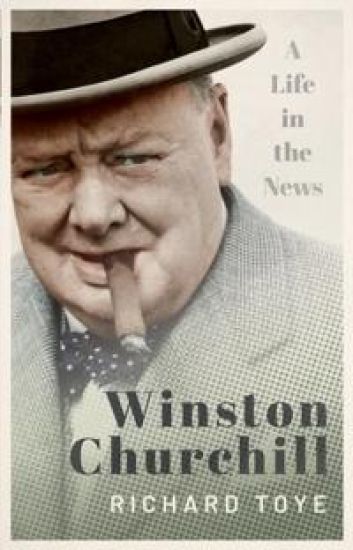
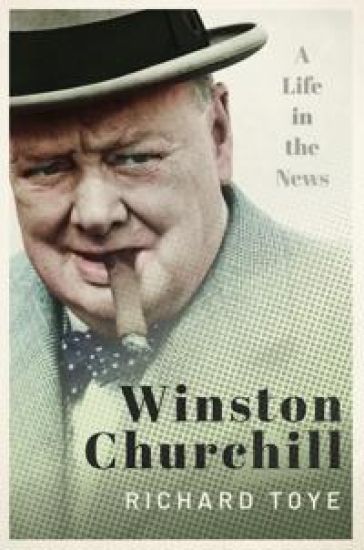
Before Winston Churchill made history, he made news. To a great extent, the news made him too. If it was his own efforts that made him a hero, it was the media that made him a celebrity - and it has been considerably responsible for perpetuating his memory and shaping his reputation in the years since his death. Churchill first made his name via writing and journalism in the years before 1900, the money he earned helping to support his political career (at a time when MPs did not get salaries). Journalistic activities were also important to him later, as he struggled in the interwar years to find the wherewithal to run and maintain Chartwell, his country house in Kent. Moreover, not only was journalism an important aspect of Churchill's political persona, but he himself was a news-obsessive throughout his life. The story of Churchill and the news is, on one level, a tale of tight deadlines, off-the-record briefings and smoke-filled newsrooms, of wartime summits that were turned into stage-managed global media events, and of often tense interactions with journalists and powerful press proprietors, such as Lords Northcliffe, Rothermere, and Beaverbrook. Uncovering the symbiotic relationship between Churchill's political life and his media life, and the ways in which these were connected to his personal life, Richard Toye asks if there was a 'public Churchill' whose image was at odds with the behind-the-scenes reality, or whether, in fact, his private and public selves became seamlessly blended as he adjusted to living in the constant glare of the media spotlight. On a wider level, this is also the story of a rapidly evolving media and news culture in the first half of the twentieth century, and of what the contemporary reporting of Churchill's life (including by himself) can tell us about the development of this culture, over a period spanning from the Victorian era through to the space age.
Age of Promises

Age of Promises

David Thackeray; Richard Toye

Oxford University Press
2021
sidottu
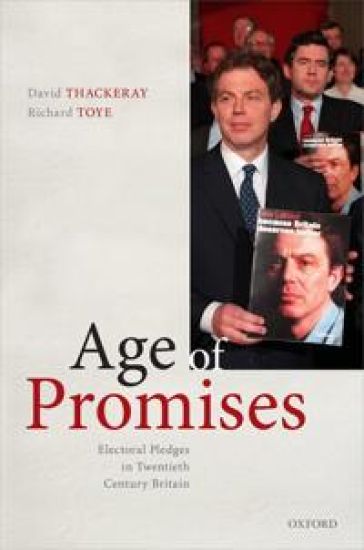
Age of Promises explores the issue of electoral promises in twentieth century Britain - how they were made, how they were understood, and how they evolved across time - through a study of general election manifestos and election addresses. The authors argue that a history of the act of making promises - which is central to the political process, but which has not been sufficiently analysed - illuminates the development of political communication and democratic representation. The twentieth century saw a broad shift away from politics viewed as a discursive process whereby, at elections, it was enough to set out broad principles, with detailed policymaking to follow once in office following reflection and discussion. Over the first part of the century parties increasingly felt required to compile lists of specific policies to offer to voters, which they were then considered to have an obligation to carry out come what may. From 1945 onwards, moreover, there was even more focus on detailed, costed, pledges. We live in an age of growing uncertainty over the authority and status of political promises. In the wake of the 2016 EU referendum controversy erupted over parliamentary sovereignty. Should 'the will of the people' as manifested in the referendum result be supreme, or did MPs owe a primary responsibility to their constituents and/or to the party manifestos on which they had been elected? Age of Promises demonstrates that these debates build on a long history of differing understandings about what status of manifestos and addresses should have in shaping the actions of government.
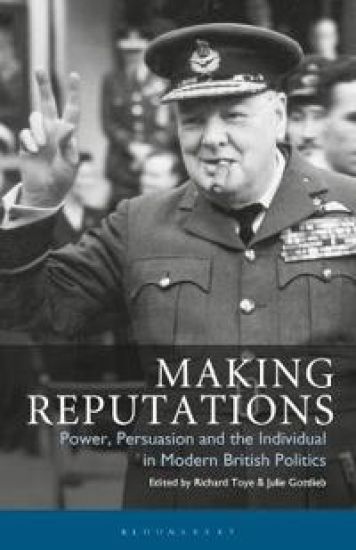
Making Reputations

Making Reputations

Richard Toye; Julie Gottlieb

Bloomsbury Academic
2020
nidottu
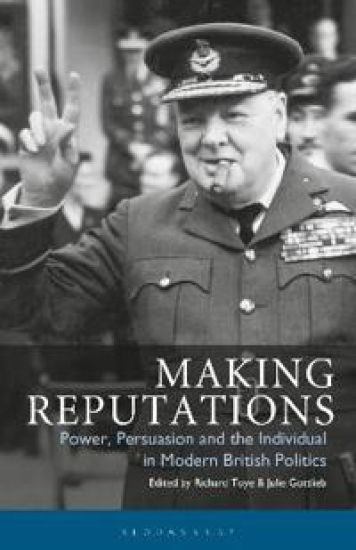
Is a charismatic leader also an effective one? What role do commentators and historians have in shaping politicians' personae? Making Reputations provides a major new assessment of the role of individuals in British politics. The authors examine the personalities and rhetoric of key figures, such as Gladstone, Churchill, Thatcher and Blair, as well as shedding new light on other neglected but significant individuals. Drawing on a variety of methods from gender to cultural history, the book presents a comprehensive examination of the relationship between the individual and the pursuit, maintenance and execution of power.
The Churchill Myths

The Churchill Myths

Steven Fielding; Bill Schwarz; Richard Toye

Oxford University Press
2020
sidottu
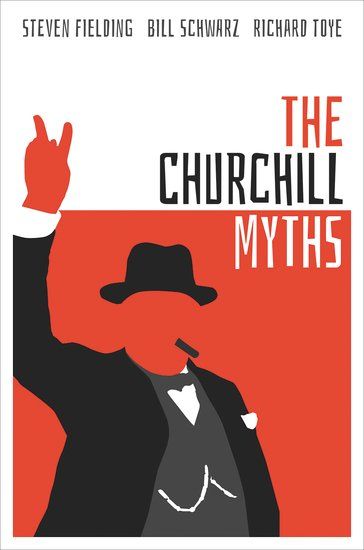
This is not a book about Winston Churchill. It is not principally about his politics, nor his rhetorical imagination, nor even about the man himself. Instead, it addresses the varied afterlives of the man and the persistent, deeply located compulsion to bring him back from the dead, capturing and explaining the significance of the various Churchill myths to Britain's history and current politics. The authors look at Churchill's portrayal in social memory. They demonstrate the ways in which politicians have often used the idea of Churchill as a means of self-validation - using him to show themselves as tough and honest players. They show the man dramatized in film and television - an onscreen persona that is often the product of a gratuitous mixing of fact and fantasy, one deliberately shaped to meet the preferences of the presumed audience. They discuss his legacy in light of the Brexit debate - showing how public figures on both sides of the Leave/Remain debate were able to use elements of Churchill's words and character to argue for their own point-of-view.
Winston Churchill

Winston Churchill

Richard Toye

Oxford University Press
2020
sidottu

Halvin toimitettuna 31,50 €

Before Winston Churchill made history, he made news. To a great extent, the news made him too. If it was his own efforts that made him a hero, it was the media that made him a celebrity - and it has been considerably responsible for perpetuating his memory and shaping his reputation in the years since his death. Churchill first made his name via writing and journalism in the years before 1900, the money he earned helping to support his political career (at a time when MPs did not get salaries). Journalistic activities were also important to him later, as he struggled in the interwar years to find the wherewithal to run and maintain Chartwell, his country house in Kent. Moreover, not only was journalism an important aspect of Churchill's political persona, but he himself was a news-obsessive throughout his life. The story of Churchill and the news is, on one level, a tale of tight deadlines, off-the-record briefings and smoke-filled newsrooms, of wartime summits that were turned into stage-managed global media events, and of often tense interactions with journalists and powerful press proprietors, such as Lords Northcliffe, Rothermere, and Beaverbrook. Uncovering the symbiotic relationship between Churchill's political life and his media life, and the ways in which these were connected to his personal life, Richard Toye asks if there was a 'public Churchill' whose image was at odds with the behind-the-scenes reality, or whether, in fact, his private and public selves became seamlessly blended as he adjusted to living in the constant glare of the media spotlight. On a wider level, this is also the story of a rapidly evolving media and news culture in the first half of the twentieth century, and of what the contemporary reporting of Churchill's life (including by himself) can tell us about the development of this culture, over a period spanning from the Victorian era through to the space age.
Arguing about Empire

Arguing about Empire

Martin Thomas; Richard Toye

Oxford University Press
2019
nidottu
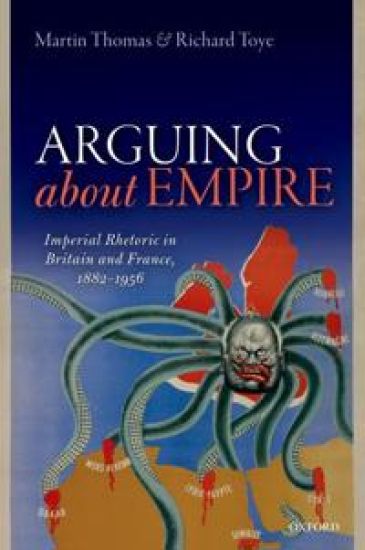
Arguing about Empire analyses the most divisive arguments about empire between Europe's two leading colonial powers from the age of high imperialism to the post-war era of decolonization. Focusing on the domestic contexts underlying imperial rhetoric, Arguing about Empire adopts a case-study approach, treating key imperial debates as historical episodes to be investigated in depth. The episodes in question have been selected both for their chronological range, their variety, and, above all, their vitriol. Some were straightforward disputes; others involved cooperation in tense circumstances. These include the Tunisian and Egyptian crises of 1881-2, which saw France and Britain establish new North African protectorates, ostensibly in co-operation, but actually in competition; the Fashoda Crisis of 1898, when Britain and France came to the brink of war in the aftermath of the British re-conquest of Sudan; the Moroccan crises of 1905 and 1911, early tests of the Entente Cordiale, when Britain lent support to France in the face of German threats; the 1922 Chanak crisis, when that imperial Entente broke down in the face of a threatened attack on Franco-British forces by Kemalist Turkey; World War Two, which can be seen in part as an undeclared colonial war between the former allies, complicated by the division of the French Empire between De Gaulle's Free French forces and those who remained loyal to the Vichy Regime; and finally the 1956 Suez intervention, when, far from defusing another imperial crisis, Britain colluded with France and Israel to invade Egypt -- the culmination of the imperial interference that began some eighty years earlier.
Arguing about Empire

Arguing about Empire

Martin Thomas; Richard Toye

Oxford University Press
2017
sidottu
Arguing about Empire analyses the most divisive arguments about empire between Europe's two leading colonial powers from the age of high imperialism to the post-war era of decolonization. Focusing on the domestic contexts underlying imperial rhetoric, Arguing about Empire adopts a case-study approach, treating key imperial debates as historical episodes to be investigated in depth. The episodes in question have been selected both for their chronological range, their variety, and, above all, their vitriol. Some were straightforward disputes; others involved cooperation in tense circumstances. These include the Tunisian and Egyptian crises of 1881-2, which saw France and Britain establish new North African protectorates, ostensibly in co-operation, but actually in competition; the Fashoda Crisis of 1898, when Britain and France came to the brink of war in the aftermath of the British re-conquest of Sudan; the Moroccan crises of 1905 and 1911, early tests of the Entente Cordiale, when Britain lent support to France in the face of German threats; the 1922 Chanak crisis, when that imperial Entente broke down in the face of a threatened attack on Franco-British forces by Kemalist Turkey; World War Two, which can be seen in part as an undeclared colonial war between the former allies, complicated by the division of the French Empire between De Gaulle's Free French forces and those who remained loyal to the Vichy Regime; and finally the 1956 Suez intervention, when, far from defusing another imperial crisis, Britain colluded with France and Israel to invade Egypt -- the culmination of the imperial interference that began some eighty years earlier.
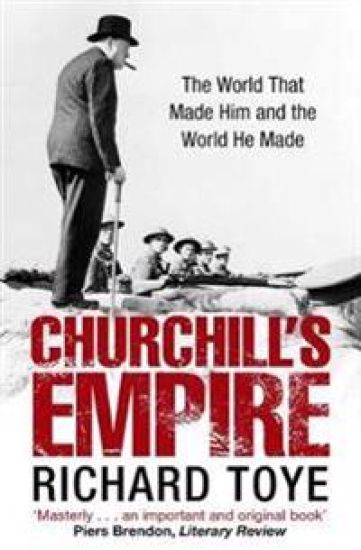
Churchill's Empire

Churchill's Empire

Richard Toye

Macmillan
2015
pokkari
‘I have not become the King’s First Minister in order to preside over the liquidation of the British Empire.’ These notorious words, spoken by Churchill in 1942, encapsulate his image as an imperial die-hard, implacably opposed to colonial freedom – a reputation that has prevailed, and which Churchill willingly embraced to further his policies. Yet, as a youthful minister at the Colonial Office before World War I, his political opponents had seen him as a Little Englander and a danger to the Empire. Placing Churchill in the context of his times and his contemporaries, Richard Toye evaluates his position on key Imperial questions and examines what was conventional about Churchill’s opinions and what was unique. Combining a lightness of touch and entertaining storytelling with expert and insightful analysis, the result is a vivid and dynamic account of a remarkable man and an extraordinary era. 'Wonderfully informative' Daily Telegraph 'Excellent' Spectator ‘Mature, intelligent, thoughtful, judicious’ Washington Times ‘One of Britain's smartest young historians’ Independent
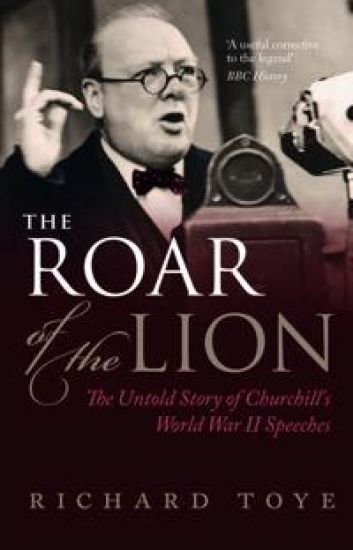
The Roar of the Lion

The Roar of the Lion

Richard Toye

Oxford University Press
2015
nidottu
''My aunt, listening to the Prime Minister's speech, remarked of "our greatest orator", "He's no speaker, is he?"' -diary of teacher M. A. Pratt, 11 Nov. 1942. The popular story of Churchill's war-time rhetoric is a simple one: the British people were energized and inspired by his speeches, which were almost universally admired and played an important role in the ultimate victory over Nazi Germany. Richard Toye now re-examines this accepted national story - and gives it a radical new spin. Using survey evidence and the diaries of ordinary people, he shows how reactions to Churchill's speeches at the time were often very different from what we have always been led to expect. His first speeches as Prime Minister in the dark days of 1940 were by no means universally acclaimed - indeed, many people thought that he was drunk during his famous 'finest hour' broadcast - and there is little evidence that they made a decisive difference to the British people's will to fight on. In actual fact, as Toye shows, mass enthusiasm sat side-by-side with considerable criticism and dissent from ordinary people. Yes, there were speeches that stimulated, invigorated, and excited many. But there were also speeches which caused depression and disappointment in many others, and which sometimes led to workplace or family arguments. Yet this more complex reality has been consistently obscured from the historical record by the overwhelming power of a treasured national myth. The first systematic, archive based examination of Churchill's World War II rhetoric as a whole, The Roar of the Lion considers his oratory not merely as a series of 'great speeches', but as calculated political interventions which had diplomatic repercussions far beyond the effect on the morale of listeners in Britain. Considering his failures as well as his successes, the book moves beyond the purely celebratory tone of much of the existing literature. It offers new insight into how the speeches were written and delivered - and shows how Churchill's words were received at home, amongst allies and neutrals, and within enemy and occupied countries. This is the essential book on Churchill's war-time speeches. It presents us with a dramatically new take on the politics of the 1940s - one that will change the way we think about Churchill's oratory forever.
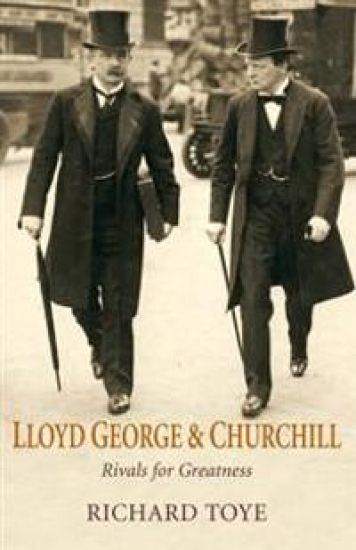
Lloyd George and Churchill

Lloyd George and Churchill

Richard Toye

Macmillan
2014
pokkari
The two most significant British political figures of the twentieth-century, Churchill and Lloyd George were political rivals but personal friends. Between them their ministerial careers spanned seventy years and two world wars. Althought they could not have been more different temperamentally, and often disagreed violently about politics, theirs was 'the longest political friendship in the life of Great Britain' and Churchill was the only person outside his family to call Lloyd George 'David'. Richard Toye's book is a dynamic account of their relationship. Drawing on diaries and letters, some never before published, (there are more than 1,000 pieces of correspondence between the two men), he explores their long-standing friendship and rivalry, the impact they had on each other's careers, and the fate of their respective reputations, arguing that Lloyd George's major achievements have been undeservedly overshadowed, in part as a consequence of Churchill's later mythmaking. It is a major work from a brilliant young historian.
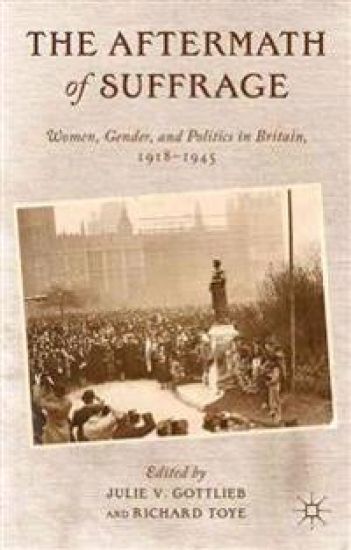
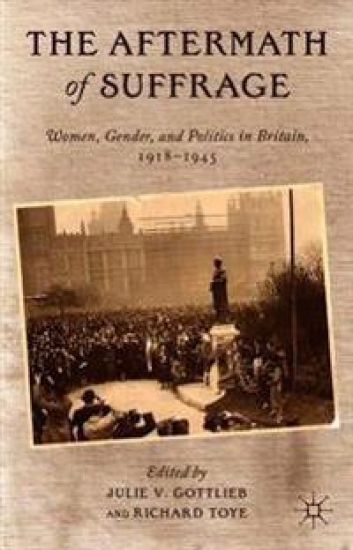
The Aftermath of Suffrage

The Aftermath of Suffrage

Julie V. Gottlieb; Richard Toye

Palgrave Macmillan
2013
sidottu
This collection explores the aftermath of the Representation of the People Act, which gave some British women the vote. Experts examine the paths taken by both former-suffragists as well as their anti-suffragist adversaries, the practices of suffrage commemoration, and the changing priorities and formations of British feminism in this era.
The Aftermath of Suffrage

The Aftermath of Suffrage

Julie V. Gottlieb; Richard Toye

Palgrave Macmillan
2013
nidottu
This collection explores the aftermath of the Representation of the People Act, which gave some British women the vote. Experts examine the paths taken by both former-suffragists as well as their anti-suffragist adversaries, the practices of suffrage commemoration, and the changing priorities and formations of British feminism in this era.
Rhetoric

Rhetoric

Richard Toye

Oxford University Press
2013
nidottu

Halvin toimitettuna 18,90 €

Rhetoric is often seen as a synonym for shallow, deceptive language, and therefore as something negative. But if we view rhetoric in more neutral terms, as the 'art of persuasion', it is clear that we are all forced to engage with it at some level, if only because we are constantly exposed to the rhetoric of others. In this Very Short Introduction, Richard Toye explores the purpose of rhetoric. Rather than presenting a defence of it, he considers it as the foundation-stone of civil society, and an essential part of any democratic process. Using wide-ranging examples from Ancient Greece, medieval Islamic preaching, and modern cinema, Toye considers why we should all have an appreciation of the art of rhetoric. ABOUT THE SERIES: The Very Short Introductions series from Oxford University Press contains hundreds of titles in almost every subject area. These pocket-sized books are the perfect way to get ahead in a new subject quickly. Our expert authors combine facts, analysis, perspective, new ideas, and enthusiasm to make interesting and challenging topics highly readable.
Churchill's Empire: The World That Made Him and the World He Made
This is the first book to provide a comprehensive account of Churchill's lifelong involvement with the empire, from the early stages of his childhood that shaped his imperialist outlook to his emergence as a self-made hero. Instead of locating him on a left/right spectrum, Toye presents Churchill as a human being, a man whose imperialist outlook brought both acclaim and dread. Churchill was a powerful leader who believed in the strength of his race, but not necessarily the human race--he stood alone against Hitler, but he was also an imperialist who equated Gandhi with Hitler, celebrated racism, and believed India would always remain unsuited to democracy. "Toye traces Churchill's shifts and velleities with impressive skill and erudition, using a vast range of contemporary newspapers to particularly good effect" (Literary Review). Toye, named Young Academic Author of the Year by Times Higher Education magazine in 2007, has synthesized the details of Churchill's life to produce "a thought-provoking, sensitive account of the nerve and muscle of empire" (Daily Express).
Making Reputations

Making Reputations

Richard Toye; Julie Gottlieb

I.B. Tauris
2005
sidottu
Is a charismatic leader also an effective one? What role do commentators and historians have in shaping politicians' personae? Making Reputations provides a major new assessment of the role of individuals in British politics. The authors examine the personalities and rhetoric of key figures, such as Gladstone, Churchill, Thatcher and Blair, as well as shedding new light on other neglected but significant individuals. Drawing on a variety of methods from gender to cultural history, the book presents a comprehensive examination of the relationship between the individual and the pursuit, maintenance and execution of power.
The UN and Global Political Economy

The UN and Global Political Economy

John Toye; Richard Toye

Indiana University Press
2004
pokkari
Against the backdrop of a 20-year revolt against free trade orthodoxy by economists inside the UN and their impact on policy discussions since the 1960s, the authors show how the UN both nurtured and inhibited creative and novel intellectual contributions to the trade and development debate. Presenting a stirring account of the main UN actors in this debate, The UN and Global Political Economy focuses on the accomplishments and struggles of UN economists and the role played by such UN agencies as the Department of Economic (and Social) Affairs, the United Nations Commission on Trade and Development, and the Economic Commission for Latin America (and the Caribbean). It also looks closely at the effects of the Latin American debt crisis of the 1980s, the growing strength of the World Trade Organization (WTO) in the 1990s, and the lessons to be drawn from these and other recent developments.
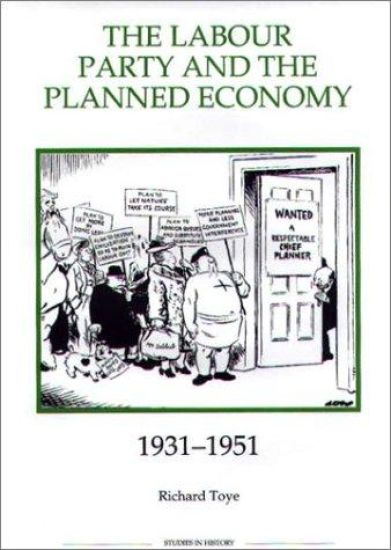
The Labour Party and the Planned Economy, 1931-1951

The Labour Party and the Planned Economy, 1931-1951

Richard Toye

Royal Historical Society
2003
sidottu
An exploration of Labour's 1931 pledge to create a planned socialist economy and the reasons for its failure to do so. In the general election of 1931, the Labour Party campaigned on the slogan "Plan or Perish". The party's pledge to create a planned socialist economy was a novelty, and marked the rejection of the gradualist, evolutionary socialism to which Labour had adhered under the leadership of Ramsay MacDonald. Although heavily defeated in that election, Labour stuck to its commitment. The Attlee government came to power in 1945 determined to plan comprehensively. Yet, the aspiration to create a fully planned economy was not met. This book explores the origins and evolution of the promise, in order to explain why it was not fulfilled. RICHARD TOYE lectures in history at Homerton College, Cambridge.