

Kirjailija
Richmond Wong
Kirjat ja teokset yhdessä paikassa: 4 kirjaa, julkaisuja vuosilta 2022–2025, suosituimpiin kuuluu The 1st-Time B2B SaaS Startup Founder's Compass. Vertaile teosten hintoja ja tarkista saatavuus suomalaisista kirjakaupoista.
4 kirjaa
Kirjojen julkaisuvuodet: 2022–2025.

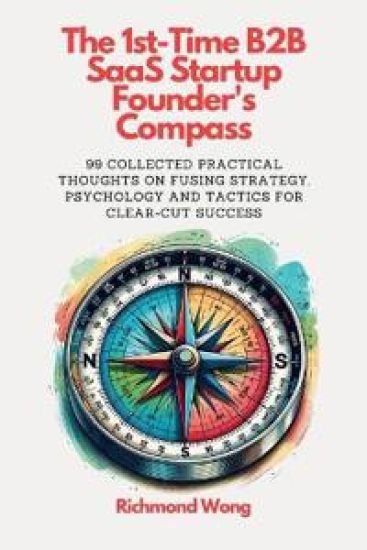
The 1st-Time B2B SaaS Startup Founder's Compass
Richmond Wong
Library and Archives Canada / Government of Canada
2023
pokkari
Who this book is forThis book is for 1st-time startup founders in the B2B space. Maybe you're a software engineer, product manager, salesperson, doctor or lawyer building your first startup. My bet is that although you're an expert at your technical skill, you yourself recognize that there's a lot to learn when it comes to building a product, marketing it to a specific audience and overall running a company. How you will benefitThe chapters cover the gamut of getting Product-Market-Fit, marketing traction, sales optimization, pricing, churn reduction and general business advice I learned through the process of working with 150+ founders and senior decision makers at startups around the world. These chapters are answers I've come up with to issues that come up again and again with the clients I work with. The material in this book is also informed by my time working around the world (primarily North America and Asia) in several industries including B2B enterprise software, legal practice, coaching and journalism so you'll get a wider viewpoint than from authors who have only ever worked in one industry and/or in one market. How the chapters are organizedThese essays are arranged to take into account your attention span (alternating between technical deep dives and lighter fare) and topic variety while maintaining an overall narrative arc. Who else this book will benefitThose in the B2C space (founders, marketers and product managers) will also find value within these pages.

Modes of Uncertainty in HCI
Robert Soden; Laura Devendorf; Richmond Wong; Yoko Akama; Ann Light
Now Publishers Inc
2022
nidottu
Uncertainty is a prevalent characteristic of contemporary life and a central challenge of HCI. As humans, researchers, and designers we encounter uncertainty in a multitude of forms and a variety of settings. The growing attention to uncertainty in HCI is due to the ever increasing expansion of the field and questions and contexts to which we seek to apply HCI research and practice. It is also due to events in the world that force us to engage more directly with questions related to uncertainty. Consequently, society is turning more than ever to data as a means to enable or mediate our understanding of phenomena such as climate change, political turmoil, increased economic upheaval, and a global pandemic. This monograph examines how HCI conceptualizes, situates, and responds to uncertainty — particularly arguing that our ability to respond to such uncertainties is governed to a great extent by the concepts we use to enframe a single, encompassing, overburdened and slippery idea. The authors propose four distinct “modes of uncertainty” to begin to draw together the varied strands of work in HCI that address uncertainty in its many forms. Rather than focusing on uncertainty as a discrete phenomenon in the world to be studied, they look to how research goals, methods, and theoretical frames used in HCI research influence the various ways in which we encounter it. By switching from uncertainty (a noun) to modes of engaging uncertainty (a verb), they foreground uncertainty as a relational concept and show that it is an active and ongoing condition that designers and researchers make present in different fashions depending upon their priorities and the context in which they are working. The authors show that adding modes of uncertainty to our conceptual toolbox facilitates conversation between domains and lets us draw new connections between disparate areas of research including visualization studies, critical design, feminist epistemologies, and sustainability.