Kirjojen hintavertailu – 12 859 819 kirjaa ja 27 kauppaa

Kirjailija

Robert Agnew

Kirjat ja teokset yhdessä paikassa: 6 kirjaa, julkaisuja vuosilta 2004–2023, suosituimpiin kuuluu Toward a Unified Criminology. Vertaile teosten hintoja ja tarkista saatavuus suomalaisista kirjakaupoista.

6 kirjaa

Kirjojen julkaisuvuodet: 2004–2023.

Juvenile Delinquency: Causes and Control

Juvenile Delinquency: Causes and Control

Robert Agnew

OXFORD UNIVERSITY PRESS INC
2023
nidottu
Offers a clear and concise overview of the latest theories and research on the causes and control of delinquency. The text is organized around three major questions: What is the nature and extent of delinquency? What are the causes of delinquency? What strategies should we employ to control delinquency? Compared to other textbooks on the market, this book is written in a more conversational style. And compared to other textbooks, this book is more focused. Other textbooks attempt to cover all the major theories and areas of research at the risk of confusing and overwhelming students. In contrast, Agnew's Juvenile Delinquincy is more student and instructor friendly in its approach. For instance, rather than covering all the major theories (and numerous versions of each theory), Agnew synthesizes the best of current delinquency theories into “generic” theories representing strain, social learning, control, and labeling theories. The book then show how these theories can be used to interpret research on the causes of delinquency. In addition, the book promotes active learning. Agnew poses questions for students throughout the text and encourage them to apply the text materials to their own lives. This emphasis on application dramatically increases the students' understanding of the materials. Finally, Juvenile Delinquincy describes how criminologists know what they know. Students, then, are not asked to accept the findings of criminology on faith. They are given a sense of what the research process is like.
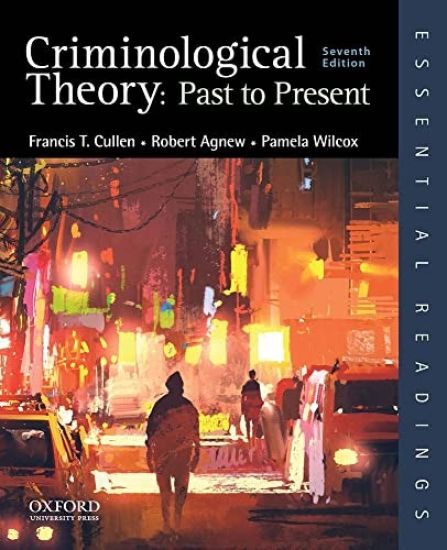
Criminological Theory: Past to Present

Criminological Theory: Past to Present

Francis T. Cullen; Robert Agnew; Pamela Wilcox

Oxford University Press
2021
nidottu
Criminological Theory: Past to Present by Francis T. Cullen, Roben Agnew, and Pamela Wilcox is a comprehensive and authoritative reader for upper-level undergraduate and graduate courses in criminological theory. An Introduction precedes each Part, as well as each individual reading, situating the book's selections within the historical development of criminological theory as a discipline.
Toward a Unified Criminology

Toward a Unified Criminology

Robert Agnew

New York University Press
2011
pokkari
Why do people commit crimes? How do we control crime? The theories that criminologists use to answer these questions are built on a number of underlying assumptions, including those about the nature of crime, free will, human nature, and society. These assumptions have a fundamental impact on criminology: they largely determine what criminologists study, the causes they examine, the control strategies they recommend, and how they test their theories and evaluate crime-control strategies. In Toward a Unified Criminology, noted criminologist Robert Agnew provides a critical examination of these assumptions, drawing on a range of research and perspectives to argue that these assumptions are too restrictive, unduly limiting the types of "crime" that are explored, the causes that are considered, and the methods of data collection and analysis that are employed. As such, they undermine our ability to explain and control crime. Agnew then proposes an alternative set of assumptions, drawing heavily on both mainstream and critical theories of criminology, with the goal of laying the foundation for a unified criminology that is better able to explain a broader range of crimes.
Toward a Unified Criminology

Toward a Unified Criminology

Robert Agnew

New York University Press
2011
sidottu
Why do people commit crimes? How do we control crime? The theories that criminologists use to answer these questions are built on a number of underlying assumptions, including those about the nature of crime, free will, human nature, and society. These assumptions have a fundamental impact on criminology: they largely determine what criminologists study, the causes they examine, the control strategies they recommend, and how they test their theories and evaluate crime-control strategies. In Toward a Unified Criminology, noted criminologist Robert Agnew provides a critical examination of these assumptions, drawing on a range of research and perspectives to argue that these assumptions are too restrictive, unduly limiting the types of "crime" that are explored, the causes that are considered, and the methods of data collection and analysis that are employed. As such, they undermine our ability to explain and control crime. Agnew then proposes an alternative set of assumptions, drawing heavily on both mainstream and critical theories of criminology, with the goal of laying the foundation for a unified criminology that is better able to explain a broader range of crimes.
Pressured Into Crime

Pressured Into Crime

Robert Agnew

Oxford University Press Inc
2010
nidottu
Pressured Into Crime: An Overview of General Strain Theory by Robert Agnew provides an overview of general strain theory (GST), one of the leading explanations of crime and delinquency, developed by author Robert Agnew. Written to be student-friendly, Pressured Into Crime features numerous real-world examples, insightful and colorful quotes from former and active criminals, clear summaries of major points, and challenging review and discussion questions at the end of each chapter. This book provides the following: * It compares and contrasts GST to other leading theories of crime, including biopsychological, control, social learning, routine activities, and social disorganization theories (presenting brief descriptions of these theories). * It describes the evidence on GST, including the most current research on the types of strains most likely to cause crime, why these strains cause crime, and the factors that influence the effects of strains on crime. * It employs GST to explain patterns of offending over the life course as well as age, gender, class, and race/ethnic differences in offending. * It uses GST to explain community and societal differences in crime rates. * It draws on GST to make recommendations for reducing crime. * It revises and extends GST to take into account the latest research findings. Pressured Into Crime allows students to explore this major theory in depth--reviewing the research on the theory, comparing it to other theories, and applying the theory to key issues in the study of crime.
Why Do Criminals Offend?

Why Do Criminals Offend?

Robert Agnew

Oxford University Press Inc
2004
nidottu
This book focuses on what is probably the most frequently asked question about crime: Why do criminals offend? Renowned criminologist Robert Agnew draws on a broad range of crime theories and the latest research to present a general theory of crime and delinquency, rich with student-accessible examples. The general theory integrates the essential arguments from social learning, social control, self-control, strain, labeling, social support, bio-psychological, and other theories. And it draws on the latest research examining the relationship between crime, individual traits, and the social environment--including family, school, peer, and work environments. Agnew's general theory is concise and written at a level readily accessible to undergraduates. It provides a good sense of the major causes of crime and how they mutually influence and interact with one another to affect crime. Key points are illustrated with examples from qualitative and quantitative research, and each chapter ends with a set of thought-provoking discussion questions. While the book focuses on explaining why some individuals are more likely than others to offend, the general theory is also used to explain group differences in crime rates and patterns of offending over the life course. Further, the theory is used to evaluate current efforts to control crime and suggest new crime control initiatives.