
Kirjailija
Robert Byron
Kirjat ja teokset yhdessä paikassa: 28 kirjaa, julkaisuja vuosilta 2007–2026, suosituimpiin kuuluu The Station Athos. Vertaile teosten hintoja ja tarkista saatavuus suomalaisista kirjakaupoista.
28 kirjaa
Kirjojen julkaisuvuodet: 2007–2026.

Fresh out of Oxford at the height of the Roaring Twenties, the young Englishman Robert Byron was already making waves as a bold young travel writer with a keen eye for art and a sharp wit when, in 1927, he embarked on a journey to the isolated monastic community of Mount Athos. With the world around him rapidly changing, this timeless Holy Mountain, a place steeped in centuries of tradition, called to him "like a star to the wise men." The Station chronicles Byron's explorations of this unique peninsula, where twenty monasteries cling to the rugged slopes above the Aegean Sea and time seems to stand still. He delves into the intricacies of Eastern Orthodox monastic life, with its elaborate rituals, exquisite Byzantine art, and complex political history. Byron recounts his journey and reflections with verve and erudition, and he never shies away from offering bold opinions, whether in debating theology with monks, critiquing architectural styles, or contemplating the decline of the Byzantine Empire. Byron's book is a pioneering travelogue that would set the bar for literary travel writing for every twentieth-century writer working in his wake. It is a vibrant and insightful portrait of a world rarely seen by outsiders. Byron's irreverent humor and intellectual curiosity illuminate every page, making this a captivating read for anyone interested in history, religion, or art generally, the Byzantine world in particular, or above all, the enduring fascination of cultured travel in the analog era. Our new edition features an introduction by our editorial team, clean and modern modern typesetting, and a conveniently accessible paperback format suitable for both library shelves and travelers' carry-on luggage.
Eta kniga soedinjaet v sebe putevye zametki anglijskogo puteshestvennika, zhurnalista, iskusstvoveda i pisatelja Roberta Bajrona (1905-1941) o Rossii, Indii i Tibete - trekh stranakh, kotorye v nachale 1930-kh godov nakhodilis na rubezhe znachitelnykh peremen v obschestve i kulture. Priekhav v Sovetskij sojuz k momentu nachala stalinskikh repressij, Bajron pogruzilsja v izuchenie drevnerusskoj zhivopisi, no esche uspel poobschatsja s tvortsami avangarda, v chastnosti Schusevym i Grinbergom. Iz strany, javljajuschej soboj apofeoz promyshlennoj revoljutsii, cherez okhvachennuju besporjadkami Indiju on otpravilsja v doindustrialnyj Tibet, gde Dalaj-lama ukryvalsja vo dvortse i peredvigalsja iskljuchitelno v palankine. Bajron predprinjal svoe puteshestvie s tselju najti alternativnye Zapadu modeli organizatsii zhizni obschestva, a takzhe uznat, "iz kogo i chego sostoit etot mir", i v rezultate ono vylilos v chestnyj, strastnyj i vizionerskij rasskaz ochevidtsa ob antagonizme dvukh velikikh kultur i gromkikh istoricheskikh potrjasenijakh pervoj poloviny XX veka.
The Station follows three high-spirited young men as they visit twenty monasteries on Mount Athos in 1927. They examine treasures, photograph frescoes and sketch the courtyards and those who live in them. They swim ecstatically off the sparkling, deserted beaches, climb mountains, talk and share meals with monks and transcribe these conversations with relish. For life is very different for a celibate hermit on Mount Athos. Time has no meaning: the Son of God, His Virgin Mother, the Angels and the Saints are all living creatures of flesh and blood, and the Pope is a heretic. This slim book was little short of revolutionary in its fearless championing of Greek Orthodoxy and Byzantine civilization, reversing centuries of western prejudice. It was the first of Robert Byron s travel books, revealing the flashing wit, bravery, passion and astonishing powers of visual observation which made him such a brilliant writer. The playfully obscure title is only finally explained in his last sentence: This is the holy Mountain Athos, station of a faith where all the years have stopped.


In 1933, Robert Byron set off from Venice with his friend Christopher Sykes to explore the architecture of the Middle East. Their long and arduous journey took them from Cyprus and Jerusalem to Syria, Iraq, Persia and Afghanistan, and finally Oxiana, a tiny country around the River Oxus, the Greek name for the river Amu Darya, which snakes down from Russia into Afghanistan. They travel by any means necessary (truck, camel, horses and foot), and encounter several setbacks, but their risks are rewarded as they encounter some of the greatest examples of Eastern art and architecture, many of which have now vanished forever. Funny and erudite, The Road to Oxiana's combination of exquisite lyricism, detail and humour gave birth to a new kind of travel literature, serving as inspiration for later writers such as Bruce Chatwin, Peter Matthiesson and Jan Morris.
In 1933, Robert Byron set off from Venice with his friend Christopher Sykes to explore the architecture of the Middle East. Their long and arduous journey took them from Cyprus and Jerusalem to Syria, Iraq, Persia and Afghanistan, and finally Oxiana, a tiny country around the River Oxus, the Greek name for the river Amu Darya, which snakes down from Russia into Afghanistan. They travel by any means necessary (truck, camel, horses and foot), and encounter several setbacks, but their risks are rewarded as they encounter some of the greatest examples of Eastern art and architecture, many of which have now vanished forever. Funny and erudite, The Road to Oxiana's combination of exquisite lyricism, detail and humour gave birth to a new kind of travel literature, serving as inspiration for later writers such as Bruce Chatwin, Peter Matthiesson and Jan Morris.
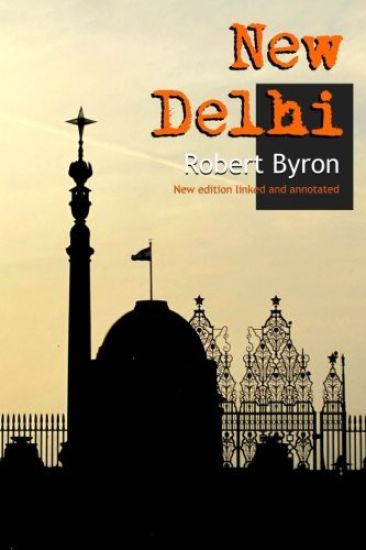
"THAT New Delhi exists, and that, twenty years ago, it did not exist, are facts known to anyone who is at all aware of the British connection with India. It is expected, and assumed, that the representatives of British sovereignty beyond the seas shall move in a setting of proper magnificence; and that in India, particularly, the temporal power shall be hedged with the divinity of earthly splendour. To satisfy this expectation; New Delhi was designed and created. But that the city's existence marks, besides an advance in the political unification of India, a notable artistic event, has scarcely been realized. Nor is this surprising in a generation which has been taught by painful experience to believe architectural splendour and gaiety inseparable from vulgarity. Of the city's permanent value as an aesthetic monument, posterity must be the final judge. But to contemporaries, and in the darkness of contemporary standards, the event shines with a Periclean importance." - New Delhi, Robert ByronJust before New Delhi was inaugurated as capital of colonial India in February 13, 1931, the magazine "The Architectural Review" published an issue devoted to a study of the new capital of India, with texts, criticisms, and photographs by Robert Byron. In this edition, the texts and photographs of the author are complemented by annotations. The ebook edition also contains links to modern photos of the buildings and places.

"The Road to Oxiana" is an account of Robert Byron's ten-month journey to Iran and Afghanistan in 1933-34 in the company of Christopher Sykes. This travelogue is considered by many modern travel writers to be the first example of great travel writing. Bruce Chatwin has described it as "a sacred text, beyond criticism" and carried his copy since he was fifteen years old, "spineless and floodstained" after four journeys through central Asia. By the Si-o-seh pol bridge in Isfahan, Iran, Byron wrote: "The lights came out. A little breeze stirred, and for the first time in four months I felt a wind that had no chill in it. I smelt the spring, and the rising sap. One of those rare moments of absolute peace, when the body is loose, the mind asks no questions, and the world is a triumph, was mine."
The Birth of Western Painting (Routledge Revivals)
Robert Byron; David Talbot Rice
Routledge
2014
nidottu
First published in 1930, this book deals with Byzantine art, not as an isolated province, but as one intimately connected with the subsequent history of European painting. After a summary of the whole question in its relation to modern art, the second chapter opens with a novel analysis of the iconoclast controversy, and shows how it was only by this movement that Hellenistic naturalism was finally vanquished and the seed of interpretational art planted in Europe in its stead. The third chapter reveals how this seed was nourished by the Constantinopolitan Renascence, and how that event, combined with the increasing humanisation of religious emotion, culminated, not only in Duccio and Giotto, but in the equally important work of their contemporaries at Mistra and Mount Athos. A detailed account of these works is given and in the last part of the book, the mystery of El Greco is finally resolved. The book is based, not only on extensive research but on personal observation of nearly all the works mentioned, in Constantinople, Greece, Crete, Italy, and Spain. It is an important and exciting addition to the history of European Art and establishes, scientifically, theories which only existed in conjecture before its publication. The book includes 94 black and white plates.