Kirjojen hintavertailu – 12 870 152 kirjaa ja 27 kauppaa
Kirjailija
Robert D Blackwill
Kirjat ja teokset yhdessä paikassa: 10 kirjaa, julkaisuja vuosilta 2015–2026, suosituimpiin kuuluu Containing Russia. Vertaile teosten hintoja ja tarkista saatavuus suomalaisista kirjakaupoista.
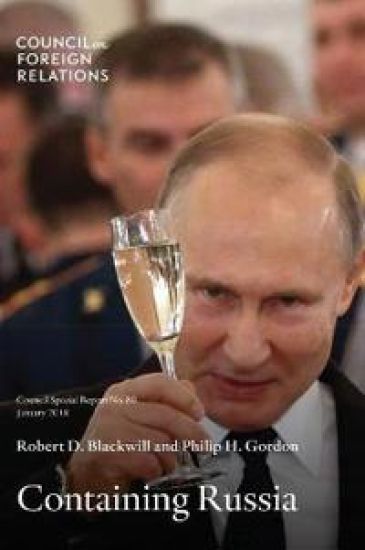
"The evidence that Russia interfered in the 2016 U. S. presidential election is overwhelming," note CFR Senior Fellows Robert D. Blackwill and Philip H. Gordon in a new Council Special Report, Containing Russia: How to Respond to Moscow's Intervention in U. S. Democracy and Growing Geopolitical Challenge. As the report shows, Russia not only meddled in the U. S. democratic process and sought to exacerbate American social divisions but also seeks to undermine U. S. power in Europe and around the world. Blackwill and Gordon, former senior officials in numerous Republican and Democratic administrations, respectively, argue that "neither President Barack Obama nor President Donald J.] Trump--for different reasons--adequately elevated Russia's intervention in the United States to the national priority that it is, or responded to it in a way sufficient to deter Russia or other hostile states from undertaking future attacks." In this report, Blackwill and Gordon contend that "Russia's intervention should not be seen as just another of many stumbles in U. S.-Russia relations over the decades but as a historic turning point" because of the nature of Moscow's threat to America's democratic institutions. A more robust and comprehensive strategy to protect the United States, its allies, and its interests against Russian attacks is therefore sorely needed. To that end, the authors put forth a wide range of policy prescriptions to strengthen U. S. defenses and increase the costs of continued Russian interference. Their prescriptions include expanded sanctions on Russian officials and entities to punish past transgressions and deter future ones; strengthened measures to defend U. S. electoral bodies and cybersecurity and to create greater transparency in social media; and additional U. S. commitments to European security to better protect allies and U. S. interests against Russian aggression. Blackwill and Gordon conclude that "the United States is currently in a second Cold War with Russia" and urge the Trump administration to change its policies to reflect this fact.
CFR Senior Fellow Robert D. Blackwill outlines the conceptual pillars of five grand strategy schools and analyzes arguments for and against those strategies advanced by their proponents and critics. He then proposes an alternative American grand strategy: resolute global leadership.
Taiwan "is becoming the most dangerous flash point in the world for a possible war that involves the United States, China, and probably other major powers," warn Robert D. Blackwill, Council on Foreign Relations (CFR) Henry A. Kissinger senior fellow for U. S. foreign policy, and Philip Zelikow, University of Virginia White Burkett Miller professor of history. In a new Council Special Report, The United States, China, and Taiwan: A Strategy to Prevent War, the authors argue that the United States should change and clarify its strategy to prevent war over Taiwan. "The U. S. strategic objective regarding Taiwan should be to preserve its political and economic autonomy, its dynamism as a free society, and U. S.-allied deterrence-without triggering a Chinese attack on Taiwan.""We do not think it is politically or militarily realistic to count on a U. S. military defeat of various kinds of Chinese assaults on Taiwan, uncoordinated with allies. Nor is it realistic to presume that, after such a frustrating clash, the United States would or should simply escalate to some sort of wide-scale war against China with comprehensive blockades or strikes against targets on the Chinese mainland.""If U. S. campaign plans postulate such unrealistic scenarios," the authors add, "they will likely be rejected by an American president and by the U. S. Congress." But, they observe, "the resulting U. S. paralysis would not be the result of presidential weakness or timidity. It might arise because the most powerful country in the world did not have credible options prepared for the most dangerous military crisis looming in front of it." Proposing "a realistic strategic objective for Taiwan, and the associated policy prescriptions, to sustain the political balance that has kept the peace for the last fifty years," the authors urge the Joe Biden administration toaffirm that it is not trying to change Taiwan's status;work with its allies, especially Japan, to prepare new plans that could challenge Chinese military moves against Taiwan and help Taiwan defend itself, yet put the burden of widening a war on China; andvisibly plan, beforehand, for the disruption and mobilization that could follow a wider war, but without assuming that such a war would or should escalate to the Chinese, Japanese, or American homelands." The horrendous global consequences of a war between the United States and China, most likely over Taiwan, should preoccupy the Biden team, beginning with the president," the authors conclude.
"China wants to replace the United States as the strongest and most influential power in Asia and beyond," warns Council on Foreign Relations (CFR) Henry A. Kissinger Senior Fellow for U. S. Foreign Policy Robert D. Blackwill. "Washington should launch an all-out effort to limit the dangers that Beijing's economic, diplomatic, technological, and military expansion pose to U. S. interests in Asia and globally," he writes. To more effectively compete with China, Blackwill offers proposals starting with modernizing U. S. domestic infrastructure, improving education, and harnessing next-generation technologies. On the foreign policy front, Blackwill recommends spending fewer resources on the Middle East, deepening ties with allies in Asia and Europe, shifting military assets to Asia, and seeking a more constructive relationship with Russia." Although the Trump administration is the first to recognize the failed policies of the past toward China, it has developed no such grand strategy toward the country, and thus no integrated and detailed work plan. This puts the United States at a major strategic disadvantage because China does have a grand strategy," writes Blackwill. On ratcheting up tensions between the United States and China, the author warns, "If both foolishly continue to actively seek primacy in the Indo-Pacific, few consequential compromises will be advanced or accepted by Washington or Beijing. With little or no willingness by either side to take the other's vital national interests into account, the road opens to sustained confrontation and perhaps even, in extremis, military conflict.""However, such a dangerous outcome is far from inevitable," Blackwill writes. "Washington and Beijing, through sustained diplomacy, can manage this enduring policy contention in ways that avoid perpetual confrontation. This would require thoughtful and prudent statecraft in both capitals, which is now not the case."
A Foreign Affairs Best Book of 2016Today, nations increasingly carry out geopolitical combat through economic means. Policies governing everything from trade and investment to energy and exchange rates are wielded as tools to win diplomatic allies, punish adversaries, and coerce those in between. Not so in the United States, however. America still too often reaches for the gun over the purse to advance its interests abroad. The result is a playing field sharply tilting against the United States.“Geoeconomics, the use of economic instruments to advance foreign policy goals, has long been a staple of great-power politics. In this impressive policy manifesto, Blackwill and Harris argue that in recent decades, the United States has tended to neglect this form of statecraft, while China, Russia, and other illiberal states have increasingly employed it to Washington’s disadvantage.”—G. John Ikenberry, Foreign Affairs“A readable and lucid primer…The book defines the extensive topic and opens readers’ eyes to its prevalence throughout history…[Presidential] candidates who care more about protecting American interests would be wise to heed the advice of War by Other Means and take our geoeconomic toolkit more seriously.—Jordan Schneider, Weekly Standard