Kirjojen hintavertailu – 12 903 725 kirjaa ja 27 kauppaa

Kirjailija

Robert D. Keppel

Kirjat ja teokset yhdessä paikassa: 4 kirjaa, julkaisuja vuosilta 2003–2010, suosituimpiin kuuluu Signature Killers. Vertaile teosten hintoja ja tarkista saatavuus suomalaisista kirjakaupoista.

4 kirjaa

Kirjojen julkaisuvuodet: 2003–2010.

The Riverman

The Riverman

Robert D. Keppel

Simon Schuster
2010
pokkari
"After a search of over twenty years, one of America's most elusive serial killers was finally apprehended. Now, read the true story of one man's attempt to get inside se mind of the Green River Killer" July 15, 1982: 3 woman's strangled body was filed, caught on the pilings of Washington state's Green River. Before long, the "Green River Killer" would be suspected in at least forty-nine more homicides, with no end in sight. Then the authorities received an unbelievable letter from the infamous serial killer Ted Bundy -- then on Florida's death row -- offering to help catch the Green River Killer. But he would only talk to one man: Robert Keppel, the former homicide detective who had helped track Bundy's cross-county killing spree. Now these conversations are revealed, in which Bundy speculates about the motive and methods of the Green River Killer -- and reveals his "own" twisted secrets as well. Now, as never before, we look into the face of evil...and into the heart of a killer.

Serial Violence

Serial Violence

Robert D. Keppel; William J. Birnes

CRC Press Inc
2008
sidottu
Linking the murders of an alleged serial killer to successfully present a case in court involves a specific methodology that has been scrutinized by the judicial system but is largely absent in the current literature. Serial Violence: Analysis of Modus Operandi and Signature Characteristics of Killers fully explains the process of finding the nexus between one violent crime and another for the purpose of pursuing the same offender at trial. Examines real cases of some of the world’s most notorious serial killersWritten by renowned experts, this book focuses on analyzing crimes of violence to unveil common characteristics that might prove useful in the identification, apprehension, and conviction of murderers. It begins by detailing the historical origins of modus operandi as an investigative tool. It examines murderous ritualistic behavior in a variety of cases, including William Heirens, Harvey Glatman, Morris Frampton, and Jack the Ripper. Later chapters discuss serial murders accompanied by burglary, torture, picquerism, sexual violence, sexual degradation, and a host of other behaviors. Includes color photographs of actual crime scenesContaining numerous color photos, this volume includes useful information for expert witnesses and portions of transcripts of original testimony. The scintillating detail and rigorous analysis presented in this volume enables those charged with solving these violent crimes to discern the types of modus operandi and ritualistic behaviors that can be linked to the same offender, helping law enforcement bring these dangerous offenders to justice. About the AuthorsBob Keppel served on the King County homicide task force that investigated the infamous Ted Bundy and has been an expert witness on scores of serial killer signature profile cases across the United States. Along with coauthor William Birnes, Dr. Keppel worked on a United States Department of Justice grant to evaluate how local police homicide units use computer database technology to track serial killer and sexual offender cases by cross-referencing offender psychological signatures.
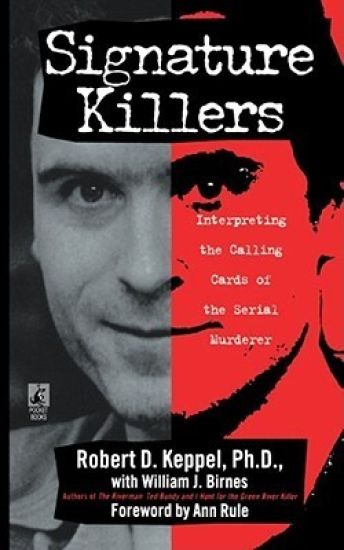
Signature Killers

Signature Killers

Robert D. Keppel

Pocket Books
2007
pokkari
In a real-life scenario straight out of "The Silence of the Lambs, " Robert Keppel went one-on-one with the notorious serial killer Ted Bundy, who advised Keppel on the detective's highly publicized search for the elusive Green River Killer. Bundy's chilling revelations were chronicled in "The Riverman, " "a page-turner" (Ted Montgomery, Detroit News) praised by Ann Rule as "the definitive book on serials." But Ted Bundy wasn't the first killer of his kind -- or the last. Signature Killers They leave telltale identifiers, their gruesome "calling cards," at the scenes of their crimes. They are driven by a primitive motivation to act out the same brutality over and over. With brilliant detection, high-tech analysis -- and a little luck -- they can be caught. But what does the signature killer seek from victim to victim? The answers are hidden among the grisly evidence, the common threads that link each devastating act. Sparked by a growing concern over the steady rise of signature murders, Robert Keppel explores in unflinching detail the monstrous patterns, sadistic compulsions, and depraved motives of this breed of killer. From the Lonely Hearts Killer who hunted the most desperate of women in 1950s America, to the savage Midtown Torso Murders that stunned the NYPD, to such infamous symbols of evil as Jeffrey Dahmer, Ted Bundy, and John Gacy, these are the cases -- horrifying, graphic and unforgettable -- that Keppel ingeniously taps to shed light on the darkest corners of the pathological mind.
The Psychology of Serial Killer Investigations

The Psychology of Serial Killer Investigations

Robert D. Keppel; William J. Birnes

Academic Press Inc
2003
sidottu
Serial killers like Seattle's Ted Bundy, Maryland's Beltway Sniper, Atlanta's Wayne Williams, or England's Peter Sutcliffe usually outsmart the task forces on their trail for long periods of time. Keppel and Birnes take readers inside the operations of serial killer task forces to learn why. What is the underlying psychology of a serial killer and why this defeats task force investigations? This is the first book of its kind that combines state-of-the-art psychological assessment experience with the expertise of a homicide investigator who has tracked some of this country's most notorious serial killers. The author also brings to the book hands-on best practices gleaned from the experience of other task forces. Readers, both professionals and students, will benefit from the comprehensive and critical case reviews, the analysis of what went wrong, what went right, and the after-action recommendations of evaluators in the US, UK, and Canada. The book covers: * The nature of the psychology of a serial killer * How crime assessment profiling reveals that psychology * Why psychological profiles fail * How serial killer task forces defeat themselves * How the media can, and usually does, undermine the task force operation * The big secret of all serial killer investigations: police already have the killer's name * The best practices for catching a serial killer