Kirjojen hintavertailu – 12 903 725 kirjaa ja 27 kauppaa

Kirjailija

Robert Furbey

Kirjat ja teokset yhdessä paikassa: 3 kirjaa, julkaisuja vuosilta 2003–2025, suosituimpiin kuuluu The Eclipse of Council Housing. Vertaile teosten hintoja ja tarkista saatavuus suomalaisista kirjakaupoista.

3 kirjaa

Kirjojen julkaisuvuodet: 2003–2025.

The Eclipse of Council Housing

The Eclipse of Council Housing

Ian Cole; Robert Furbey

TAYLOR FRANCIS LTD
2025
sidottu
In the 1990s, council housing was widely criticised, rejected by government and was the object of waning public support. Yet at one time direct state provision accounted for one-third of the nation's housing stock. How did this decline come about? Originally published in 1994, Ian Cole and Robert Furbey trace the emergence, rise and decline of council housing and explore its fluctuating status within the welfare state. The authors ask whether council tenure was misconceived from the start and whether it should now be seen as a suitable case for reform, or for total abolition. They examine why, of all welfare sectors, public housing has been subjected to the most intense attack by the Conservatives since 1979, and consider why it has proved so vulnerable. Their detailed analysis charts the development of policies towards council housing and the long-term retreat into a residual tenure. A distinctive aspect of the account is its analysis of the quality of housing offered by local authorities, and the responsiveness, democracy and efficiency of housing management. Particular emphasis is given to the deal which users have received from local authorities and their varying responses to that deal. The authors also review New Right arguments for the final eclipse of state housing while at the same time discussing initiatives to reform it. The Eclipse of Council Housing presents a lucid study of a key social policy issue which was central to the housing crisis at the time, and challenges the view that council housing should be consigned to the scrapheap. It will be invaluable to all students and lecturers in social policy, housing, town planning and urban studies, as well as social policy and housing professionals.
Faith as social capital

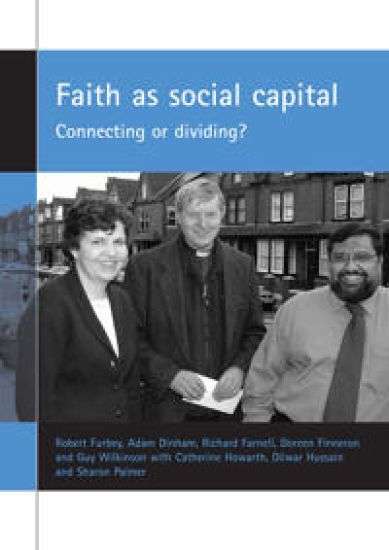
Faith as social capital

Robert Furbey; Adam Dinham; Richard Farnell; Doreen Finneron; Guy Wilkinson

Policy Press
2006
nidottu
The UK government has identified Faith communities as important sources of 'social capital' in community development and regeneration. But religion is also associated with conflict and division. How far is this faith in 'Faith' justified? And how far should Faith communities comply? This report assesses the debate and the evidence and summarises the controversies surrounding the idea of 'social capital' and the place of 'Faith' in community policy. It assesses the contribution of Faith communities to social capital that extends beyond bonding to build bridges and links with others in civil society; and identifies policy and practice implications for secular and Faith organisations and networks. The research in the report encompasses five major Faith traditions across four English regions. It explores the nature and the quality of social capital stemming from Faith buildings, association; engagement with governance, and participation in the wider public domain. This exploration of Faith communities and social capital is important for all who work to achieve well-connected communities. It will interest policy makers and researchers, those working in community development, regeneration and related fields, national and local Faith leaders and their communities, and all in the voluntary and community sectors.
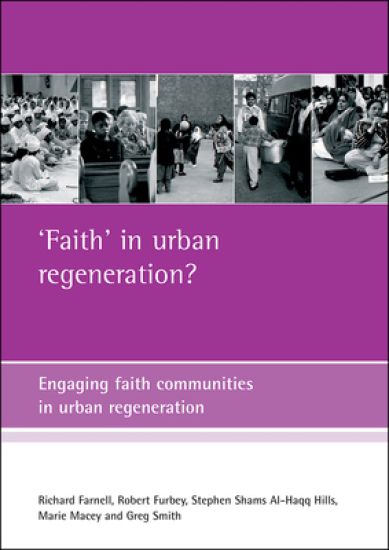
'Faith' in urban regeneration?

'Faith' in urban regeneration?

Richard Farnell; Robert Furbey; Stephen Shams al-Haqq Hills; Marie Macey; Greg Smith

Policy Press
2003
nidottu
Faith groups are already important in the regeneration of communities, and are often more committed and have long-term involvement. However, despite government directives to involve faith communities in regeneration and renewal, official agencies lack understanding about faith communities and their diversity, and conflicts arise between secular liberal views and those of religious groups. 'Faith' in urban regeneration: summarises the politics and policy of involving religion in regeneration; looks at the motivations, theologies and values that underpin faith organisations; locates both good and problematic practice in the participation of faith communities in urban regeneration, and their experiences of involvement with official regeneration programmes; explores issues of cohesion and conflict; makes practical recommendations to local, regional and national regeneration agencies and highlights implications for policy.