Kirjojen hintavertailu – 12 903 739 kirjaa ja 27 kauppaa

Kirjailija

Robert Gilmore

Kirjat ja teokset yhdessä paikassa: 17 kirjaa, julkaisuja vuosilta 1995–2017, suosituimpiin kuuluu Alice im Quantenland. Vertaile teosten hintoja ja tarkista saatavuus suomalaisista kirjakaupoista.

17 kirjaa

Kirjojen julkaisuvuodet: 1995–2017.

Through the Years, in Sunshine and Shadows
An inspirational book of poetry to which everyone can relate. Poems from My Life in Sunshine and Shadows is an uplifting read, with many compositions on life, love and happiness. A positive attitude and sunny disposition that will have you chuckling out loud. A wonderful mix of humor and spirituality.
Through the Years, in Sunshine and Shadows
An inspirational book of poetry to which everyone can relate. Poems from My Life in Sunshine and Shadows is an uplifting read, with many compositions on life, love and happiness. A positive attitude and sunny disposition that will have you chuckling out loud. A wonderful mix of humor and spirituality.
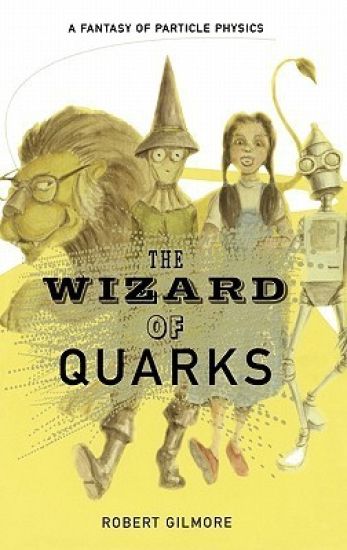
The Wizard of Quarks

The Wizard of Quarks

Robert Gilmore

Copernicus Books
2012
nidottu
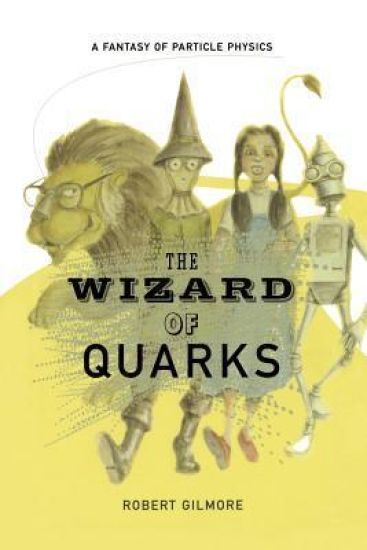
Get ready to take another fantastic journey with physicist and author Robert Gilmore, this time with Dorothy, following the yellow building block road through the land of the Wizard of Quarks. Using characters and situations based on the universally known story, The Wizard of Oz, we learn along the way about the fascinating world of particle physics. Classes of particles, from quarks to leptons are shown in ab atomic garden, where atoms and molecules are produced; see how Dorothy, The Tin Geek, and the Cowardly Lion experience the bizarre world of subatomic particles. Thousands of readers who were delighted by the adventures and science content of "Alice in Quantumland" are in for another treat, with the prose and illustrations of Robert Gilmore.
Alice im Quantenland

Alice im Quantenland

Robert Gilmore

Vieweg+Teubner Verlag
2012
nidottu
Alice sitzt gelangweilt vor dem Fernseher; da fallt ihr Blick auf "Alice im Wunderland", das sie kurzlich gelesen hat. Sie sehnt sich danach, vergleichbare Abenteuer zu erleben, sturzt und fallt in Ohnmacht. In ihrem Traum fallt sie durch den Bildschirm hindurch, wo sie - verkleinert - auf die Elektronen trifft, die als Strahl den Bildschirm zum Leuchten bringen. Das ist erst der Anfang der Geschichte, in der Alice nach und nach die Besonderheiten der Quantenwelt kennenlernt. Sie begegnet Menschen wie Niels Bohr, die sie unter ihre Fittiche nehmen, und steht mit Elektronen und Quarks auf du und du. In dieser neuen Form der Geschichte von Alice beschreibt Robert Gilmore - selbst angesehener Physiker - kenntnisreich und amusant, welche Besonderheiten uns die Welt der Elektronen und Quarks bietet. Schliesslich wird Alice (und damit den Lesern) klargemacht, dass nach 70 Jahren der Forschung auf diesem Gebiet ungeloste Fragen an die Grundlagen der Quantentheorie ubriggeblieben sind, die vielleicht nie gelost werden konnen. Rezension erschienen in: junge wissenschaft Ausgabe / Band 12Jg., Heft 45, S. 60f Feb. 97 (...) ist es dem Autor in hervorragender Weise gelungen, eine didaktisch ausserst wertvolle Darstellung der Quantenmechanik zu prasentieren(...) (...)erreicht damit einen wesentlich grosserenLeserkreis(...) (...)sehr abgerundetes Bild der Quantenphysik(...) (...)in sehr geschickter Weise(...) (...)in sehr pragnanter Form, jedoch in fachlicher Hinsicht vollig korrekt(...) (...)Als besonders gelungen darf man die Ubersetzung aus dem englischen Original bezeichnen(...) (...)Sehr lobenswert erwahnt werden muss wohl auch die vom deutschen Ubersetzer vorgenommene Aktualisierung beim inzwischen gelungenen Nachweis des top-Quark am Fermilab(...) (...)Der rezensent ist davon uberzeugt, dass auch der versierte Physiker dieses Buch mit grossem Genuss lesen muss(...)
The Topology of Chaos

The Topology of Chaos

Robert Gilmore; Marc Lefranc

Wiley-VCH Verlag GmbH
2011
sidottu
A highly valued resource for those who wish to move from the introductory and preliminary understandings and the measurement of chaotic behavior to a more sophisticated and precise understanding of chaotic systems. The authors provide a deep understanding of the structure of strange attractors, how they are classified, and how the information required to identify and classify a strange attractor can be extracted from experimental data. In its first edition, the Topology of Chaos has been a valuable resource for physicist and mathematicians interested in the topological analysis of dynamical systems. Since its publication in 2002, important theoretical and experimental advances have put the topological analysis program on a firmer basis. This second edition includes relevant results and connects the material to other recent developments. Following significant improvements will be included: * A gentler introduction to the topological analysis of chaotic systems for the non expert which introduces the problems and questions that one commonly encounters when observing a chaotic dynamics and which are well addressed by a topological approach: existence of unstable periodic orbits, bifurcation sequences, multistability etc. * A new chapter is devoted to bounding tori which are essential for achieving generality as well as for understanding the influence of boundary conditions. * The new edition also reflects the progress which had been made towards extending topological analysis to higher-dimensional systems by proposing a new formalism where evolving triangulations replace braids. * There has also been much progress in the understanding of what is a good representation of a chaotic system, and therefore a new chapter is devoted to embeddings. * The chapter on topological analysis program will be expanded to cover traditional measures of chaos. This will help to connect those readers who are familiar with those measures and tests to the more sophisticated methodologies discussed in detail in this book. * The addition of the Appendix with both frequently asked and open questions with answers gathers the most essential points readers should keep in mind and guides to corresponding sections in the book. This will be of great help to those who want to selectively dive into the book and its treatments rather than reading it cover to cover. What makes this book special is its attempt to classify real physical systems (e.g. lasers) using topological techniques applied to real date (e.g. time series). Hence it has become the experimenter?s guidebook to reliable and sophisticated studies of experimental data for comparison with candidate relevant theoretical models, inevitable to physicists, mathematicians, and engineers studying low-dimensional chaotic systems.
Once Upon a Universe

Once Upon a Universe

Robert Gilmore

Springer-Verlag New York Inc.
2010
nidottu
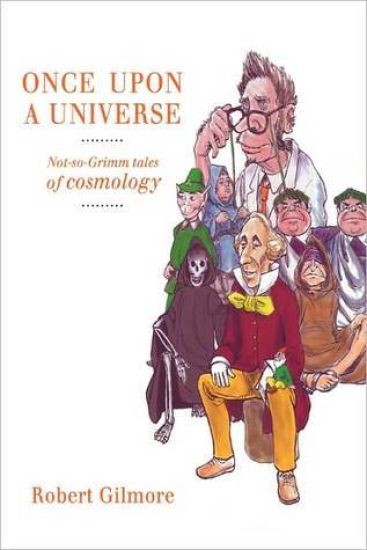
"Once upon a time there was no Universe," began the Storyteller. . . ." First Snow White encounters one of the Little People, then one of the Even Smaller People, and finally one of the Truly Infinitesimal People. And no matter how diligently she searches, the only dwarves she can find are collapsed stars! Clearly, she’s not at home in her well-known Brothers Grimm fairy tale, but instead in a strange new landscape that features quantum behavior, the wavelike properties of particles, and the Uncertainty Principle. She (and we) must have entered, in short, one of the worlds created by Robert Gilmore, the physicist and fabulist who brought us the classic "Alice in Quantumland." Whether he’s recasting such classic tales as "Jack and the Quarkstalk," "Waking Beauty," or "Cinderenda and the Death of Stars," Gilmore shows us that there’s more than one way to shed light on the strange profundities of modern physics and cosmology, and what they have to tell us about the nature of time and space and motion. Black holes, dying stars, traveling backward through time to the Big Bang - they’re all here in accessible, instructive, and charmingly illustrated retellings. Robert Gilmore has published three previous books with Copernicus, "Alice in Quantumland," "Scrooge’s Cryptic Carol," and "The Wizard of Quarks." He is a Visiting Research Fellow, with a special focus on the public understanding of science, at Bristol University in England. He has also worked in particle physics at Brookhaven, Stanford, and CERN in Geneva.

Lie Groups, Physics, and Geometry

Lie Groups, Physics, and Geometry

Robert Gilmore

Cambridge University Press
2008
sidottu
Describing many of the most important aspects of Lie group theory, this book presents the subject in a 'hands on' way. Rather than concentrating on theorems and proofs, the book shows the applications of the material to physical sciences and applied mathematics. Many examples of Lie groups and Lie algebras are given throughout the text. The relation between Lie group theory and algorithms for solving ordinary differential equations is presented and shown to be analogous to the relation between Galois groups and algorithms for solving polynomial equations. Other chapters are devoted to differential geometry, relativity, electrodynamics, and the hydrogen atom. Problems are given at the end of each chapter so readers can monitor their understanding of the materials. This is a fascinating introduction to Lie groups for graduate and undergraduate students in physics, mathematics and electrical engineering, as well as researchers in these fields.
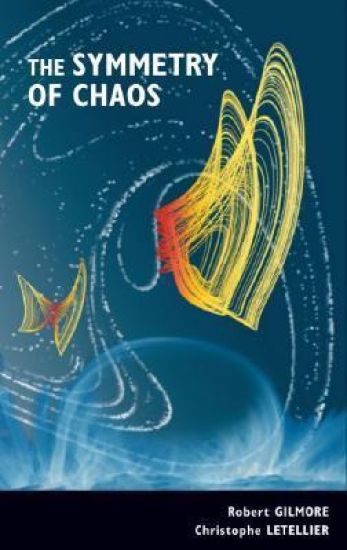
The Symmetry of Chaos

The Symmetry of Chaos

Robert Gilmore; Christophe Letellier

Oxford University Press Inc
2007
sidottu
Why have scientists, engineers, and mathematicians become intrigued by chaos? Chaos is about predictability in even the most unstable systems, and symmetry is a pattern of predictability - a conceptual tool to help understand complex behaviour. The Symmetry of Chaos treats this interplay between chaos and symmetry. This graduate textbook in physics, applied mathematics, engineering, fluid dynamics, and chemistry is full of exciting new material, illustrated by hundreds of figures. Nonlinear dynamics and chaos are relatively young fields, an in addition to serving textbook markets, there is a strong interest among researchers in new results in the field.
Lie Groups, Lie Algebras & Some of Their Applications

Lie Groups, Lie Algebras & Some of Their Applications

Robert Gilmore

Dover Publications Inc.
2006
nidottu
This text introduces graduate students to Lie group theory and its physical applications with rigor and clarity. An opening discussion of introductory concepts leads to explorations of the classical groups, continuous groups and Lie groups, and Lie groups and Lie algebras. Some simple but illuminating examples are followed by examinations of classical algebras, Lie algebras and root spaces, root spaces and Dynkin diagrams, real forms, and contractions and expansions. Reinforced by numerous exercises, solved problems, and figures, the text concludes with a bibliography and indexes. 1974 ed. 75 figures. 17 tables.
Elementary Quantum Mechanics in One Dimension

Elementary Quantum Mechanics in One Dimension

Robert Gilmore

Johns Hopkins University Press
2004
pokkari

Halvin toimitettuna 39,80 €

One of the key components of modern physics, quantum mechanics is used in such fields as chemistry, electrical engineering, and computer science. Central to quantum mechanics is Schrodinger's Equation, which explains the behavior of atomic particles and the energy levels of a quantum system. Robert Gilmore's innovative approach to Schrodinger's Equation offers new insight into quantum mechanics at an elementary level. Gilmore presents compact transfer matrix methods for solving quantum problems that can easily be implemented on a personal computer. He shows how to use these methods on a large variety of potentials, both simple and periodic. He shows how to compute bound states, scattering states, and energy bands and describes the relation between bound and scattering states. Chapters on alloys, superlattices, quantum engineering, and solar cells indicate the practical application of the methods discussed. Gilmore's concise and elegant treatment will be of interest to students and professors of introductory and intermediate quantum courses, as well as professionals working in electrical engineering and applied mathematics.
Elementary Quantum Mechanics in One Dimension

Elementary Quantum Mechanics in One Dimension

Robert Gilmore

Johns Hopkins University Press
2004
sidottu
One of the key components of modern physics, quantum mechanics is used in such fields as chemistry, electrical engineering, and computer science. Central to quantum mechanics is Schrodinger's Equation, which explains the behavior of atomic particles and the energy levels of a quantum system. Robert Gilmore's innovative approach to Schrodinger's Equation offers new insight into quantum mechanics at an elementary level. Gilmore presents compact transfer matrix methods for solving quantum problems that can easily be implemented on a personal computer. He shows how to use these methods on a large variety of potentials, both simple and periodic. He shows how to compute bound states, scattering states, and energy bands and describes the relation between bound and scattering states. Chapters on alloys, superlattices, quantum engineering, and solar cells indicate the practical application of the methods discussed. Gilmore's concise and elegant treatment will be of interest to students and professors of introductory and intermediate quantum courses, as well as professionals working in electrical engineering and applied mathematics.
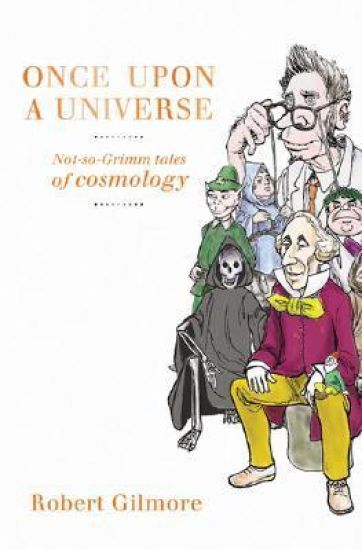
Once Upon a Universe

Once Upon a Universe

Robert Gilmore

Copernicus Books
2003
sidottu
Snow White introduces us to quantum mechanics. Relative motion, momentum, and energy are explained by a prince. And Cinderenda sheds light on white dwarves, neutron stars, and black holes.
The Wizard of Quarks

The Wizard of Quarks

Robert Gilmore

Copernicus Books
2000
sidottu
Get ready to take another fantastic journey with physicist and author Robert Gilmore, this time with Dorothy, following the yellow building block road through the land of the Wizard of Quarks. Using characters and situations based on the universally known story, The Wizard of Oz, we learn along the way about the fascinating world of particle physics. Classes of particles, from quarks to leptons are shown in ab atomic garden, where atoms and molecules are produced; see how Dorothy, The Tin Geek, and the Cowardly Lion experience the bizarre world of subatomic particles. Thousands of readers who were delighted by the adventures and science content of "Alice in Quantumland" are in for another treat, with the prose and illustrations of Robert Gilmore.
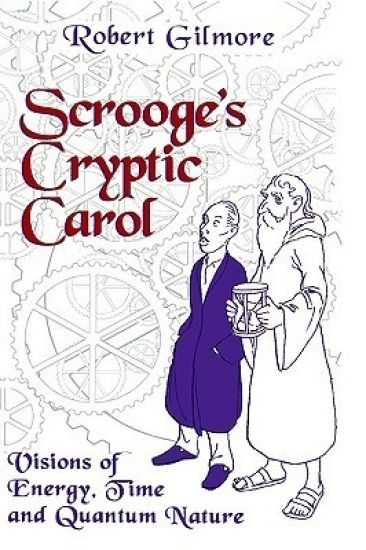
Scrooge's Cryptic Carol

Scrooge's Cryptic Carol

Robert Gilmore

Springer-Verlag New York Inc.
1996
sidottu
When the destination sign on Scrooges train reads "HEAT DEATH" instead of "HEATHROW," when his dead partner Marleys face appears as a talking head in a department store TV, and when the street lights outside his flat begin acting strangely, it is a sign of a bad night to come. Like his famous ancestor, the modern Scrooge is about to be visited by ghosts. But its not his hard heart that needs opening; its his closed mind. Physicist Robert Gilmore, author of the popular Alice in Quantumland, presents here a delightful takeoff, where the three visitations represent Science Past, Present and Future. For everyone who wants a playful, painless yet surprisingly sophisticated introduction to the ideas of modern physics, this is a brilliant tour de force and a charming read.
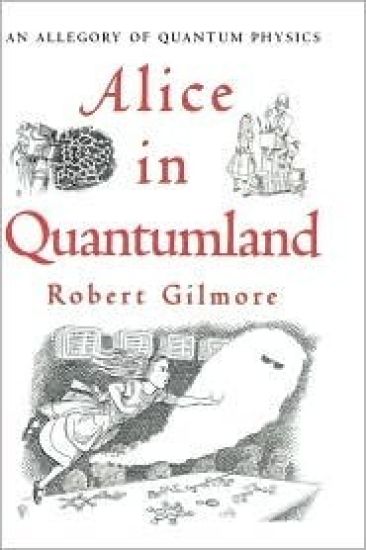
Alice in Quantumland

Alice in Quantumland

Robert Gilmore

Springer-Verlag New York Inc.
1995
sidottu

Halvin toimitettuna 42,60 €

In this cleverly conceived book, physicist Robert Gilmore makes accessible some complex concepts in quantum mechanics by sending Alice to Quantumland-a whole new Wonderland, smaller than an atom, where each attraction demonstrates a different aspect of quantum theory. Alice unusual encounters, enhanced by illustrations by Gilmore himself, make the Uncertainty Principle, wave functions, the Pauli Principle, and other elusive concepts easier to grasp.